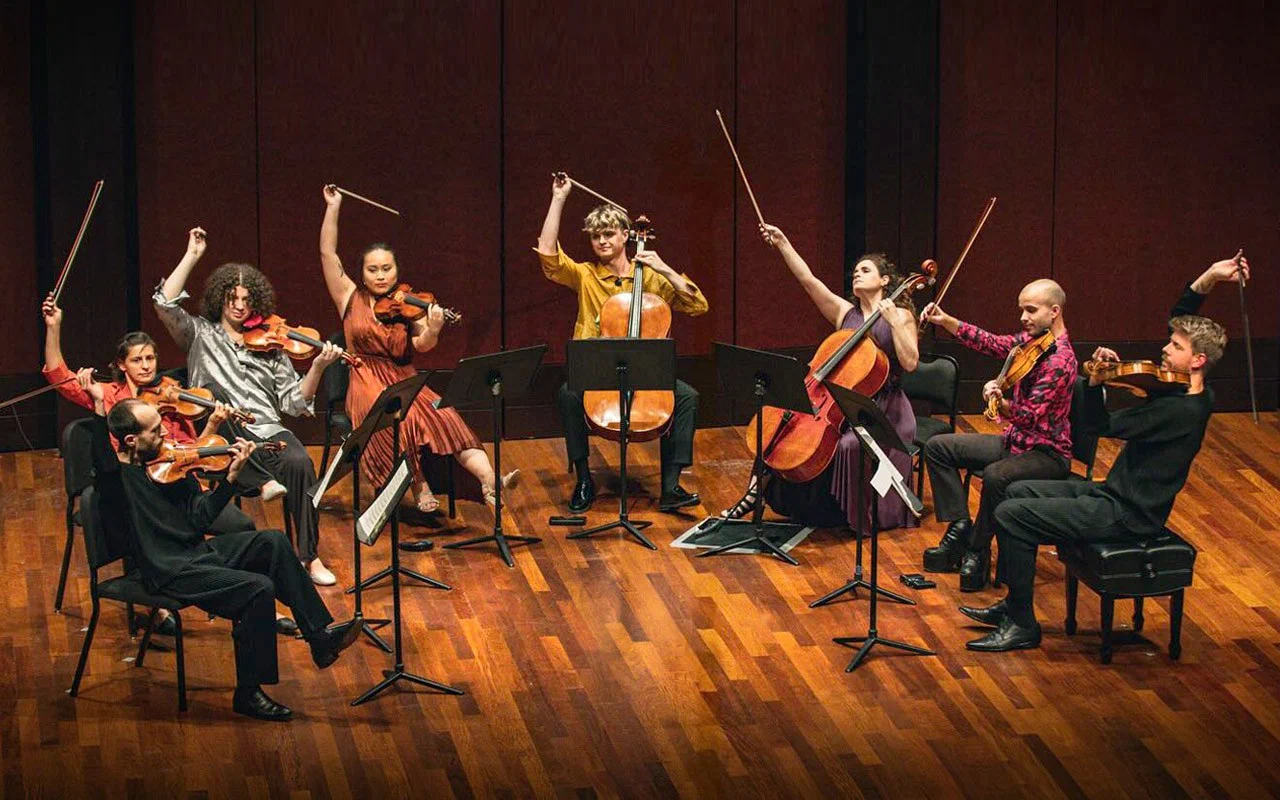
What is chamber music? Chamber music is music written for a small group, usually with one performer playing each independent part. Its close musical dialogue allows you to hear individual lines, changing leadership, and the choices players make together.
The name comes from its historical association with rooms in homes and courts, though performances now take place everywhere from recital halls to schools and community spaces. This article explains its defining features, common ensembles, history, major composers, performance demands, and what to listen for.
In This Article
- What Is Chamber Music? A Practical Chamber Music Definition
- From Private Rooms To Modern Concert Halls
- How Small-Group Performance Works
- Chamber Music: Key Context, Examples, And Next Steps
- Key takeaways
- Frequently asked questions
- Listen for the Musical Conversation
What Is Chamber Music? A Practical Chamber Music Definition
A practical chamber music definition begins with the distribution of parts: one player normally takes each line. A string quartet, for example, has two violinists, one violist, and one cellist, each with distinct material. Duos, trios, quintets, and larger combinations can follow the same principle.
In small groups such as this one, the performers communicate directly with each other, without words. They react to a breath, to a movement of the bow, to a slight change in tone. There is no conductor required. It may be more enjoyable in a small room, but the same is true anywhere.
The main difference between a chamber group and a small orchestra is that a few people play the same part (especially in the strings) and usually there is a conductor. In a chamber group, the players usually share responsibility, even when just one instrument takes the lead for a bit.
Common Chamber Music Instruments And Groupings
The best-known chamber music instruments belong to the string, keyboard, and wind families. Their combinations range from standardized ensembles to mixed groups chosen for a particular work.
- A string quartet is composed of two violin players, a viola player and a cello player.
- A piano trio consists of a piano, a violin and a cello.
- The normal instrumentation of a piano quintet is the standard string quartet (two violins, a viola, and a cello) augmented by a piano.
- A woodwind quintet uses flute, oboe, clarinet, bassoon, and horn.
- A brass quintet commonly has two trumpets, horn, trombone, and tuba.
- The instruments used in mixed ensembles can include strings, winds, percussion, piano and/or voice.
Chamber Music: Key Decision Factors
When deciding whether a piece counts as chamber music, consider how its parts are assigned and how the musicians coordinate. No single chamber music instrument defines the category. The stronger signs are a small ensemble, one performer per independent line, and shared responsibility for timing and interpretation.
There’s some wiggle room in that definition: Some composers use a conductor in more modern or complicated pieces of chamber music. Some also incorporate electronics or percussion instruments into their compositions. The difference between solo and chamber music is often one of balance. A sonata for solo piano is obviously a solo piece, but a sonata for violin and piano is considered chamber music since both musicians play a large portion of the score.
From Private Rooms To Modern Concert Halls
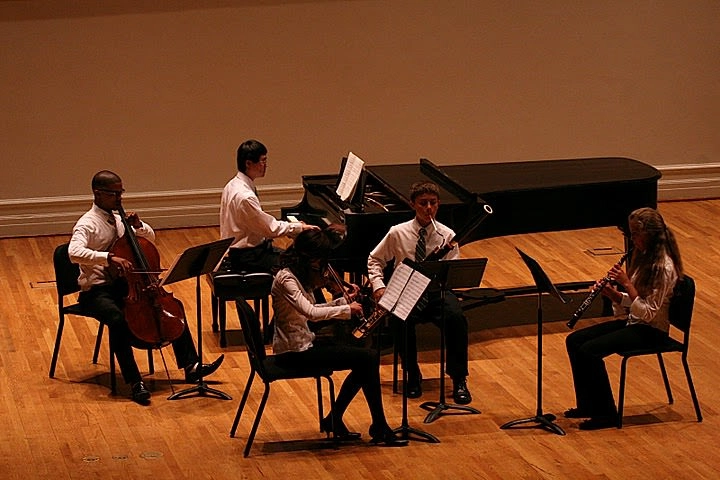
The origins of chamber music were rooted in domestic, courtly and religious spheres. During the Baroque period, small instrumental groups played sonatas and other pieces in homes and other informal venues that allowed direct communication between performers and listeners.
The string quartet became more prominent in the classical period. Haydn laid down its basic structure, Mozart pushed its technical and expressive limits, and Beethoven completely changed it up with more drama and bold new structures. It was also during this period that music began to be performed in public concerts rather than just in private homes.
Later in the 19th century, Franz Schubert, Felix Mendelssohn, Robert Schumann, and composers associated with nationalist schools added to the genre. Modernist compositions added new styles of harmony, rhythm, and instrumental colour. Contemporary works under the catalogue code “Chamber Works” might be written for a conventional ensemble, or for an exotic combination, for electronic instruments, or for musicians from disparate traditions.
Important Composers And Chamber Works
In the main classical chamber music repertoire, we see how composers often used the chamber ensemble as a testing ground to develop new forms of structure, texture, and musical language.
- The Op. 20 and Op. 33 quartets by Haydn were instrumental in defining the classical string quartet.
- He wrote six string quartets for Haydn, among them the “Dissonance” Quartet, K. 465.
- The Beethoven String Quartets, Op. 59, Three “Razumovsky” Quartets expanded the scale and technical requirements of the genre.
- Examples of such close motivic development and unconventional structures can be found in Beethoven’s late quartets (e.g., Op. 127 and Op. 131).
- In Schubert’s “Death and the Maiden” Quartet, D. 810, he takes a song and transforms it.
- D. 667 (the “Trout” Quintet) by Schubert includes piano, violin, viola, cello, and double bass.
- Mendelssohn wrote his Octet in E-flat major, Op. 20, for four violins, two violas, and two cellos.
- The E-flat major Piano Quintet, Op. 44 by Schumann cemented the piano quintet as one of the major Romantic chamber groupings.
How Small-Group Performance Works
In many cases, there is no fixed leader of the ensemble (the “chamber ensemble” generally does not have a leader), and the leadership passes from one musician to another: for example, if the first violin starts off an entrance in one section, the cello or piano might guide the subsequent passage instead. It is easy to see that cooperation is an inherent element of the performance process and is why chamber music is sometimes called “music of friends.”
This kind of cooperation doesn’t require that all performers take the same decisions in advance. Musicians discuss timing, articulation, phrasing, dynamics and character, with some room to manoeuvre during the actual performance. So if one performer delays a cadence a little bit, the rest will adapt to the new reality as they play.
Balance is another issue. The piano must not cover the violin or cello, the strings must blend their tone but not lose their identity, and intonation must be precise, because every note has the potential of affecting the whole ensemble’s harmonic result.
How A Chamber Ensemble Creates The Listener Experience
With one musician for each part, this is very easy to hear: the melody that weaves through the violin and cello; the delicate line of the viola; the way the piano shifts between accompaniment and solo.
Or you might see what’s called “visible coordination.” If someone raises their bow, takes a deep breath, or exchanges a quick look, you might be able to guess when someone will play next. In the concert hall, where musicians are near each other, this type of visual cueing is easier to see and further emphasizes the idea that the players are in communication.
Chamber Music: Key Context, Examples, And Next Steps
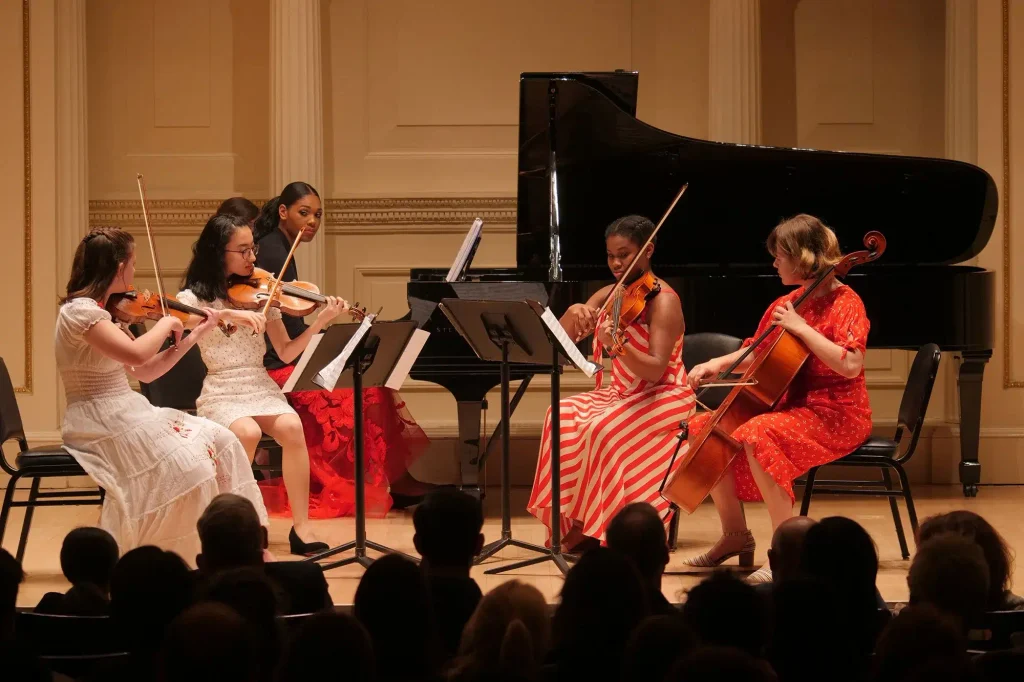
The most useful way to understand chamber music is to compare ensembles and follow the role of each instrument. Begin with a Haydn or Mozart string quartet, where four related string sounds reveal changes in texture clearly. Then try a Beethoven quartet to hear how the form can become denser, longer, and more dramatic.
A piano trio provides a different balance problem because the piano can produce more volume and play many notes at once. Schubert’s “Trout” Quintet changes the color again by adding double bass and replacing the string quartet’s second violin with piano.
As you listen, choose one line and follow it for a full movement. On a second hearing, focus on who begins phrases, who supports them, and how leadership changes. This approach turns an apparently unified sound into a set of individual decisions.
Key takeaways
- This is a chamber music ensemble, meaning that each part is played by one player (instead of being divided into sections, like in an orchestra).
- Its most familiar forms are string quartets and piano trios.
- Then its history moved from private rooms to public concert halls.
- The repertoire was influenced by the works of Haydn, Mozart, Beethoven and Schubert.
- With close musical conversation, both coordination and listening become unusually intimate.
Frequently asked questions
What qualifies as chamber music?
Chamber music generally uses a small group with one performer assigned to each independent part. The musicians usually coordinate through shared cues and listening instead of relying on a conductor.
What’s the difference between chamber music and an orchestra?
In chamber music, every instrument is performed by a single person as opposed to a larger orchestra in which there could be several people playing the same violin line. In addition, chamber groups don’t have a conductor, unlike an orchestra.
What is an example of chamber music?
A string quartet is a standard example. Haydn’s String Quartets, Op. 33, Mozart’s “Dissonance” Quartet, K. 465, and Beethoven’s “Razumovsky” Quartets, Op. 59, all use two violins, viola, and cello.
Does chamber music have a piano?
Some of it does. Piano trios, piano quartets, and piano quintets pair the instrument with strings, while other works use piano with winds or mixed groups. String quartets and wind quintets do not include it.
Where was chamber music traditionally performed?
It was traditionally played in private homes, aristocratic courts, and other relatively small rooms. During the 18th and 19th centuries, it increasingly entered public recital rooms and concert halls.
Listen for the Musical Conversation
Choose a string quartet or piano trio and listen specifically for the way in which the musicians interact. Listen for when one musician passes something on to another and follow up on what comes next. Is it the same melody? A variation of the melody? Does it come back in a different octave? Does it play against the melody with something entirely new?
The great joy of this interaction is the possibility to create richly textured music in a small group, with every part crucial and each player making real decisions about the result. As you learn to hear these changing interactions, chamber music becomes not a single mass of sound but a dialogue that you can listen to.