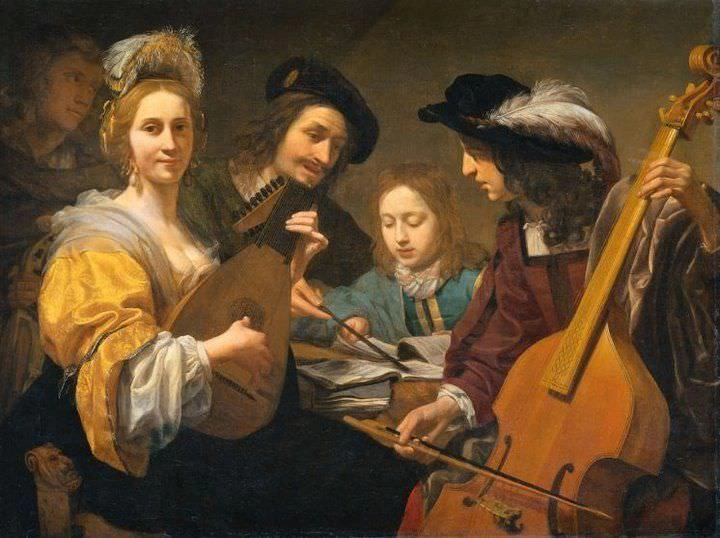
Renaissance music is the vocal and instrumental music created in Europe between roughly 1400 and 1600. It is recognizable by its interweaving melodic lines, blended voices, modal harmonies, and focus on the meaning of a text. This article will show you how churches, courts, composers, musical forms, and Renaissance instruments influenced that sound.
The period does not have one uniform style. Sacred polyphony developed alongside courtly songs, dances, and instrumental arrangements, while regional traditions crossed borders through travel and print. Following those connections makes the music easier to hear: first consider its setting, then its form, texture, and treatment of words.
In This Article
- From Church Patronage To Courtly Culture
- Characteristics Of Renaissance Music
- Sacred Forms And Worship
- Secular Forms For Courts And Social Life
- Renaissance Instruments And Ensemble Sound
- Performance, Listening, And Lasting Influence
- Key takeaways
- Frequently asked questions
- Hear the Renaissance for Yourself
From Church Patronage To Courtly Culture
The Renaissance music period lasted roughly from 1400 to 1600, when churches and aristocratic courts employed singers, composers, and instrumentalists. Religious institutions commissioned Masses, motets, hymns, and music for daily worship. Courts supported songs, dances, ceremonies, and private entertainment, allowing musicians to move between sacred and secular work.
Music printing expanded after Ottaviano Petrucci published his first collection of polyphonic music in Venice in 1501. Printed editions helped compositions circulate beyond individual chapels. Franco-Flemish composers were especially influential: their contrapuntal methods spread through appointments in Italy, France, Spain, and the German-speaking lands.
Renaissance Musicians Who Shaped The Era
Among the most influential Renaissance musicians, Josquin des Prez used imitation to pass memorable phrases between voices. Giovanni Pierluigi da Palestrina became associated with balanced sacred polyphony and clearly shaped vocal lines.
Orlando di Lasso worked across several languages and genres. Thomas Tallis and William Byrd adapted their sacred writing to England’s religious changes, while Carlo Gesualdo used striking chromatic shifts in his madrigals. Giovanni Gabrieli wrote ceremonial works for divided vocal and instrumental groups at St Mark’s Basilica in Venice, making spatial contrast part of the composition.
Characteristics Of Renaissance Music
Renaissance music is distinguished by balanced polyphony, where multiple melodic lines combine without any single line dominating the others; they tend to use similar ranges and rhythmic patterns, producing a more uniform sound. Imitative counterpoint is also characteristic, in which one voice sings a musical phrase, and other voices follow with similar but modified phrases.
Many of these pieces were written in modes, instead of the major and minor keys that came to dominate Western music. Cadences are present but you might not get the same sense of arriving at the end point that modern ears expect. Often composers engaged in word-painting, using musical figures to describe a certain kind of motion: going up, going down, crying, fleeing, rejoicing, etc.
Sacred Forms And Worship
The Mass was the largest recurring sacred form, setting sections such as the Kyrie, Gloria, Credo, Sanctus, and Agnus Dei. Composers could connect these movements through a borrowed melody, a recurring opening gesture, or related contrapuntal techniques. Some settings drew on chant; others adapted existing songs or polyphonic works.
Motets set Latin sacred texts outside the fixed Mass sequence and ranged from intimate devotional pieces to music for major ceremonies. Chorales and hymn settings served congregational or liturgical traditions, especially as the Reformation encouraged worship in local languages. These forms linked elaborate composition with the practical needs of religious communities.
Secular Forms For Courts And Social Life
Outside worship, patrons and amateur performers cultivated songs about love, humor, nature, politics, and classical mythology. The Italian madrigal usually set refined poetry for several voices, with composers changing texture and harmony to reflect individual words. Its expressive detail made it suitable for attentive social performance.
The chansons tended to have a regular rhythm, clear melody and small form even if there was a large difference in styles during the time. There were many dances for court life, such as pavanes, galliards, branles, and allemandes. These were played by instrumentalists at court parties, and sometimes instrumentalists would link two dances together as pairs with contrasting meters.
Renaissance Songs Beyond The Church
Renaissance songs could be sung by soloists, small vocal ensembles, or voices supported by instruments. Vernacular language gave each tradition a distinct relationship between verbal rhythm and melody: Italian madrigals followed the inflections of Italian poetry, while French chansons often emphasized concise phrases and rhythmic directness.
However, the term “Renaissance songs” fails to capture the specific differences in song styles between regions. Although English composers composed madrigals and consort songs while German composers wrote polyphonic Lieder, there are significant differences between the two. For example, a madrigal might change texture to highlight an image from the poem. A chanson might emphasize a characteristic rhythmic motif. The broad category obscures these important distinctions.
Renaissance Instruments And Ensemble Sound
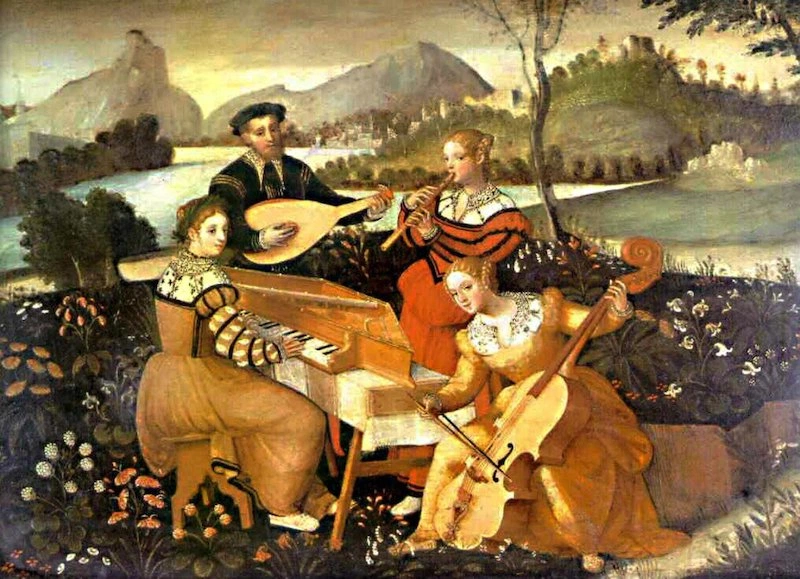
Instrumental music employed a wide variety of instruments, namely plucked and bowed strings, winds, keyboard and percussion instruments. Consorts were made up of instruments of the same family but of different sizes much like a vocal choir might combine soprano, alto, tenor, and bass voices. This meant that viol or recorder consorts had a consistent quality of sound (timbre) among all of their parts.
For indoor entertainment, lutes, viols, recorders, and keyboards might have been favored over more powerful instruments like the shawm, sackbut, cornett, and drum, which were more appropriate for outdoor dancing and civic occasions. In fact, the distinction between the two categories of instruments was fluid: performers doubled the vocal line; they used whatever instruments were available; they performed vocal music without voices. The instruments used in a Renaissance performance could vary depending upon what was at hand and the circumstances of the performance.
Renaissance Musical Instruments By Family
Representative Renaissance musical instruments include the lute, viol, and rebec among strings; recorder, shawm, and sackbut among winds; and the harpsichord, organ, drums, and tambourine in keyboard or percussion roles.
Renaissance music instruments compared by family, sound, and use
| Instrument family | Representative instruments | Best for | Advantages | Limitations |
|---|---|---|---|---|
| Plucked strings | Lute, cittern, guitar, harp | Solo songs, dance music, domestic ensembles | Chordal accompaniment; agile ornamentation; portable | Soft projection; gut strings require frequent tuning |
| Bowed strings | Viol, rebec, Renaissance violin | Consort music, vocal doubling, sustained polyphony | Continuous tone; blended family sizes; expressive dynamics | Gut strings project modestly; bow control demands practice |
| Woodwinds | Recorder, flute, crumhorn, shawm | Consorts, dances, ceremonies, outdoor performance | Distinct timbres; recorder consorts blend; shawms carry outdoors | Limited dynamics on some types; shawm tone can overpower voices |
| Brass winds | Cornett, sackbut, natural trumpet | Church galleries, civic events, vocal reinforcement | Strong projection; sackbut supports chromatic lines; cornett resembles the voice | Cornett intonation is difficult; trumpets have restricted natural notes |
| Keyboards | Harpsichord, clavichord, chamber organ | Domestic playing, sacred music, ensemble support | Polyphonic range; organ sustains tones; harpsichord gives clear attacks | Harpsichord lacks touch-based dynamics; clavichord is very quiet |
| Percussion | Tabor, side drum, tambourine, nakers | Dance rhythms, processions, military and civic events | Clear pulse; high projection; supports coordinated movement | Few surviving written parts; loud drums can obscure polyphony |
Six Renaissance musical instrument families are compared through representative instruments, typical performance settings, practical strengths, and historical limitations.
Performance, Listening, And Lasting Influence
Modern performers use surviving partbooks, treatises, and period instruments to reconstruct the sound of Renaissance music. Ensembles such as The Tallis Scholars favor clear vocal lines, while groups including Hespèrion XXI bring viols, lutes, and historical tuning to secular works.
Audiences now meet this repertoire through recordings, concerts, and church acoustics close to those it once inhabited. Historically informed performance cannot recreate the 16th century exactly, but it makes counterpoint, text, and instrumental color easier to hear.
Key takeaways
- Renaissance composition flourished from about 1400 to 1600 in churches and courts.
- Polyphony, imitation, modal harmony, and word painting define its sound.
- Sacred music was dominated by masses and motets, while madrigals and chansons served secular life.
- Composers such as Josquin, Palestrina, Tallis, and Byrd shaped distinct regional traditions.
- And voices, instrument consorts, and historically informed performance make the repertoire accessible today.
Frequently asked questions
What is Renaissance music called?
Music from the Renaissance period, also known as Renaissance music, can be divided into different genres or categories based on style and/or performing practice. Some examples include the Mass, motet, madrigal, chanson, and consort music.
What are the five characteristics of Renaissance music?
There are five main characteristics. These include: balanced polyphony, imitative counterpoint, blended vocal tone, modal harmony, and expressive treatment of words. However, each piece is different. For example, a homophonic dance song might have more emphasis on rhythm and melody than imitation.
Who is the famous composer of the Renaissance?
Josquin des Prez is one of the era’s most famous composers because of his influential approach to imitation and text setting. Palestrina, Byrd, Tallis, Lasso, Gesualdo, and Gabrieli are also major figures, each representing different regions, genres, or expressive methods.
How did Renaissance music differ from medieval music?
Renaissance composers generally favored fuller textures, smoother relationships between vocal lines, and more systematic imitation. Medieval music included polyphony, but it also relied heavily on monophonic chant and rhythmic methods associated with earlier notation and forms.
Where can beginners hear representative Renaissance works today?
Start with historically informed vocal groups and instrumental consort recordings, then listen to different renditions of a single work. A concert at Wigmore Hall or an exhibition in a large museum collection can bring the repertoire into contact with live performance and surviving instruments.
Hear the Renaissance for Yourself
Once you know how to look for it, Renaissance music becomes much more recognizable. Look for interwoven vocal lines, imitative entrances, modal harmony and word-painting gestures that express the text’s meaning. Masses and motets show us the church, while madrigals, chansons and dances offer a glimpse of courtly society.
Start with works by Josquin, Palestrina, Tallis, Byrd, or Gabrieli. Then compare an unaccompanied vocal performance with a viol, recorder, or mixed consort arrangement. The change in tone color shows how flexible this repertoire can be, even when performers begin from the same written parts.