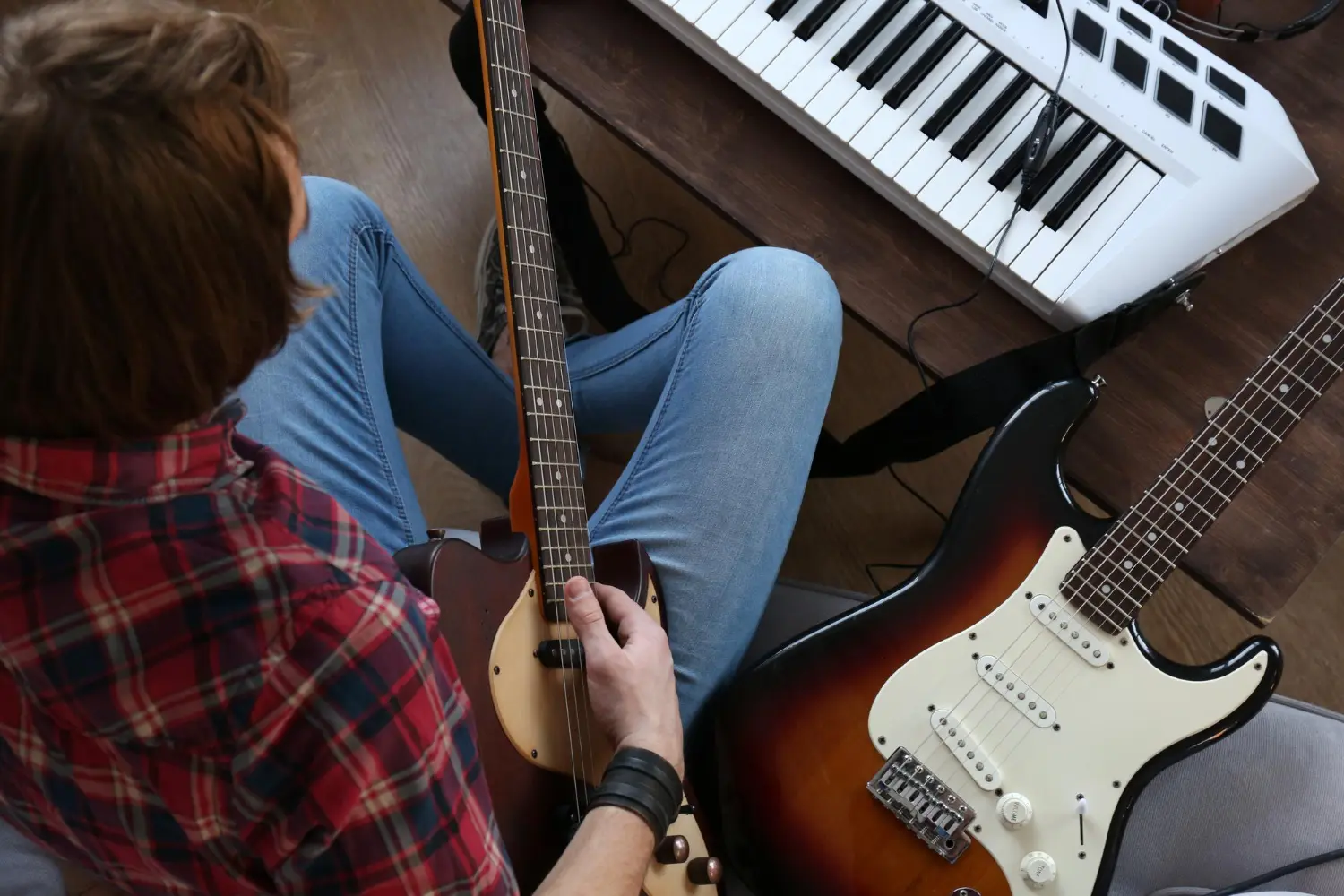
Does playing an instrument make you smarter? It’s one of those claims that gets repeated constantly, often as a way to sell parents on music lessons. But the honest answer is more interesting than a simple yes or no — and worth understanding properly, whether you’re deciding about lessons for a child or reconsidering your own relationship with music.
The short version: playing a musical instrument does produce measurable changes in the brain. Those changes appear to have real cognitive benefits across a range of skills. But the relationship is more specific and more qualified than ‘music makes you smarter’ suggests. Here’s what’s actually going on.
What Happens to the Brain When You Learn a Musical Instrument?
Learning to play an instrument is one of the most cognitively demanding things a person can do. Think about what’s actually required: reading notation, translating symbols into physical movements, coordinating both hands (and often both feet) independently, listening to yourself and adjusting in real time, interpreting rhythmic and dynamic information simultaneously.
Neuroscience research has consistently shown that musicians have structural brain differences compared to non-musicians. One of the most studied findings is that musicians tend to have a larger corpus callosum — the bundle of nerve fibers connecting the two hemispheres of the brain. This is particularly pronounced in people who began training before age seven, but it shows up across adult musicians as well.
The motor cortex, auditory cortex, and visual-spatial areas of the brain all show increased development in musicians. A widely cited 2003 study by Schlaug and colleagues at Harvard Medical School found that the cerebellum — which coordinates movement and timing — was significantly larger in professional musicians than in non-musicians. These are structural differences, not just functional ones.
Does Learning Music Increase IQ?
This is where the research gets more careful. A 2004 study by Schellenberg found that children assigned to music lessons showed slightly higher IQ gains than children assigned to other activities or no lessons. The effect was real but modest: about three IQ points over a year of lessons.
Three points isn’t nothing. But it’s also not a dramatic transformation, and the effect on IQ specifically shouldn’t be overstated. IQ is a narrow measure of cognitive function, and music’s benefits tend to show up more robustly in other domains.
Where the evidence is stronger: language skills, working memory, executive function, and auditory processing. Children who receive music training typically show measurable improvements in reading ability, phonological awareness (the ability to distinguish and manipulate speech sounds), and the capacity to hold and process information in working memory. These aren’t trivial benefits — they’re foundational to academic performance broadly.
How Playing an Instrument Benefits Your Brain Specifically
Let’s get specific about what the benefits actually are:
- Auditory discrimination: Musicians get significantly better at hearing distinctions between sounds — in pitch, timing, and timbre. This translates into better speech perception in noisy environments and, in children, better reading and language acquisition.
- Fine motor skills: Playing an instrument demands precision coordination. The motor programs developed through instrumental practice transfer to other fine motor tasks and reinforce neural pathways used in hand-eye coordination.
- Working memory: Learning and performing music requires holding multiple streams of information in mind simultaneously. Studies show that musicians outperform non-musicians on working memory tasks even when the tasks have nothing to do with music.
- Attention and focus: Sustained practice demands the ability to concentrate over long periods. Musicians show advantages in sustained attention tasks that appear to carry over into other contexts.
- Pattern recognition: Both reading music and performing it require constantly identifying and predicting patterns. This kind of structural processing appears to strengthen mathematical and logical reasoning.
The benefits are most pronounced when training starts early, but they’re not exclusively a childhood benefit. Adults who take up instruments show cognitive improvements as well, and the research on music as a tool for cognitive maintenance in aging populations is genuinely promising.
Are Musicians Actually Smarter? Sorting Out Cause and Effect
Here’s where it gets complicated. Most studies showing cognitive benefits of music training are correlational — they compare people who already play instruments to people who don’t. That means it’s hard to rule out that smarter or more motivated people are simply more likely to stick with music lessons.
The randomized controlled studies (where researchers randomly assign some children to music lessons and compare them to a control group) do show benefits, but the effects are smaller and more specific than the broader claims suggest. A 2013 meta-analysis by Sala and Gobet found that while music training is associated with cognitive benefits, the size of those benefits in randomized studies is more modest than in observational ones.
This doesn’t mean music training doesn’t help. It means the mechanism is more targeted than ‘music makes you smarter.’ Specific skills are developed through specific kinds of practice. Reading music develops auditory discrimination. Learning scales and chords develops pattern recognition and fine motor precision. Performing from memory develops working memory capacity. These are real and transferable.
Does Playing Guitar or Piano Specifically Make You Smarter?
The research doesn’t strongly differentiate between instruments in terms of cognitive outcomes, though keyboard instruments get studied most frequently because they’re common in educational settings and have a clear visual-to-motor-to-auditory chain that’s easy to study.
Piano training in particular has a reasonably strong research base, partly because it requires using both hands independently to a high degree, which is cognitively demanding in specific ways. But guitar players, string players, and wind players all show similar patterns of brain development — the common thread is sustained, disciplined practice, not the specific instrument.
Vocal training follows similar patterns. The benefits of developing your voice as an instrument include many of the same auditory discrimination and breath control skills that translate into broader cognitive and physiological benefits.
Benefits of Learning an Instrument Beyond Cognition
The cognitive benefits get the most attention, but they’re not the only reason to learn an instrument. A few other evidence-backed benefits:
- Emotional regulation: Learning a challenging skill and managing frustration is itself training in emotional regulation. The process of practicing an instrument develops patience and persistence that appears to transfer into other areas.
- Social skills: Ensemble playing — being in a band, an orchestra, a chamber group — requires listening, cooperation, and adaptation in real time. These are social skills with concrete cognitive demands.
- Long-term cognitive health: Several studies suggest that musicians show slower cognitive decline with age and have better maintained cognitive function in later life. Musical training appears to build ‘cognitive reserve’ — a kind of buffer against age-related decline.
- Discipline and goal-setting: Learning a piece of music involves breaking a large goal into achievable subgoals and working through frustration. These habits of mind transfer broadly.
The film and television world has long recognized music’s power to shape emotional experience — and the best movie soundtracks of all time were composed by musicians whose deep instrumental training directly informed their ability to create emotionally resonant music at scale.
Frequently Asked Questions
At what age should a child start music lessons?
Research suggests that starting before age seven produces the most pronounced structural brain changes, particularly in the corpus callosum. But this doesn’t mean later is useless — it isn’t. Children who start at 8 or 10 still show meaningful benefits. And there’s solid evidence for adults benefiting from music training at any age. The practical recommendation: start as early as a child shows genuine interest and can sustain attention during lessons, without forcing it.
Does passive music listening make you smarter?
No, not in the same way. The ‘Mozart Effect’ — the claim that listening to Mozart temporarily boosts spatial reasoning — was a popular finding in the 1990s that did not replicate reliably. Simply listening to music doesn’t produce the same structural brain changes as playing it. Active engagement — learning to produce music, not just consume it — is what drives the documented benefits. That said, listening to music carefully and analytically develops auditory skills that passive listening doesn’t.
Is it too late to start as an adult?
No. Adults who take up instruments consistently show cognitive improvements in the domains that music practice develops: auditory discrimination, working memory, fine motor coordination. The structural brain changes may be less dramatic than in childhood, but functional improvements are real. Adults also have advantages: better ability to understand instruction, clearer motivation, and often more focused practice time. Many people find learning an instrument as an adult to be one of the most satisfying things they’ve done.
A More Honest Way to Think About This
Music intersects with intelligence in ways that resist simple summary. Understanding how music affects your mind and mood goes deeper than the IQ question — the emotional and physiological effects of music are real and well-documented even separate from the cognitive training benefits.
Does playing an instrument make you smarter? The accurate answer is: it makes you better at specific things in ways that can translate into better cognitive function broadly. That’s a more honest claim than ‘music makes you smarter,’ and it’s actually a stronger one, because it’s based on what the research shows rather than what sounds good on a school fundraiser flyer.
Play music because it’s worth playing. The cognitive benefits are real, but they’re a bonus. The experience of making music — of taking something that exists only as symbols or sounds in your head and producing it in the world — is valuable in itself, regardless of whether it nudges your IQ three points upward.