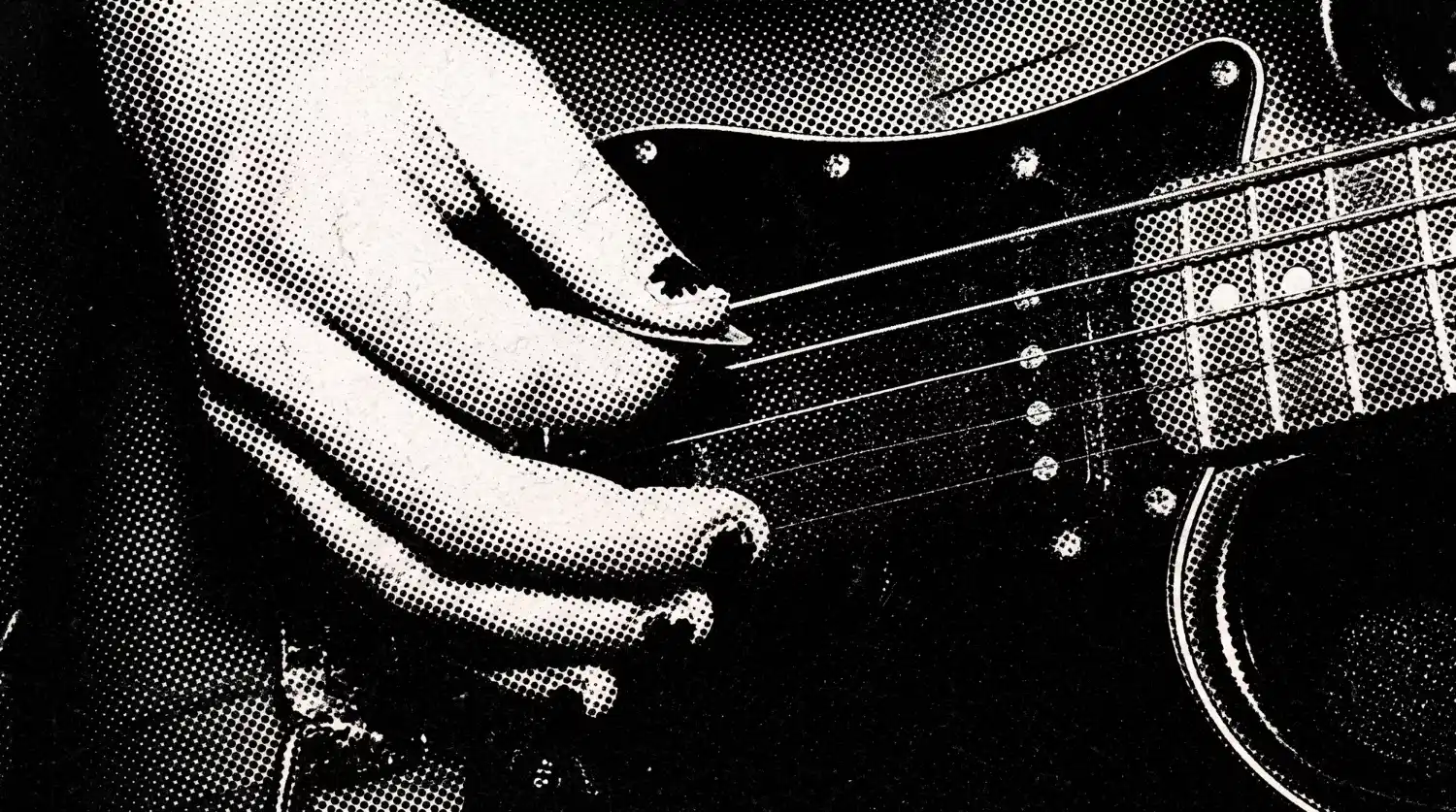
Grunge music started as a musical movement in the underground music scene of Seattle and then exploded into an international phenomenon. Musicians explored themes of alienation, drug use, the role of women, and the death of loved ones with a frankness never before heard, while dealing with their new-found worldwide success in a genre which rejected the glitz and glam of rock. Here are nine albums that you should add to your music collection if you haven’t heard grunge music before. Starting with a gem of an album released in 1984 by the criminally underrepresented Bam Bam, this collection takes you through grunge’s punk-infected evolution, complete with harsh guitar riffs, raw emotion, and an aversion to mainstream rock sensibilities to some surprisingly big songs recorded on a massive scale in 1994.
In This Article
- How Grunge Music Grew From Seattle’s Underground
- Bam Bam’s Free Fall From Space Opens The Story
- Mudhoney Defines The Fuzz On Superfuzz Bigmuff
- Nirvana’s Bleach Captures The Underground
- Pearl Jam’s Ten Broadens The Audience
- Temple Of The Dog Turns Grief Into A Supergroup
- Nevermind Makes Nirvana A Global Force
- Alice In Chains Descends Into Dirt
- Hole Confronts Pain On Live Through This
- Soundgarden Expands The Palette With Superunknown
- Key takeaways
- Frequently asked questions
- Hear the Movement’s Full Story
How Grunge Music Grew From Seattle’s Underground
It would be easy to call this music a Seattle phenomenon, if it weren’t for the fact that so many record labels rushed to package its disparate elements. What is clear is that grunge rock needed Seattle’s infrastructure, specifically clubs, musicians, and an independent record label, to come together as it did, and to develop as it did outside established industry centers. But here’s the thing: it’s also a mistake to reduce its impact to just an industry phenomenon, because even with its worldwide success, the music retained some of its countercultural appeal. The independent record label Seattle’s musical infrastructure was bolstered significantly by the work of Sub Pop, a regional label that promoted local talent. The label’s 7-inch singles, released in small quantities, helped to define a particular sound. It was a sound that melded punk rock’s energy and confrontational attitude with alternative rock and metal’s heavier guitar tones. Record labels then rushed to homogenize these elements, smoothing over the musical and political differences within this very localized music scene. A collective voice The music had the appeal of something that wanted to be different and to buck trends. Musicians and audiences alike responded to its bracing immediacy and its frustration not just with the excesses of the music industry, but with social conformity more generally. It rejected rock-star aloofness and corporate glitz, which gave it an edge and energy that is difficult to replicate on demand.
The Sound: Heavy Riffs, Distortion, And Fuzz
The defining tension came from combining punk velocity with the slower weight of metal. Guitarists pushed distortion until riffs sounded unstable, using fuzz pedals to turn garage-rock simplicity into a dense physical force. During the grunge era, that approach left room for contrasting dynamics: restrained verses could rupture into huge choruses, while rough vocals made vulnerability sound confrontational. The production did not need pristine separation. Bleed, feedback, and overloaded tones often strengthened the effect, making performances feel close enough for you to sense the room around the amplifiers.
How Grunge Culture Shaped Image And Identity
There is also the alienated artist trope; the notion that musicians are damaged or damaged themselves as a form of posturing. While it’s easy to view that alienation as simply an attitude, for many it was painfully real. Depression, substance abuse and emotional disconnection were common plagues.
In Seattle’s heavy scene women existed but had to fight for their place and recognition. While grunge as a genre wasn’t explicitly dealing with sexism the nearby riot grrrl movement in punk was.
The shambolic thrift-store look of grunge, with the layers and work boots, was a product of the Seattle climate and a reflection of the city’s blue-collar work environment. While fashion marketers turned it into a costume, it’s important to recognize the real-world inspirations for these fashion choices.
Similarly, the rejection of glamour in the grunge era was about working-class identification as much as anything else. Musicians were uncomfortable with the idea of celebrity. Like the clothing, this attitude is often reduced to an issue of aesthetics and authenticity.

Bam Bam’s Free Fall From Space Opens The Story
Free Fall From Space Although released way earlier than others, and therefore being crucial to who-was-first debates, this 1984 classic is rightfully placed near the beginning of this chronology of albums. This record harks to the underground melding of hardcore punk spunk and heavy hard-rock riffs and a general theatrical edge. Although Seattle was yet to gain an international rap for a particular brand of flannel-clad shrugging and fuzzy guitar tones, all of the basic components were already in play. It’s important to take a listen to Bam Bam’s Free Fall From Space for that reason. The so-called rise of the grunge, as it is often recounted, usually begins a bit later in time and with the releases from Sub Pop. This record reminds us that it wasn’t until later, with its marketable aspects in tow, that there was a need for an identifying label of sorts. In reality the grunge didn’t drop out of a clear blue sky, but developed out of a community of artists influencing each other in the trenches, and audiences and venues receptive to such sounds. Bam Bam did its part.
Tina Bell And The Overlooked Black Frontwoman
Worth pausing on that for a second. The conventional story of the grunge is as a white, male evolution, with its major players rising to prominence at around the same time it became commercially successful. But Tina Bell fronting a band like Bam Bam, a black woman fronting a band at all, in a heavy music scene that very rarely put black women at center stage, complicates that story. Listening to Bam Bam without keeping Bell’s forceful presence in mind would be like treating her as an afterthought, an addendum to the group’s sound instead of an integral component of it. She was a central figure in the band, and she was part of the scene right from the start. Tina Bell, fronting Bam Bam, was a foundational part of the movement. And it was a role that challenged convention, and she had to break through not only gender barriers, but also racial ones. That Bell is often missing from the history is not a testament to lack of importance; it’s instead a testament to the fact that our recognition and celebration have been lacking.
Mudhoney Defines The Fuzz On Superfuzz Bigmuff
The guitar tone itself is in the title! The Mudhoney record Superfuzz Bigmuff is named after the device responsible for the fuzzy, distorted, blown-out tone of the tracks. These sounds were perfectly paired with a more scrappy, punk-led take on garage rock. In its pairing with an abrasive sound, the record emphasized how these aspects of the music weren’t shortcomings, but rather a strength. Superfuzz Bigmuff’s 1988 release is one of the defining moments of the Seattle sound, particularly of the attitude that the label Sub Pop was looking to present as distinctly Seattle. The Superfuzz Bigmuff record and Sub Pop’s use of it not only named a set of musical qualities as positive and replicable–the sarcastic vocals, loose momentum, blown-out guitars–but also connected the label with the attitude. And while the record gave a name to the grunge and gave it a basis for replication, it also preserved some of the scene’s unruliness, the hostility and the underground humor that defined this period of music before the advent of major labels and industry standards.
Nirvana’s Bleach Captures The Underground
The 1989 debut record Bleach is a fine example of grunge music. The record’s low budget sound and its relation to the underground scene which the band was a part of at the time gave the tracks a severely compressed and heavy sound. Where Kurt Cobain’s melodically inclined songwriting would ideally float over the rough heavy riffs, his melodies seem to strain to overcome the harsh soundscape. The result is the perfect example of grunge. This is grunge defined by metal but confined to shorter, more punk-like songs. Bleach, through its abrasive sound, uncomfortableness, and catchy hooks that lie beneath its surface is a textbook example of grunge music. In many ways, Nirvana captured the essence of grunge on their debut release, but took these ideas and shaped them to fit a more mainstream audience on future records. Bleach is Nirvana as an underground band, but is also a collection of focused, major league songwriting. It marks a band on the cusp of breaking out of the local scene
Pearl Jam’s Ten Broadens The Audience
And that’s where Pearl Jam’s 1991 self titled debut Ten fit in: in the realm of grandiose arrangements and arenas. The band’s music had an openness and straight-forwardness in Eddie Vedder’s vocals that made it seem like a step away from grunge altogether. However, the sentiment of the alienated and the sympathy for those that are cast aside is still very much there. It took more than Nirvana’s rougher sound to make people interested in the sounds coming out of Seattle, and Ten proved that once and for all. It gave voice to the isolated, but with Vedder’s powerful delivery, made it less of an individual experience and more of a shared one. The guitars on Ten were extremely dynamic, taking hints from hard rock anthems and arena rockers of days gone by. In this respect, the band made an important bridge between those that liked alternative music and those that only ever cared for the bigger harder riffs. By making such an accessible record with such broad appeal, Ten helped make grunge a worldwide commercial force, not just a Seattle movement.
Temple Of The Dog Turns Grief Into A Supergroup
A soulful vocal performance with room to breathe and heavy guitars: The contrast couldn’t be starker, but that’s exactly what we get with Temple of the Dog. Formed by Seattle musicians with close ties and deep mutual respect, Temple of the Dog was the result of grief and a tribute. The project brought together musicians connected to Soundgarden, as well as the emerging Pearl Jam lineup, to explore those ties, to think about the experience of grief and catharsis, and to acknowledge the relationships across the line of individual bands. Temple of the Dog’s self-titled 1991 album went past the usual fare for a supergroup, as the novelty wore off when you heard how personally important this project was. The music itself, while still in its alternative style, shows how broad grunge music can be, proving it can be spacious and dynamic without sacrificing the sense of place in its sound. From grief came trust, and the trust allowed the bands to create something greater than themselves.
Nevermind Makes Nirvana A Global Force
[5]What did this change mean for audiences? This is where Nirvana came in: nevermind (1991) turned subterranean tension into a polished, readily accessible vehicle for rock ’n’ roll that still managed to maintain its impact-full loud/quiet dynamics and frontman Cobain’s underlying personal uncertainty. Nevermind’s concise song structures translated readily to a larger scale and the album’s refined sound guaranteed that its choruses would make an immediate hit. The stylistic compromise struck at the heart of the musical moment and catapulted alternative rock into mainstream domination, a force traditional outlets of rock music had to respond to. It also changed the The grunge genre from a media term overnight. The music beneath this moniker, though, was far less cohesive than its name and its practitioners still harbored widely varying musical influences and personal ambitions. Nirvana’s international critical acclaim stemmed from its ability to write anthemic rock music that still somehow managed to sound very uninterested in the idea of success. For young audiences dealing with their own alienation Nirvana’s music provided a new outlet, Cobain’s mixture of sarcasm, anger and doubt perfectly reflected their own concerns.
Kurt Cobain, Outsider Identity, And Authenticity
Who invented grunge? This is not a question to which there is a simple answer, but it’s also not the important question when it comes to Nirvana. The deeper question, and the reason Nirvana’s popularity exploded after Nevermind, is why did Cobain connect with people? And the answer is surprisingly simple. Cobain was able to express being a misfit without making it a rock & roll mythology of triumph. His performances were both vulnerable and abrasive, funny and uncomfortable with polish. Nirvana’s success wasn’t predicated on Cobain’s ability to craft a rock star image, indeed, it was almost precisely the lack of rock star mythology that made him appealing. Listeners didn’t identify with an idealized persona, they identified with his contradictions.
His torn clothing, his abrasive singing style were signifiers of authenticity that made him appealing. And while that was still somewhat true even as Nirvana became a global act, those signifiers had been commodified as the band rose to popularity. The fact that his star was built on contradiction, on authenticity that was undermined by the commodification of its signifiers only increased his popularity while simultaneously making that role unsustainable for him personally.

Alice In Chains Descends Into Dirt
The argument over which band started grunge, while entertaining, pushes for an oversimplified history in which each band started from the same place. Seattle’s Dirt, on the other hand, highlights the ways in which these bands sounded different as they found their own identities. Thematically, it offers a bleak depiction of drugs and alcoholism as suffocating forces rather than exciting rebellion. Stylistically, the group embraces their metal influences and uses heaviness not as a vehicle for flash or fantasy but as the perfect medium to evoke a tone of dread. On this album, the band’s sluggish guitars and dual vocals create an inescapable feeling of isolation. Released in 1992, Alice in Chains’ album Dirt features slow and grinding guitar riffs that, paired with the dual vocal harmonies that became a Seattle standard, set an atmosphere of loneliness and paranoia. The lyrics of the songs deal with issues including addiction, failed relationships, and self-harm, and offer little escape. The riffs, vocals, and lyrics all work together to achieve the title’s goal, providing a bleak picture of addiction.
Hole Confronts Pain On Live Through This
Hole’s Live Through This (1994) is the sound of a band and culture grappling with a multitude of complex feelings and emotions, both aggressive and melodic in nature (due to Hole’s punk influences and refined musical skills, respectively), the end result of which are songs that are wounded but combative, about being a victim and being the aggressor, surviving but not without the trauma. Released at a time when public scrutiny of Courtney Love was rampant, this album stands on its own as a testament to survival as well as what it means to be a woman and what is expected of a woman.
Love writes from the perspective of a woman being judged (fittingly so given the attention surrounding her) and her lyrics confront these notions of female sexuality, rage, ambition, and pain, not only making these subjects matter, but also making them fodder for public scrutiny. With Live Through This, Hole took the grunge out of its box as simply a movement of the white (usually male) outsider, and broadened its reach and appeal.
Courtney Love On Violence, Misogyny, And Motherhood
The lyrics of Love’s songs focus on pain, both for herself and as a response to the world. But her expression of pain, specifically female pain, is not what would typically be considered acceptable within the confines of the grunge . She questions the boundaries of what is considered acceptable in terms of the pain that can be authentically experienced and who has the right to express it. She challenges what kinds of female anger are socially acceptable. Violence and misogyny are linked to the body, to the family, and the entitlement men feel towards women’s bodies. Motherhood is linked with fear and defiance. Her lyrics challenge the idea that motherhood is always redemptive and positive. Emotional and psychological pain are explored in the lyrics, expressed through changes in perspective, abrupt emotional turns. Love explores contradictions and juxtapositions, with the harsh following immediately after the sweet. The confident persona of the songs belies the difficulty of constant public scrutiny All this is presented in the songs in defiant lyrics by Love.
The above lyrical issues are not necessarily new; they are, however, central to Live Through This. Love’s songwriting defies expectations within the confines of the grunge .
Soundgarden Expands The Palette With Superunknown
In their most adventurous venture into heavy music, Soundgarden’s Superunknown combines unusual rhythms and twanged guitar timbres with psychadelic elements, but never loses sight of a catchy hook. Superunknown is a much wider collection of musical ideas than their earlier garage-inspired works; an exploration into the depths of dread, death, confusion and disorientation, not just adolescent angst, while still retaining a sense of immediacy which saw the record staying on the mainstream side of the fence. Released at the back-end of the grunge era, the record’s tracks pulsate with a tautly executed precision, yet still manage to maintain a sense of unease. Rather than act as a fitting conclusion to nine albums of rock and roll, Superunknown closes the chapter with the band’s ambition still intact. Soundgarden Expands The Palette With SuperunknownSoundgarden’s 1994 album is arguably the best in the band’s catalogue. A wider-ranging and more adventurous record than any of their previous material, which is still very much a grunge record
Key takeaways
Key Takeaways
- The origins of the grunge genre can be attributed to the punk, metal, and garage-rock underground communities of Seattle.
- Distortion, raw emotion, and heavy guitar riffs were all hallmarks of the grunge music genre.
- Albums play an instrumental role in understanding how grunge grew from being a small local movement to a global phenomenon.
- While the impact and influence of the genre can be measured in many different ways, 9 albums offer up a well-rounded understanding of grunge and its rise to fame.
- Bam Bam, and subsequently Tina Bell, is a key figure in grunge history that complicates the origin stories of the genre.
- While grunge is typically thought of strictly as a musical term, it’s also an influential subculture when you consider other aspects of identity like fashion, politics, outsiders, and gender.
Frequently asked questions
Who are the big 5 of grunge?
What are the ‘big five’ grunge bands? The ‘big five’ grunge bands, as in the five most commercially prominent grunge bands are Nirvana, Pearl Jam, Soundgarden, Alice in Chains and Stone Temple Pilots. The term has nothing to do with any kind of ranking, it is just used to refer to the five most commercially prominent grunge bands. This does not mean that these five bands cover the whole history of grunge music or even the whole Seattle music scene, but only that they are the most commercially successful. The term itself is somewhat controversial. Some argue that Stone Temple Pilots, who came from California and not Washington State, shouldn’t be included in a Seattle-based list. In this circle, especially if the conversation is based on which bands were Seattle scene favorites, you may hear people substitute Mudhoney for STP.
What is considered grunge music?
“what is grunge music,” is a frequently asked question for those who are interested in this style of music. The grunge is one that could be called a heavy alternative rock and it has many characteristics that are similar to the heavy metal. It was a musical style that attempted to marry heavy metal riffs with the energy found in punk rock. Grunge was also closely linked to the Pacific Northwest music scene so much so that this genre cannot be fully defined by musical techniques alone. It is defined by its community, geography, recording practices and, just as importantly, attitude. Grunge music is not technically defined by any real limits, it is however characterized by distorted guitars, raw energy and vulnerable lyrics.
What are the top 10 grunge songs?
It is hard to pick definitive popular tracks, as this can fluctuate based on popularity at the time. For a more popular selection based on current streaming data, check the figures in this space as they fluctuate. A representative selection would be “Smells Like Teen Spirit,” “Alive,” “Black Hole Sun,” “Man in the Box,” “Touch Me I’m Sick,” “Come as You Are,” “Would?,” “Jeremy,” “Violet,” and “Hunger Strike.” This list is in no way comprehensive, but the tracks are balanced between commercial juggernauts and records that were significant to the scene. This information should be used in conjunction with further search as music rankings can be subjective. If you’re interested in the most popular tracks in this genre, it is advised to seek tracks based on current playlist appearances and streaming figures.
Who are the big 4 in grunge?
What are the big four? The term big four is used to describe Nirvana, Pearl Jam, Soundgarden, and Alice in Chains. When did that term originate? It was originally used to describe the four Seattle-associated bands that achieved the greatest level of popular recognition in the early 1990s. The name is meant to imply no more nor less than their place in relation to other bands as they relate to sheer marketability and visibility (it does not imply quality), particularly when contrasted to other influential grunge bands that aren’t included in the grouping (Mudhoney, Hole, Bam Bam, Temple of the Dog, etc).
Why did Seattle become the center of the grunge scene?
Seattle’s musicians created what was packaged as the ‘Seattle sound’ As an independent record label, Sub Pop was very local. The music scene in Seattle was a very connected entity, with artists and bands often crossing genre lines between metal, punk and garage rock. The local nature of the clubs, music outlets and records labels also meant that many musicians could have been involved with all three genres. Once the music started to receive national attention through journalism and major labels it became branded as having this unified Seattle sound. The fact that Seattle was somewhat of a musical outlier, separated from the glitz and glamour of other industry hubs, allowed for the music to develop on its own terms.
Hear the Movement’s Full Story
Grunge music was never one sound, four famous groups, or a short-lived fashion. Its history runs from Bam Bam and Seattle’s underground through Mudhoney’s fuzz, Nirvana’s breakthrough, Pearl Jam’s reach, Temple of the Dog’s communal grief, and the darker perspectives of Alice in Chains, Hole, and Soundgarden. Together, these nine albums reveal music shaped by outsider identity, emotional candor, politics, gender, and resistance to polished rock culture. Hear them in chronological order and the transformation becomes unmistakable: a local counterculture reached a global audience while retaining enough friction to resist one fixed definition. The sequence also restores overlooked voices to a story too often reduced to four famous names.