The band’s instrumentals create a strong beat by playing off of each other. There is no real drummer here. Instead, the mandolin picks the off-beats, the banjo plays a rolling beat, and the fiddle adds in some notes in-between. Multiple singers are singing over a single microphone, which unifies their sound. Although there is no drummer, there is still a beat that comes from the way they play their instruments together.
The common thread is what allows you to hear bluegrass music. Follow the path musicians take from song to instruments to voices, and from performer to performer. Whether it’s a traditional ballad or an advanced concert piece, bluegrass music is about the interplay between the musicians.
In This Article
- What Is Bluegrass? Its Sound And Southern Roots
- Artists Who Shaped Bluegrass Music
- Essential Songs For A First Playlist
- Choosing The Best Way To Listen
- Key takeaways
- Frequently asked questions
- Start Listening Beyond the Labels
What Is Bluegrass? Its Sound And Southern Roots
What is bluegrass is a form of American roots music that is related in variety to most other forms of the music of the United States, rooted in the music of Ireland, Scotland and Wales during the period when these immigrated to the United States. The form was pioneered in the US by Scots-Irish musician Bill Monroe in the 1940s. Bluegrass is characterized by banjo, fiddle, mandolin, guitar, and upright bass. Instrumental solos, vocal harmonies, and story lines form the basis of bluegrass songs. Fast tempo and rhythmic instrumental breaks create the essence of bluegrass.
This form of music, developed in the southeastern United States over a long period of time, drew on the ballads of the British Isles, African-American banjo playing, singing in churches, fiddling, the blues, and country music. Radio and stage shows in the 20th century helped folks pull all these different sounds together into a proper band setup.
That format is commonly associated with Bill Monroe and his Blue Grass Boys. Monroe’s group supplied both a model and a name. Kentucky is known as the Bluegrass State, and the band’s name led listeners and promoters to describe similar music as bluegrass. The question “why is it called blue grass?” therefore has a more specific answer than the plant alone: blue grass referred to Kentucky, then to Monroe’s band, and finally to the emerging genre.
There are also the older spellings/search terms of blue grass music and blue grass, though the more common version is now bluegrass. But in any case, bluegrass’s history was built around live interaction through jam circles, radio broadcasts, touring bands, and the festivals that still exist. These environments were where bluegrass musicians could share repertoire and technique with each other. This community has helped bluegrass songs keep passing from generation to generation.
You’ll know what to listen for once you know what to hear. A banjo might be driving the rolling beat and the mandolin is providing the backbeat. The lead singer is giving a very tight little story. The higher vocals are adding tension. All of this ties the folk roots to the country style but also creates its own language.
Storytelling Through Narrative Lyrics
In traditional ballads, the singer may play out the parts of a character facing exile, hardship, religious doubt, perilous travel, or mortality. Still other songs take on farming or love woes and deliver them in deadpan comedy. Even the saddest plots can be told with simple words in as few as four lines.
An All-Acoustic Instrumental Lineup
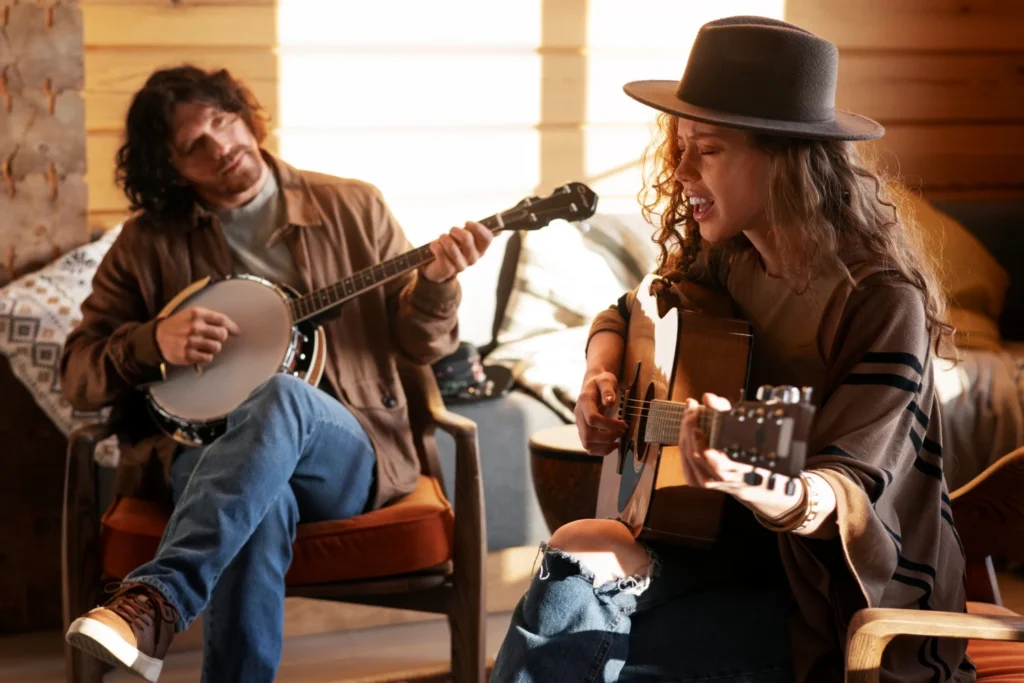
The banjo, fiddle, and mandolin do most of the heavy lifting on the attack. The acoustic guitar lays down the chords, the upright bass holds down the rhythm, and the dobro sings in a slide. It’s all very easy to pick out with your ears because each instrument has a defined role.
The bluegrass instrument group (right) is intended for use in the context of a classic string band, which would include banjo, fiddle, mandolin, acoustic guitar, dobro and upright bass, all quintessential instruments of the bluegrass genre.
High, Tightly Stacked Vocal Harmonies
Usually, the melody is sung by the lead, with the tenor harmonizing above him and the baritone singing any notes necessary to fill out the chord. This three-part harmony creates the unique high-lonesome sound. Call and response, where one line is sung by the soloist and answered by the whole group, might be heard as well.
Driving Rhythms Without A Drummer
The momentum comes from the closely interlocking strings. Bass anchors the pulse; guitar strums boom-chuck style on low strings and higher chords; and mandolin chop sounds like a snare. And faster banjo licks ride the groove of the strong beat.
Breakdowns And Instrumental Solos
While the others hold a chord, each instrument takes a turn for a short solo during instrumental breaks. For example, there can be a fiddle break followed by a mandolin, guitar, or banjo break. Banjo picking in the style of Earl Scruggs sounds like a continuous run of notes because of its unique three-finger approach.
From Appalachian Traditions To Country Stages
The ballads of the British Isles added melody and structure, African American banjo playing provided an instrumental core, gospel added close harmony and hymns, and country music opened up a professional stage and distribution network.
How The Genre Got Its Name
Kentucky’s Bluegrass nickname was the inspiration for Bill Monroe’s Blue Grass Boys. As the group’s fast, carefully arranged string sound became a model for other groups, audiences began to refer to their style as bluegrass. This is how the musical genre and the regional term have come to share the word blue grass.
Artists Who Shaped Bluegrass Music
Not all of the pioneers approached the genre the same way. Some defined the language, some polished the harmonies, some expanded the audience, and some explored how much an acoustic band could stretch. The distinctions between them help you distinguish the genre’s roots from its branches.
Monroe set the standard as the mandolin man of the [Blue Grass] Boys; Scruggs developed his style during his time with Monroe’s band; and the Stanleys gave bluegrass its streamlined, ballad-based look with their sibling harmonies. All of them showed that finesse and group feeling trumped raw speed.
Other artists brought these attributes into their own recordings for a country, folk, and Americana audience. Alison Krauss and Union Station combined careful technique with a clear and open style. Emmylou Harris sang harmonies and traditional songs to appeal to fans of acoustic-based music who might have originally known her from their country music tastes.
More progressive acts have stretched the envelope as well: Chris Thile and Punch Brothers make extended arrangements with familiar instruments that feature odd time signatures and a chamber-like interplay; Old Crow Medicine Show draws more overtly from old-time performance styles, using communal energy and sing-along choruses to help string band music reach bigger crowds.
This playlist will take you on an auditory journey from the roots of the bluegrass style, through the experiments and crossovers that have kept the sound fresh and exciting, all the way up to some of today’s most progressive bands and the way they’re taking the genre to new levels. Though the styles of arranging, composing and recording have changed dramatically over the years, these bluegrass pieces maintain enough familiarity with the traditional bluegrass style to clearly convey the roots of the music, while introducing novel elements that keep listeners interested.

Bill Monroe And The Blue Grass Boys
Bill Monroe led from the mandolin, using clipped rhythm and forceful solos to direct the ensemble. His 1940s Blue Grass Boys lineup established the classic combination of guitar, fiddle, mandolin, bass, and Earl Scruggs’s three-finger banjo, helping define the genre’s name and sound.
The Stanley Brothers
Stanley sang the lead with Ralph singing the high tenor, creating clear, brotherly harmonies that drew from the traditional songbook. Ralph’s banjo provided a punchy attack. The Stanley Brothers brought old ballads and hymns up to date.
Alison Krauss
Alison Krauss has a pure, controlled singing voice and a dynamic fiddling style that helped propel Union Station to success. The band gives great attention to instrumental nuances while maintaining arrangements that create space above the melodic line. Her records for a wider audience also made many listeners aware of acoustic string-band music.
Emmylou Harris
Through her harmonic singing, Emmylou Harris links bluegrass to country music, folk music and American roots music. In her duet and trio performances, she treats old songs as a living repertoire. Often focusing on the lyric, Harris lets the subdued accompaniment and harmony support and deepen the song’s message.
Punch Brothers
Mandolinist Chris Thile leads Punch Brothers, a band that uses the conventional string-band repertoire of instruments for progressive music. The band’s intricate musical arrangements sometimes change time signature, deconstruct motifs into shorter segments, and allow each player a distinctive voice. It can sound like a contemporary version of an acoustic chamber orchestra with bluegrass sensibilities.
Old Crow Medicine Show
A contemporary string band infused with enough juice to appeal to a huge Americana audience. The group’s live shows feature crowd participation, singing, bouncing around, and dancing. Old Crow’s signature song is “Wagon Wheel”, which has introduced many to the pleasures of roots music done by a group.
Essential Songs For A First Playlist
A good first playlist should show you a few different aspects of the music, not just one iteration of a fast banjo. These ten tracks will take you from early recordings to sibling harmonies, then to gospel-influenced recordings and the polished “crossover” sound, finally ending on modern performances of string-band music.
These songs show how bluegrass has developed and survived over time. Some of them, like “Blue Moon of Kentucky” and “Uncle Pen,” came from the very beginning of bluegrass, and show off some of the basic parts of the style: the driving beat, the fiddle, the group sound. “Foggy Mountain Breakdown” is a great example of why the banjo is so important in bluegrass. The Stanley Brothers’ versions of “Man of Constant Sorrow” and “Rank Stranger” have tight harmonies and are full of stories. They talk about people’s lives in the mountains, and how their religious faith helps them get through hard times. The Osborne Brothers used “Rocky Top” to bring bright harmonies to mainstream audiences. “Nine Pound Hammer” was made famous by Tony Rice, and it shows how he played the guitar with so much feeling. It shows his refined acoustic phrasing and emotional tension. Today, many bluegrass groups are doing their own thing. “The Lucky One” was recorded by Alison Krauss and Union Station, and it shows how they can keep things clean and clear even when they add some other instruments. “Rye Whiskey” by Punch Brothers is a good example of how they use old ideas but make them fresh. “Wagon Wheel” is a song that combines old-time music with what’s popular today. It makes it easy for new people to listen to bluegrass.
For many, Blue Moon of Kentucky is a top contender for most famous song ever recorded in the bluegrass genre since it has Bill Monroe, Kentucky and the bluegrass sound itself all tied together. If you want an instrumental piece that displays bluegrass banjo playing, Foggy Mountain Breakdown could be the first song to come to mind.
Choosing The Best Way To Listen
What you choose to listen to affects what you hear. Streaming encourages comparison, physical albums allow you to really focus, and concerts make you see how much of this music is based around the visuals. None of these provide the full picture.
If you’re not yet familiar with these names and song titles, start with streaming. The advantage of a single playlist is that you can bounce from Bill Monroe to the Stanley Brothers to Alison Krauss to Punch Brothers. It’s also helpful to compare different versions of the same song, as repertoire often circulates among performers; you may hear a particular song’s emphasis shift from vocal blend to tempo or instrumental breaks.
With physical media, you get a slower, more deliberate release. The album format puts songs in a specific order, and liner notes let you name the players if their work isn’t immediately recognizable. With CDs you get easy-to-use playback and, for many artists, old or deluxe versions can be handy. With vinyl, you add the extra steps of flipping through records, changing sides, etc., and you have to factor in your records’ pressings, condition, turntable, speakers, and room.
Listening to a performance of bluegrass music doesn’t give you a sense of how far away musicians are from the microphone, nor does it show whether they lean forward in order to sing harmony or step back to take a solo. These details matter. In addition, at a festival, many performances happen outside of the stage area, including workshops and picking circles. Seeing multiple groups play can also help give a sense of the range of rhythmic styles and repertoire variations between consecutive performances.
For finding and comparing new music, streaming is ideal. For close listening and collecting, there’s the physical album. And if you want to understand how music gets its power over a crowd, go to a concert or festival. With each of these approaches in play, you get breadth and depth.
Streaming For Discovery And Playlists
Spotify also has curated playlists to help you find standards, comedic songs, gospel songs, and contemporary artists. You can use the Artist Radio function to hear music that branches out from any particular band or artist. If several artists have recorded the same song, it’s easy and instantaneous to listen to the various renditions.
Records, Turntables, And Physical Albums
Check which album and edition include the recording you want before you purchase a record, then check the condition of the disc. Ensure that your turntable, cartridge, amplifier, and speakers are appropriate for the vinyl. Check reviews to find out if a pressing has better quality or packaging, or if a reissue was cut from a different source.
Key takeaways
Bluegrass is well known for the use of acoustic string instruments and close harmonies. It was Bill Monroe and his band, the Blue Grass Boys, who put together the basic format of the bluegrass sound. This musical tradition emerged from a variety of roots including Appalachian, African American, gospel, folk and country music. A common characteristic of the music is the breakdown, during which the band members take turns trading short instrumental solo parts played at a very fast tempo. Here are some standards, modern artists, festivals and playlists to get you started.
Frequently asked questions
What defines bluegrass music?
Bluegrass uses a stringed ensemble, vocal harmonies that are closely blended together, rhythmic drive, and solo instrumentalists that take turns taking solos. Traditional tunes and storytelling songs are standard in the genre, but contemporary artists write complicated songs. The interplay of musicians is just as important as any one musician’s skill.
What is the most iconic bluegrass song?
Blue Moon of Kentucky is a good pick too since it was written by and recorded by Bill Monroe, and the title helps make the connection between the music and the word Kentucky. If you’re looking for an instrumental, Foggy Mountain Breakdown continues to be one of the most definitive introductions to the Earl Scruggs style of banjo playing.
Is bluegrass country or folk?
The genre occupies a hybrid space between folk traditions and commercial country music. Its repertory of tunes and playing styles is drawn from folk traditions, but it also has a modern industry characterized by tour schedules, radio promotion, record albums and staged performances. Although it is closely related to country music, its instrumentation and harmonic approach are enough to differentiate it as a unique genre.
Why do they call it bluegrass?
The name comes through Bill Monroe’s band, the Blue Grass Boys, whose title referred to Kentucky’s nickname, the Bluegrass State. As other groups adopted the band’s influential approach, listeners began calling the style bluegrass.
Which instruments should beginners listen for in a bluegrass band?
The easiest place to start is the upright bass pulse and the mandolin chop. After that, listen to the guitar’s rhythm, the banjo’s rolling figures, and the fiddle’s long or dancing lines. The smooth, metal slide of a dobro is also easily recognizable.
Start Listening Beyond the Labels
Bluegrass offers an engaging performance with the chop of a mandolin keeping time, banjo and fiddle trading licks, and close harmony backing stories told with melodies common to American music. With such a complicated piece of music, it is easy for the untrained ear to miss all of the little parts that make up the whole, but Bluegrass makes it easier to recognize them.
Bluegrass is derived from Bill Monroe and the Stanley Brothers’ “high lonesome” sound. It can also be interpreted through Alison Krauss’ smooth, crossovery recordings, the progressive, jazz-based arrangements of Punch Brothers, the lush, country-tinged harmonies of Emmylou Harris or the folk punk approach of Old Crow Medicine Show. The diversity that fits inside the style, from high-lonesome ballads to polished crossover recordings to progressive string arrangements, is remarkable.
The playlist will get your foot in the door, but it’s the live experience that seals the deal. Whether you catch an online broadcast, pick up their records, or head out to a festival, really listen to how the members of each group interact. The group’s signature sound emerges from their dialogue with each other.