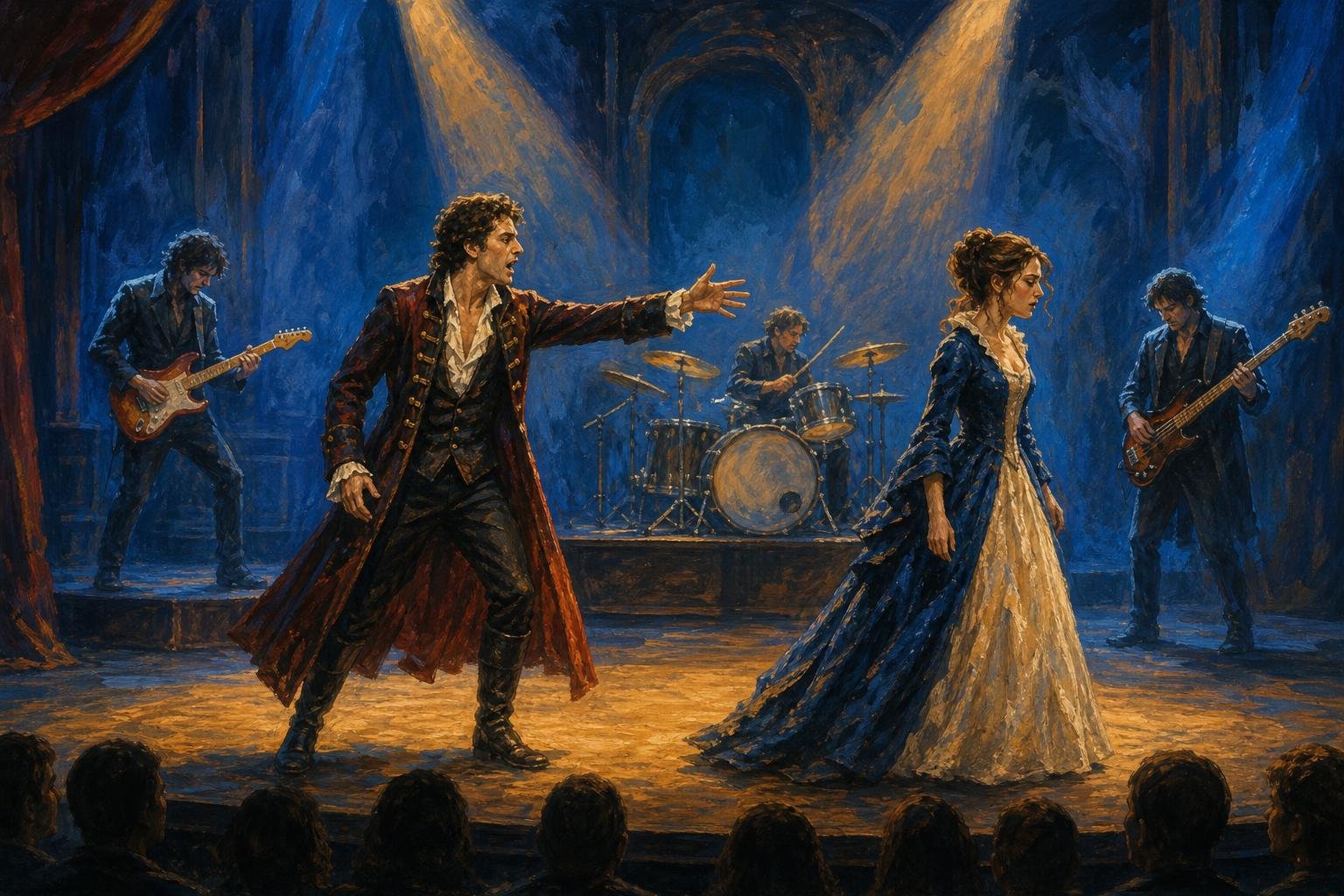
A rock opera tells a continuous story through rock music, across an album, a connected cycle of songs or a stage work. Operatic singing and a big sound do not make one. What separates it from a concept album is plot: a concept album can hold a mood or a theme across its tracks, but a rock opera needs someone to whom things happen, in order, with consequences.
The six examples below run from Nirvana's The Story of Simon Simopath in 1967 to Green Day's American Idiot in 2004. Each one finds its own way to make separate songs carry a single plot. One prints narration on the sleeve. One returns to its hero's childhood plea, and another lets its narrator come apart. Some albums grew into stage productions. The list also treats the argument over the first rock opera as an open one, because the release dates do not settle it.
In This Article
- 1. Nirvana's The Story of Simon Simopath (1967)
- 2. The Pretty Things' S. F. Sorrow (1968)
- 3. The Who's Tommy (1969)
- 4. Jesus Christ Superstar (1970)
- 5. Pink Floyd's The Wall (1979)
- 6. Green Day's American Idiot (2004)
- Key Takeaways
- Frequently Asked Questions
- Start With the Story Behind the Songs
1. Nirvana's The Story of Simon Simopath (1967)
This Nirvana is the British duo of Patrick Campbell-Lyons and Alex Spyropoulos, not the later Seattle band. Their debut came out on Island Records in 1967, ahead of every better-known title on this list, and it carried the subtitle "A Science Fiction Pantomime." That subtitle tells you how seriously to take it.
The songs are short, melodic pop with strings and harpsichord-style color. "Pentecost Hotel" is the best known of them, and almost nothing on the record sounds like hard rock. That is what makes it useful for a definition. Simon Simopath has a protagonist, a sequence of events and an ending, but story alone is not enough to define a rock opera: the music matters too.
The story is a fable. Simon is a lonely boy who dreams of having wings. The ordinary world wears him down until, as an adult, he breaks. Then the record gives him what he wanted as a child: a fantasy voyage that carries him far from the world that crushed him. The boy who wanted to fly gets his flight.
2. The Pretty Things' S. F. Sorrow (1968)
The Pretty Things released S. F. Sorrow in December 1968, after recording it at Abbey Road with producer Norman Smith, who had also worked on Pink Floyd's early albums. The original LP sleeve printed passages of narrative between the song titles, and that is how the record works. The lyrics alone are fragmentary. The printed text supplies the plot links the songs leave out.
Track titles such as "S.F. Sorrow Is Born," "Balloon Burning" and "Baron Saturday" read like chapter headings, so the band clearly thought in scenes, even when the songs drift into mood. Singer Phil May built the story around Sebastian F. Sorrow, whose life runs from birth to factory work and on to war in "Private Sorrow."
The blow that breaks him comes in "Balloon Burning." His fiancée dies in an airship disaster, and nothing on the rest of the album recovers from it.
After the crash, Baron Saturday arrives. He leads Sorrow on a dark inner journey, and the psychedelic layers thicken as the trip goes deeper. When it ends, the music drops away almost entirely. "Loneliest Person," the closing track, sounds nearly bare after everything before it. Sorrow has come through the crash, the war and the Baron's tour of his own mind, and he is alone.
3. The Who's Tommy (1969)
The Who had already tested the idea on a smaller scale. "A Quick One, While He's Away," the nine-minute closing track of their 1966 album A Quick One, strings together short sections about a woman whose lover is away, her affair, and a final reconciliation. Pete Townshend's mini-opera predates both records above. It shows him working out how to link short sections into a plot before he tried a whole album.
Tommy, released in 1969 as a double album, took that method to full length. Tommy Walker sees his father kill his mother's lover and is told he saw and heard nothing. He becomes the "deaf, dumb and blind" boy. Abuse and failed cures follow, then pinball fame in "Pinball Wizard," a miraculous recovery, and a brief career as a messiah. His followers finally reject him in "We're Not Gonna Take It."
What holds that plot together is melody. The "Overture" previews themes that return later. The plea "See me, feel me, touch me, heal me" first surfaces as Tommy's inner voice, the one thing he cannot say aloud. In the finale, after the crowd rejects him with "We're not gonna take it," Tommy returns to his childhood plea as he retreats inward.
Tommy then traveled further from the album than either earlier record. Ken Russell directed a film version in 1975, and The Who's Tommy reached Broadway in 1993, with a Broadway revival in 2024. That success is a large part of why Townshend's band is so often credited with the form. The credit belongs to popularity and scale. It does not belong to whoever released a story album first.
Quadrophenia, the Second Who Rock Opera
The Who returned to the form with Quadrophenia in 1973. Also written by Townshend, it follows Jimmy, a young mod in 1960s Britain, whose personality splits four ways. Each side of him gets its own musical theme, matched to the four members of the band. Tommy is a fable; Quadrophenia is closer to realism. It has amphetamines, scooter culture, a train ride in "5:15," and a final reckoning in "Love, Reign o'er Me." Franc Roddam's 1979 film adapted it. Within four years, one songwriter had built two very different kinds of rock opera albums.
4. Jesus Christ Superstar (1970)
After the instrumental "Overture," Judas sings the first vocal number. In "Heaven on Their Minds" he worries that the movement around Jesus has grown out of control, and he returns near the end in the title song "Superstar," asking what it all meant. "Crucifixion," sung by Jesus and the company, follows, then the orchestral "John 19:41." Giving the doubter the first word turns the last week of Jesus's life, a story most listeners already knew, into an argument between characters.
Andrew Lloyd Webber wrote the music and Tim Rice the lyrics, and they released Jesus Christ Superstar as a double album in 1970, before it had a stage production. The record was a complete rock opera on its own terms, with Ian Gillan singing Jesus and Murray Head singing Judas. It reached Broadway in 1971, and Norman Jewison's film followed in 1973.
Yvonne Elliman sang Mary Magdalene's "I Don't Know How to Love Him," which became one of the best-known rock opera songs ever written. It also shows what the form takes from the theater. A character steps forward and sings out an inner conflict, much as in an aria. That debt is why Jesus Christ Superstar is the clearest case of a rock opera musical: it began on record, and it was always meant for a stage.
5. Pink Floyd's The Wall (1979)
Pink Floyd released The Wall in November 1979, with Roger Waters writing nearly all of it. Its protagonist, a rock star named Pink, builds a mental wall out of his injuries, each one another brick. His father dies in the war, as Waters's own father did at Anzio in 1944. His mother smothers him, his teachers humiliate him, and his marriage falls apart. Cut off completely, Pink hallucinates himself as a fascist leader, then puts himself on trial. The verdict is to tear the wall down.
The title names the device. "Another Brick in the Wall" appears in three parts across the album, and each part marks a new stage of Pink's withdrawal.
That wall became literal almost at once. Pink Floyd's 1980 and 1981 concerts built a real wall across the stage during the first half and knocked it down at the end. Alan Parker's 1982 film, Pink Floyd – The Wall, starred Bob Geldof as Pink and told the story almost entirely through the songs.
On the record, though, the wall comes down and the story does not stop. The album ends with the spoken words "Isn't this where…" and begins with "…we came in?" The final track runs straight back into the first, suggesting that the cycle might begin again rather than establishing that Pink builds another wall.
6. Green Day's American Idiot (2004)
American Idiot arrived in September 2004, twenty-five years after The Wall, at a time when rock opera albums rarely reached the mainstream. Green Day built it around the Jesus of Suburbia, a young man who leaves his hometown for the city. There he encounters the apparently separate, destructive St. Jimmy and a woman known only as Whatsername.
Two long tracks hold the structure together. "Jesus of Suburbia" and "Homecoming" each run about nine minutes in five linked parts, the same mini-opera method The Who used in 1966. Shorter singles such as "Boulevard of Broken Dreams" sit between those suites, so the album worked on the radio and still carried a plot.
The suites also frame the narrator's relationship with St. Jimmy. He gets his own song, "St. Jimmy," and he swaggers through it like a real figure. But "Letterbomb" describes Jimmy as a figment of the narrator's upbringing, connecting him to the narrator's own identity rather than a separate companion. "Homecoming" then opens with a section called "The Death of St. Jimmy." The narrator's break with Jimmy marks a rejection of the destructive life he represents and a turn toward home.
He loses Whatsername too. The album closes on a song named after her, a woman he can no longer place, which leaves him with neither the person he loved nor the person he pretended to be.
The stage version premiered at Berkeley Repertory Theatre in September 2009. American Idiot opened on Broadway on April 20, 2010, under director Michael Mayer. Billie Joe Armstrong played St. Jimmy at some performances, the songwriter stepping into the role of his narrator's other self. Like Tommy before it, the album came first and the theater followed, which makes Green Day one of the few rock bands of its generation to take a rock opera all the way to Broadway.
Key Takeaways
- A rock opera needs a sustained story told through rock music; theatrical vocals or an ambitious sound alone do not qualify it.
- A shared theme does not automatically make an album a dramatic narrative.
- Early examples from 1966 to 1968 complicate claims that any single recording invented the form.
- An album can tell a complete dramatic story before it receives a stage or screen adaptation, as Jesus Christ Superstar did.
- Recurring melodies and characters, such as Tommy's "See me, feel me" or the three parts of "Another Brick in the Wall," are what connect the tracks into one drama.
Frequently Asked Questions
Are rock operas musicals?
Not necessarily. A rock opera can be written for the stage or released as an album. Tommy and American Idiot began as albums and became stage musicals later. Jesus Christ Superstar sits between the two, because it was released as a record but written with the theater in mind.
Is "Bohemian Rhapsody" a rock opera?
The classification varies: Hollywood Records describes it as a rock opera. Queen's "Bohemian Rhapsody," from the 1975 album A Night at the Opera, is a single song with a mock-operatic middle section. It has a narrator and a dramatic situation, but calling it a miniature rock opera is different from calling it an album-length narrative like the six records here.
Is Pink Floyd's The Wall a rock opera?
Yes. The Wall follows one character, Pink, through a connected sequence of events, with recurring music such as the three parts of "Another Brick in the Wall."
What was the first rock opera?
No single answer holds up. The Who's mini-opera "A Quick One, While He's Away" dates from 1966, Nirvana's The Story of Simon Simopath from 1967, and the Pretty Things' S. F. Sorrow from 1968. Tommy in 1969 is the one that made the term famous.
What's the difference between a rock opera and a concept album?
A concept album shares a theme, mood or idea across its tracks, while a rock opera tells a story. In a rock opera, characters act and change from song to song. An album-length rock opera is a narrative concept album, but the work need not be an album: the Oxford Companion to Music also includes stage shows in its definition. Many concept albums have no plot at all.
Start With the Story Behind the Songs
For a listening route through these six records, begin with Simon Simopath and follow the lonely boy's wish to fly into his fantasy voyage. Read the sleeve narrative alongside S. F. Sorrow to connect its scenes. With Tommy, listen for the melodies introduced in the "Overture" as they return. Follow Judas's questions through Jesus Christ Superstar, then trace Pink's withdrawal through the three parts of "Another Brick in the Wall." Finish with American Idiot: listen to how "Jesus of Suburbia" and "Homecoming" frame the shorter songs, and how "Letterbomb" changes your understanding of St. Jimmy.