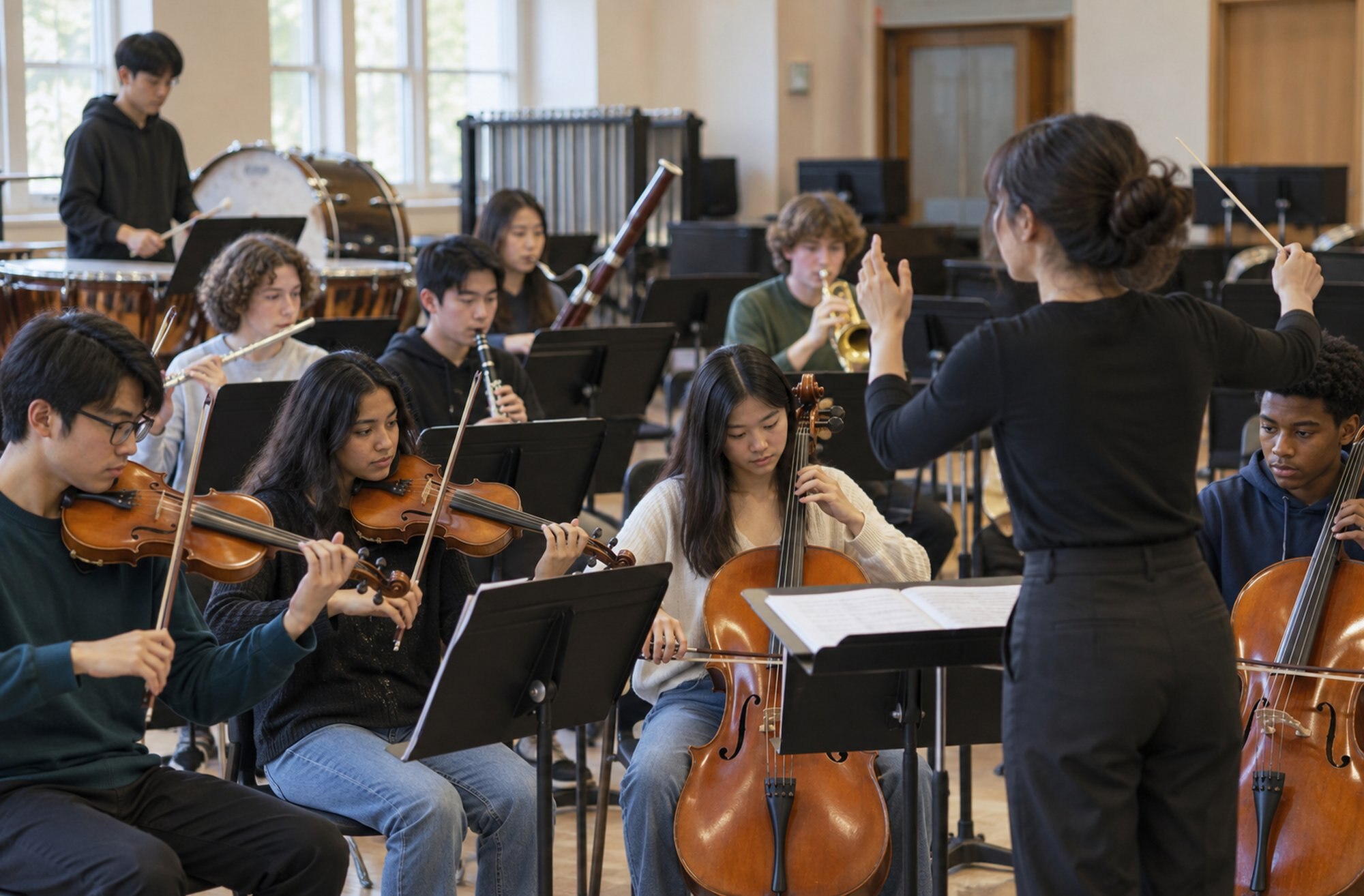
Orchestral instrument families are traditional groupings based on construction and how instruments are played, not material alone. A silver flute is still a woodwind. The four families are strings, woodwinds, brass, and percussion, but no single physical test explains every member.
| Family | How sound is produced | Common orchestral instruments |
|---|---|---|
| Strings | Strings vibrate, usually bowed or plucked. | Violin, viola, cello, double bass, harp |
| Woodwinds | Air vibrates, set in motion by an airstream crossing an edge or by a reed. | Flute, clarinet, oboe, bassoon |
| Brass | Buzzing lips set the air inside the tubing vibrating. | Trumpet, French horn, trombone, tuba |
| Percussion | A body or membrane vibrates when struck, shaken, plucked, rubbed, or scraped. | Timpani, snare drum, cymbals, xylophone |
These families are also used beyond the concert hall. A worldwide system from 1914 offers a different classification based primarily on what vibrates.
In This Article
- Strings: Bowed or Plucked
- Woodwinds: Air Across an Edge or Through a Reed
- Brass: Buzzing Lips
- Percussion: Struck, Shaken, Rubbed, or Scraped
- Instruments Outside the Orchestra
- A Worldwide System: Hornbostel–Sachs
- Key Takeaways
- Frequently Asked Questions
- Listen for What Starts the Sound
Strings: Bowed or Plucked
In the string family a stretched string vibrates, and the way it starts shapes everything you hear. A bow is strung with horsehair coated in rosin. When it is drawn across a string, the hair grips the string and drags it sideways until it slips free, then grips it again, hundreds of times a second. The bow keeps feeding in energy, so the note lasts as long as the bow moves.
A pluck gives the string one push and then leaves it alone. On the harp, a finger pulls the string aside and lets go. The note starts with a bright snap, and from then on it can only fade. The harp still belongs in the string family, because the string is what vibrates.
The four bowed orchestra instruments are violin, viola, cello, and double bass. The violin, viola, and cello share much of their design and construction; the double bass has distinct proportions and construction features. A string's pitch depends on its vibrating length, tension, and mass per unit length. Other things equal, longer or heavier strings sound lower; greater tension raises pitch. The body helps radiate and shape the sound.
Woodwinds: Air Across an Edge or Through a Reed
In a woodwind, the air inside the tube vibrates. The flute starts it with an edge. The player blows across a hole so the airstream splits on its far rim, the same trick that makes a bottle hum. Modern flutes are usually metal, but the edge works the same way.
The other orchestral woodwinds use reeds. The clarinet's single reed is a strip of cane that beats against the mouthpiece. The oboe and bassoon use a double reed: two blades of cane bound together with a narrow slit between them. Air forced through makes the blades slap shut and spring apart hundreds of times a second. That chatter gives the oboe its pointed, nasal tone. The bassoon puts the same kind of reed on a long, folded tube and reaches the lowest notes of the four.
Whichever way the sound starts, covering and uncovering holes along the tube changes the length of the air column, and that changes the pitch.
Brass: Buzzing Lips
In brass, the player's lips do the job a reed does. Pressed into a mouthpiece, the lips buzz, and the buzz sets the air in the tube moving.
Brass players change pitch in two ways. Tightening or loosening the lips picks out different notes from the same length of tubing, which is how a bugle with no valves can play a whole call. Valves or a slide change the length of the tubing. The trumpet, French horn, and tuba use valves. The trombone uses a slide that the player pushes out and pulls in. The tuba plays lowest among the standard orchestral brass instruments.
Percussion: Struck, Shaken, Rubbed, or Scraped
Percussion is the family of collisions. A stick hits a drumhead, and the skin flexes and springs back. A snare drum has wires stretched across its lower head. Every hit throws that head against the wires, and they rattle into a crisp hiss. Cymbals are crashed together. A guiro, a ridged gourd, is scraped. In each case, the object that gets hit, shaken, rubbed, or scraped is the thing that vibrates.
Some of these collisions produce definite notes. Timpani are large drums the player can retune, often with a foot pedal. A xylophone has wooden bars laid out like a keyboard, struck with mallets.
Instruments Outside the Orchestra
The same families of instruments cover far more than a concert stage holds, and some instruments bend the rules. The banjo is a string instrument whose body is a drum. Its bridge stands on a stretched head, so every plucked string shakes a membrane, and that gives the banjo its bright twang.
The tabla is a drum that plays clear pitches. The black circle on its head is a hardened paste that weights the skin, so the drum rings with tuned overtones instead of a thud. The djembe, another hand drum, has a rougher voice with no set pitch. The recorder, a common first instrument in school classrooms, is a woodwind: it aims the player's breath at an edge, the same way a flute does.
Plenty of musical instruments outside the standard orchestral lineup fit the four families this easily.
A Worldwide System: Hornbostel–Sachs
The mbira, or thumb piano, from southern Africa, is played by plucking thin metal tongues. It belongs to the percussion family; more specifically, it is a lamellaphone, or plucked idiophone.
The Hornbostel–Sachs system, published in 1914 by Erich von Hornbostel and Curt Sachs, groups acoustic instruments by their primary vibrating source, then subdivides them by features such as playing method and construction. If the instrument's own body vibrates, as in cymbals, the xylophone, or the mbira's tongues, it is an idiophone. If a stretched membrane vibrates, as in the snare drum, timpani, tabla, or djembe, it is a membranophone. Vibrating strings make a chordophone, from the violin and harp to the guitar. Vibrating air makes an aerophone. Electrophones were added later. MIMO's revised classification includes electronic instruments, electromechanical instruments, and instruments built or structurally modified to send their sound through an amplifier and loudspeaker, such as electric guitars. An unmodified acoustic instrument with an added microphone or pickup stays in its acoustic group.
Sorting this way changes the groups. Orchestral percussion splits in two, and woodwinds and brass become one group, because a flute and a tuba both make air vibrate.
Key Takeaways
- The orchestra's four musical instrument families are strings, woodwinds, brass, and percussion.
- Playing method and construction help explain orchestral families; material alone does not. A metal flute and a metal saxophone are both woodwinds.
- Hornbostel–Sachs sorts instruments from every culture by what vibrates.
Frequently Asked Questions
Is a saxophone a woodwind even though it is made of metal?
Yes, because a saxophone starts its sound with a single reed, like a clarinet. The reed beats against the mouthpiece and sets the air column vibrating.
Why can a piano be described as both a string and a percussion member?
The piano combines vibrating strings with a percussion mechanism. Pressing a key throws a felt hammer at a string; the hammer bounces off so the string can ring. This explains both descriptions. In Hornbostel–Sachs, an acoustic piano is a chordophone.
Does an orchestral family always sit together?
Usually, yes. Strings typically sit at the front, woodwinds in the middle, and brass and percussion toward the back.
Do all orchestras include a harp?
No. A harp joins the orchestra only when the music calls for one, as with the harp cadenza near the start of Tchaikovsky's "Waltz of the Flowers" in The Nutcracker.
Can one family play both melody and accompaniment?
Yes, and the strings do it all the time. The violins often carry the melody, while the cellos and double basses supply the harmony and bass line beneath them.
Are electronic keyboards part of the traditional four-family grouping?
Electronic keyboards are generally treated separately from the traditional four families. Digital pianos and synthesizers generate electrical signals that loudspeakers turn into sound. In MIMO's revised Hornbostel–Sachs classification, they are electrophones, as are electromechanical keyboards and purpose-built electric pianos.
Listen for What Starts the Sound
Put on a piece with a tuba part and wait for its lowest notes. The player's lips vibrate in the mouthpiece, the same mechanism a trumpet uses. Material alone can mislead you, as the silver flute shows. Listen for what vibrates and what sets it going, but remember that orchestral families and Hornbostel–Sachs are different ways of grouping instruments.