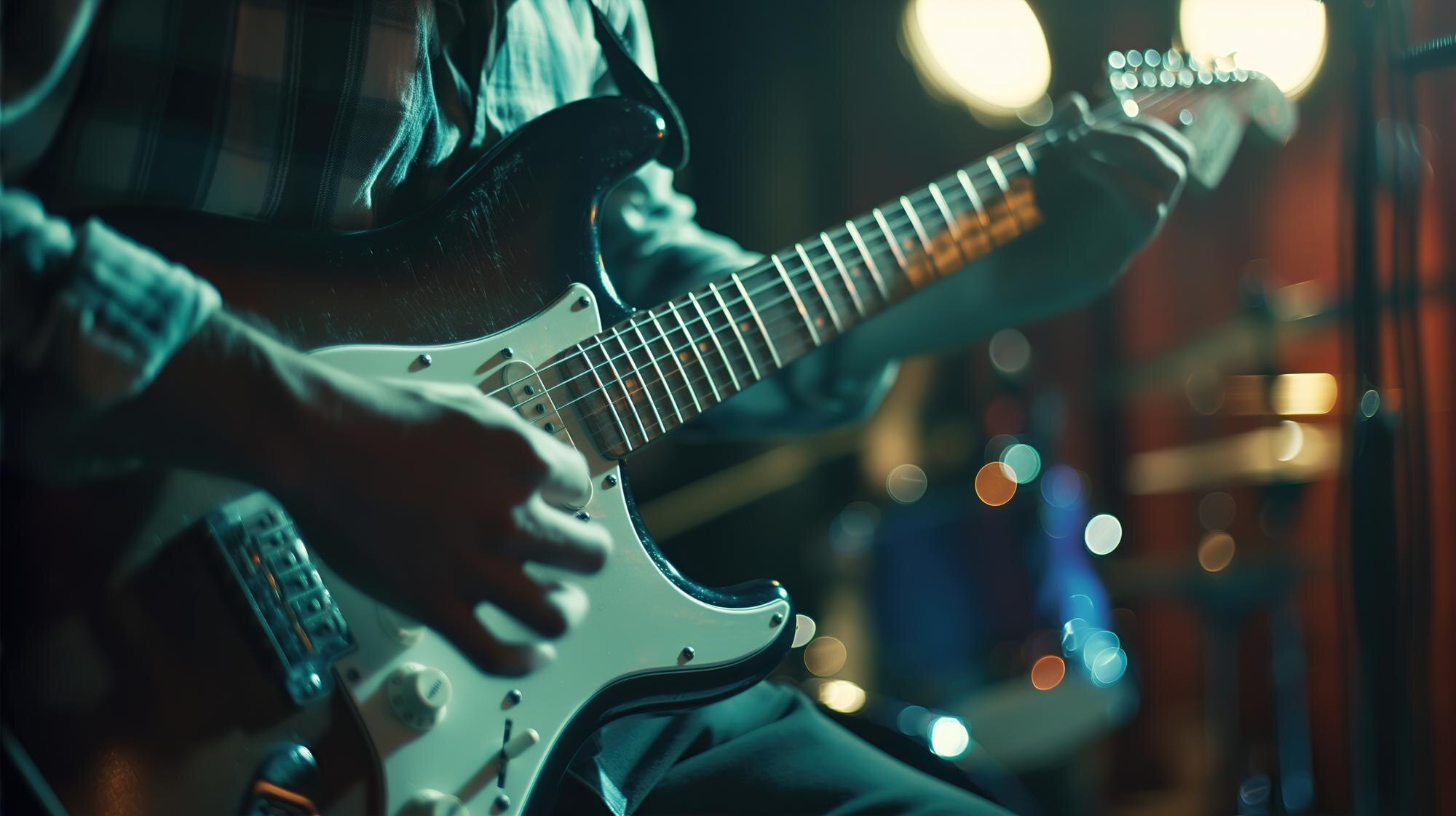
The main types of blues span rural acoustic traditions and electric band sounds. Delta and Piedmont blues grew in the rural South, while Chicago, West Coast, and jump blues took shape as urban band styles. Texas blues includes both rural acoustic and urban electric traditions, and Louisiana's electric swamp blues bridges rural and urban sounds. Around them sit classic female blues, boogie-woogie piano, and the blues rock that British and American players built in the 1960s. The twelve entries below cover each type of blues with a recording to hear and what to listen for in it.
Most blues styles share one vocabulary. Blue notes are flexible pitches rather than fixed scale alterations. Singers and guitarists bend and slur pitches, giving the music its ache. Call-and-response passes a phrase from the voice to a guitar, harmonica, or horn section. Many songs use the 12-bar form built on the I, IV, and V chords, with lyrics in an AAB pattern: a line, the same line again, then an answering line.
Because that vocabulary is shared, the real differences between blues genres show up in the rhythm, the guitar or piano, the voice, and the band, and those are what each entry below listens for.
In This Article
- 1. Country Blues
- 2. Delta Blues
- 3. Piedmont Blues
- 4. Texas Blues
- 5. Memphis Blues and Jug Bands
- 6. Classic Female Blues
- 7. Boogie-Woogie Piano
- 8. Chicago Blues
- 9. West Coast Blues
- 10. Jump Blues
- 11. Swamp Blues
- 12. Blues Rock and the British Blues Revival
- Key Takeaways
- Frequently Asked Questions
- Choose Your Next Blues Listen
1. Country Blues
Country blues is an umbrella for predominantly acoustic blues, including the regional styles recorded across the South in the 1920s and 1930s. It includes solo performers, duos, and string bands. In solo performances, the guitar often follows the singer's phrasing rather than a fixed drumbeat.
Mississippi John Hurt's "Candy Man Blues," cut for OKeh in 1928, shows how gentle it could be. Hurt fingerpicks a steady bass under a light, dancing melody and sings almost under his breath. Hurt's delivery on this recording is gentle rather than forceful, which is the point: the next three entries are regional branches of this one tradition, and they sound far less alike than the shared label suggests. Today's acoustic blues players still draw on all of them.
2. Delta Blues
Delta blues is a regional branch of country blues. Charley Patton, who worked around Dockery Plantation, recorded for Paramount in 1929. His records combine a percussive, thumbed bass with a hoarse shout that carries over it.
Robert Johnson's "Cross Road Blues," recorded in San Antonio in 1936, shows the style at its most concentrated. The bottleneck slide wails, and Johnson's voice cracks into falsetto at the ends of lines. The rhythm is hypnotic more than danceable. Muddy Waters learned this sound in Mississippi before he carried it north to Chicago.
3. Piedmont Blues
Piedmont blues came from the Southeast, chiefly the Carolinas, Georgia, and Virginia. Its guitarists fingerpick with an alternating thumb bass, so the low strings keep a steady boom-chick while the fingers play melody on top. That pattern owes a lot to ragtime piano.
Blind Blake was the virtuoso of the style on Paramount in the 1920s. Blind Boy Fuller's "Truckin' My Blues Away" makes a clear contrast with "Cross Road Blues." Fuller's guitar bounces through chord changes, and his voice sounds relaxed, almost conversational. This was party music.
4. Texas Blues
Blind Lemon Jefferson began recording for Paramount in Chicago and became one of the best-selling country blues artists of the 1920s. His guitar rarely holds a steady bass. It answers his high, clear voice with quick single-note runs, the same kind of lines T-Bone Walker would later electrify in entry 9.
What sets Jefferson apart is his clock. On "Matchbox Blues," from 1927, the bars do not come out even. He stretches a line until the words are finished, lets the guitar fill the gap, and starts the next line when he is ready.
Electric Texas blues puts lead guitar over a swinging band rhythm. T-Bone Walker's jazzy single-note playing also helped define West Coast blues, so the labels overlap. For a later Texas example, hear Stevie Ray Vaughan and Double Trouble's "Pride and Joy": the guitar moves between a driving shuffle and answering lead phrases, with bass and drums keeping the pulse steady.
5. Memphis Blues and Jug Bands
Memphis added a crowd to country blues. The Memphis Jug Band, led by Will Shade, recorded for Victor from 1927. Its bass came from a player buzzing their lips into the jug’s opening, a buzzing, hollow note somewhere between a tuba and a foghorn. Kazoo, washboard, harmonica, and guitars sat on top, and group vocals rode a bouncing two-beat pulse. The result sounds like a Beale Street sidewalk party.
That oddness was practical. A jug and a washboard cost almost nothing, carried anywhere, and could be heard over street noise. Cannon's Jug Stompers worked the same city, and their 1929 "Walk Right In" sets Gus Cannon's banjo and Noah Lewis's harmonica over the jug's thump.
6. Classic Female Blues
Classic female blues was a professional stage music of the 1920s, sung in vaudeville theaters and tent shows. Mamie Smith's "Crazy Blues" in 1920 proved that record companies could sell blues sung by Black women. Ma Rainey, billed as the Mother of the Blues, recorded for Paramount from 1923. Bessie Smith, the Empress of the Blues, debuted the same year on Columbia with "Downhearted Blues."
The accompaniment was jazz: piano, cornet, clarinet, sometimes a small band. The songs often came from professional writers, and the Depression, which gutted record sales, ended the era.
The voices are what last. Bessie Smith built hers to reach the back of a tent without a microphone, and her early records were sung into an acoustic recording horn. On "Downhearted Blues" she leans into every long note with that full stage force, and the piano behind her stays politely out of the way.
7. Boogie-Woogie Piano
Boogie-woogie is the type of blues music where the piano becomes a full rhythm section. It is primarily piano-based and often has no singer, though it can also be played on guitar. It repeats a rolling bass figure of eight notes to the bar while the right hand plays riffs and trills against it.
Meade Lux Lewis's "Honky Tonk Train Blues" uses that left hand to imitate a locomotive. Lewis and Albert Ammons played the 1938 From Spirituals to Swing concert at Carnegie Hall with Pete Johnson, and a national boogie-woogie craze followed.
8. Chicago Blues
Chicago blues is Delta blues plugged in, played by musicians who moved north during the Great Migration. Muddy Waters's "Hoochie Coochie Man," written by Willie Dixon and released by Chess in 1954, is built on a stop-time riff: the band hits together, falls silent, and Waters fills the gap with a boast.
The band defines this electric blues: amplified guitars, piano, bass, drums, and harmonica. Little Walter cupped a microphone around his harmonica and drove it through an amplifier, which made the instrument distort and sustain like a saxophone. His 1952 instrumental "Juke" shows the sound on its own.
9. West Coast Blues
T-Bone Walker took Texas guitar to Los Angeles and made it smooth. "Call It Stormy Monday," from 1947, swings easily over a horn section, and Walker's electric guitar is clean and fluid, nothing like Chicago's grit.
The phrasing is where Jefferson's single-note runs turned into something new. After each vocal line the guitar answers with a short, spaced phrase, a few bent notes and then a rest, the way a saxophonist breathes between riffs. Under the vocal he comps on jazz chords such as ninths, a long way from the drone of a Delta bass string.
Charles Brown's "Driftin' Blues," recorded in 1945 with Johnny Moore's Three Blazers, goes further toward the nightclub. Brown sings softly while playing piano, accompanied by Johnny Moore on guitar, Eddie Williams on bass, and Johnny Otis on drums.
10. Jump Blues
Jump blues shrank the swing big band to a small combo and kept the punch. Louis Jordan and His Tympany Five scored a huge hit in 1946 with "Choo Choo Ch'Boogie," riding a shuffle rhythm and riffing saxophones, with the boogie bass from entry 7 underneath.
Jordan sings it like a comedian working a room. He snaps off each rhyme with a showman's timing and turns the title phrase into a train noise. On this recording, Jordan winks rather than moans.
11. Swamp Blues
Swamp blues came out of south Louisiana in the 1950s. Much of it was recorded by producer J.D. Miller in Crowley and released on the Excello label. Compared with Chicago, the band plays less and leaves more air.
Slim Harpo's "I'm a King Bee," from 1957, has a slow, loping beat, a sparse guitar figure, and an unhurried, almost murmured vocal, with harmonica floating over it. Lightnin' Slim's records share the same laid-back pace and heavy echo.
12. Blues Rock and the British Blues Revival
In the 1960s, young British musicians learned blues from imported records. The Rolling Stones took their name from a Muddy Waters song and covered "I'm a King Bee" on their 1964 debut album. A landmark in that sound was John Mayall's 1966 album Blues Breakers with Eric Clapton.
Clapton played a Gibson Les Paul through a Marshall combo amplifier turned up well past clean. The overdrive thickened every note and made it sustain, as Little Walter had done to the harmonica in Chicago. His take on Freddie King's instrumental "Hideaway" keeps King's phrases and makes them heavier.
That is blues rock: blue notes and blues phrasing intact, with the amplifier doing new work. Within a few years Cream stretched blues songs into loud improvisations and Jimi Hendrix pushed the guitar into feedback.
Key Takeaways
- Blues categories describe overlapping regions, performance traditions, and sounds.
- Delta and Piedmont blues offer contrasting approaches to acoustic guitar.
- Chicago, West Coast, and jump blues differ in instrumentation and arrangement.
- Amplification reshaped blues through T-Bone Walker's electric guitar, Little Walter's amplified harmonica, and Eric Clapton's overdriven guitar.
Frequently Asked Questions
Can one performer belong to several blues categories?
Yes, and many do. Muddy Waters played Delta blues in Mississippi and then helped invent Chicago blues. T-Bone Walker counts as both a Texas and a West Coast guitarist. The labels describe recordings and periods more accurately than they describe whole careers.
Does electric amplification automatically make a recording Chicago blues?
No. T-Bone Walker's electric guitar defines West Coast blues, and Slim Harpo's swamp blues records were electric too. Chicago blues has a particular band sound, amplified harmonica over a tough, riff-based rhythm section, that plenty of electric blues lacks.
Are regional blues labels determined by a musician's birthplace?
Not strictly. Regional blues labels name where a sound developed, and musicians moved. Walker was raised in Texas and made his name in Los Angeles, while Blind Lemon Jefferson recorded his Texas blues in Chicago.
Why is classic female blues treated as a historical category?
It names a specific commercial era, the vaudeville and tent-show stardom of singers like Ma Rainey and Bessie Smith, which the Depression ended. Classic-blues singers including Sippie Wallace enjoyed renewed performing and recording careers in the 1960s and 1970s.
Can boogie-woogie appear within another blues style?
Often. The rolling eight-to-the-bar bass drives jump blues, turns up in Chicago piano parts, and was adapted by guitarists as a shuffle riff. It works as an ingredient as well as a style of its own.
Is country blues the same thing as country music?
No. Country blues covers predominantly acoustic traditions such as Delta and Piedmont blues, performed solo, in duos, or in string bands. Country music is a separate genre, though the two traded songs and techniques over the years.
Choose Your Next Blues Listen
Start with Robert Johnson's "Cross Road Blues" and Blind Boy Fuller's "Truckin' My Blues Away" back to back. Next, play Muddy Waters's "Hoochie Coochie Man" to hear that Delta sound with a band behind it. If you want horns and jokes, go to Louis Jordan's "Choo Choo Ch'Boogie." If you want something quiet, Charles Brown's "Driftin' Blues" is the record. Then pair Slim Harpo's "I'm a King Bee" with the Rolling Stones' 1964 cover to hear how British players took in Louisiana. Many artists cross between the different blues traditions, and following one record to the next is how these styles of blues music connect.