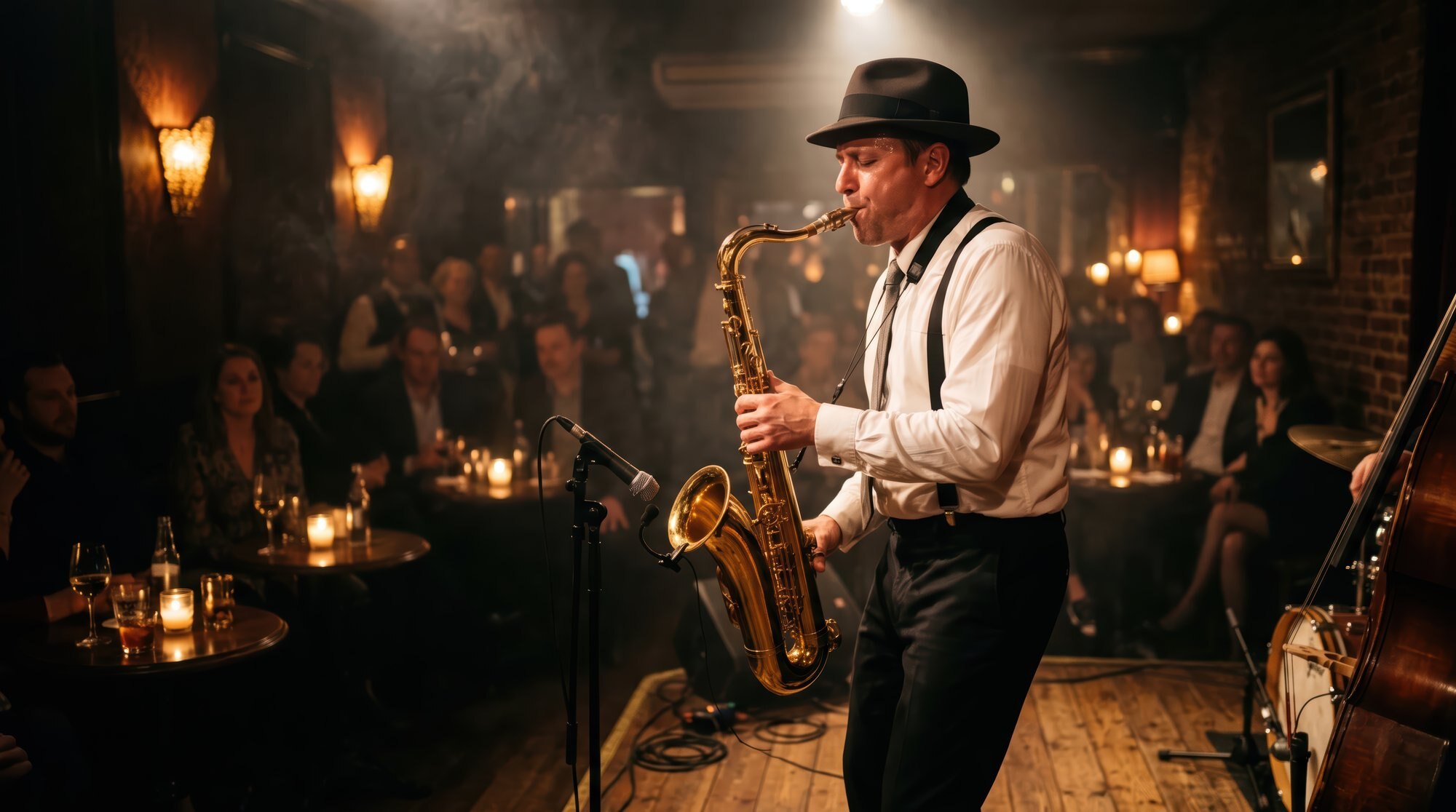
A jazz band shares four jobs: melody, harmony, bass and rhythm. Players pass those jobs around while improvising, and the band's size shapes what you hear. Art Blakey's Jazz Messengers and the Count Basie Orchestra show the difference: individual voices versus horn sections. Each example below covers the lineup, its roles and a record that makes them clear.
In This Article
- What Makes a Group of Players a Jazz Band
- How Jazz Bands Grew From New Orleans to Bebop
- Small Combos and the 17-Piece Big Band
- The Jazz Messengers: Five Voices in Conversation
- The Count Basie Orchestra: Sections Moving as One
- Hearing the Difference Between the Two
- Key Takeaways
- Frequently Asked Questions
- Hear the Roles Working Together
What Makes a Group of Players a Jazz Band
A jazz band is a group that performs jazz, with no fixed instrumental lineup. Following melody, harmony, bass and rhythm is one way to understand its players' roles. Miles Davis's "So What," from the 1959 album Kind of Blue, makes those roles audible.
Paul Chambers plays the melody on bass while the piano, later joined by the horns, answers with two chords. Jimmy Cobb keeps time on ride cymbal. When Davis solos, Chambers switches to a walking line, one note per beat, and Bill Evans supplies piano chords.
That movement follows a common form: the band plays the melody, called the head, players improvise over the harmony, and the head returns. On "So What," Chambers's bass phrase marks that return.
How Jazz Bands Grew From New Orleans to Bebop
Early-20th-century New Orleans bands often improvised collectively. Cornet or trumpet carried the melody, clarinet wove above it and trombone moved underneath.
Louis Armstrong helped shift attention toward the individual soloist. His Hot Five recordings grew from that tradition, but "West End Blues" (1928) opens with his unaccompanied trumpet cadenza. The group makes room for one voice.
Swing-era orchestras expanded that supporting role through written arrangements and spaces for solos. Duke Ellington wrote for individual players' sounds; Benny Goodman brought swing to a broad audience. Bebop in the 1940s returned to smaller groups suited to fast tempos and dense harmony.
The Jazz Messengers emerged from that small-group tradition in the mid-1950s. Basie's orchestra had formed two decades earlier.
Small Combos and the 17-Piece Big Band
Five saxophones playing together can sound like one thick voice. In a big band, you follow that voice against the brass, then hear individuals step forward to solo.
The standard 17-player lineup has five saxophones, four trumpets, four trombones and a rhythm section of piano, guitar, bass and drums. Earlier swing bands were often smaller.
A combo exposes each instrument. In a piano trio, the pianist handles melody and harmony; adding saxophone and trumpet creates the two-horn quintet heard on the Jazz Messengers' 1958 recordings.
These are example lineups, not fixed rules; instruments and roles can vary.
| Group | Instruments | Roles |
|---|---|---|
| Trio (3) | Piano, bass, drums | Piano: melody/harmony; bass: bass line; drums: time |
| Quartet (4) | Saxophone, piano, bass, drums | Saxophone: melody; piano: harmony; bass/drums: foundation |
| Quintet (5) | Trumpet, saxophone, piano, bass, drums | Horns: melody/harmony; piano, bass and drums: accompaniment |
| Big band (17) | Five saxophones, four trumpets, four trombones; piano, guitar, bass, drums | Horn sections: melody/harmony; rhythm section: chords, bass and time |
The Jazz Messengers: Five Voices in Conversation
Art Blakey ran the Jazz Messengers as a school for young musicians, including Lee Morgan and Wayne Shorter. Changing personnel makes each record's lineup important.
Bobby Timmons composed "Moanin'," recorded in 1958 with Morgan on trumpet, Benny Golson on tenor saxophone, Jymie Merritt on bass and Blakey on drums. Timmons's bluesy piano phrase draws a short answer from the horns, a call-and-response rooted in gospel.
During solos, Merritt walks the bass line while Timmons supplies harmony. Blakey does more than keep time: snare accents and rolls push the soloist forward.
The Count Basie Orchestra: Sections Moving as One
Count Basie formed his orchestra in 1935. Its relaxed swing depended on riffs: short phrases passed between horn sections.
The late-1930s rhythm section gave those exchanges room. Freddie Green strummed guitar chords on every beat, Walter Page walked on bass and Jo Jones emphasized the hi-hat. Basie added spare piano notes in the gaps.
The July 7, 1937, recording of "One O'Clock Jump" features 13 instrumentalists, not the standard 17 described above: trumpeters Ed Lewis, Buck Clayton and Bobby Moore; trombonists George Hunt and Dan Minor; saxophonists Earle Warren, Herschel Evans, Lester Young and Jack Washington; and the four rhythm players named above. It moves from Basie's piano through solos by Evans on tenor saxophone, Hunt on trombone, Young on tenor saxophone, Clayton on trumpet and Basie again on piano to overlapping horn riffs. Much was worked out by ear in rehearsal, a method called a head arrangement. This band already treated sections as answering voices.
Hearing the Difference Between the Two
On "Moanin'," Morgan or Golson solos with only the rhythm section behind him. Each phrase is exposed, and Blakey can answer immediately.
On "One O'Clock Jump," horn sections can supply riffs behind a soloist. The arrangement controls when those supporting voices enter and when the spotlight moves. Ellington's bands also combined individual freedom with arranged section parts.
Basie's closing choruses offer the clearest contrast with the quintet: the force comes from coordinated entrances across the horns, not one player's exchange with the drummer.
Key Takeaways
The contrast gives you two listening strategies. With the Messengers, follow how Blakey reacts to a soloist's phrase. With Basie, follow the changing weight of the horn sections. Both reward attention to the accompaniment: the musicians behind the featured voice help shape what happens next.
Frequently Asked Questions
What are some famous jazz bands?
- Duke Ellington and His Orchestra: A big band led by composer Duke Ellington.
- Louis Armstrong Hot Five: Armstrong's small recording group of the 1920s.
- Benny Goodman Orchestra: A swing orchestra led by clarinetist Benny Goodman.
- Jazz Messengers: Drummer Art Blakey's hard-bop group.
- Count Basie Orchestra: A Kansas City swing orchestra known for "One O'Clock Jump."
They span small-group jazz and swing orchestras.
What is a jazz band called?
Small groups are called combos, or trios, quartets and quintets by headcount. Larger groups are big bands or jazz orchestras. Schools often use "jazz ensemble" regardless of size.
Is the clarinet used in a jazz band?
Yes. Clarinet was central to early New Orleans jazz, and Benny Goodman led his orchestra on it. Big-band saxophonists sometimes switch to clarinet for particular arrangements.
What instruments are used in jazz?
Piano, bass and drums commonly form the rhythm section, sometimes with guitar. Horns include saxophone, trumpet and trombone; instruments such as vibraphone, violin and organ also appear.
Does every player improvise in every performance?
No. Combo players often take solos, while big-band arrangements assign many written parts and feature selected soloists. Rhythm players also improvise within their accompaniment, responding without necessarily taking a featured turn.
Hear the Roles Working Together
Use the opening of "Moanin'" to hear a handoff: Timmons states a phrase, and the horns answer. Then follow "One O'Clock Jump" from its piano opening toward the closing ensemble passages. The first makes conversation easy to trace; the second reveals how an arrangement gathers force.