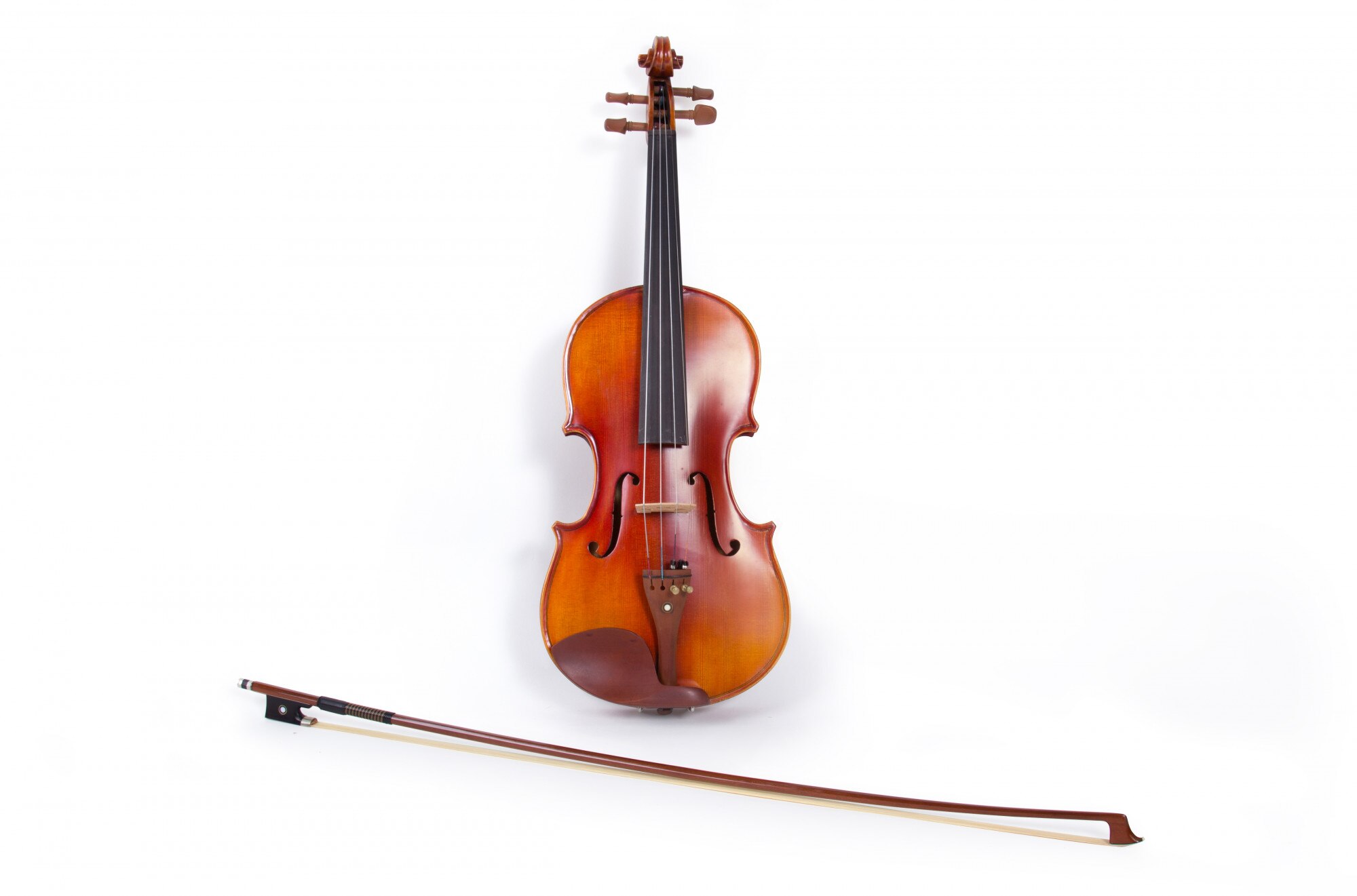
The main parts of a violin are grouped around its head, neck and body. The head contains the scroll, pegbox and tuning pegs. The fingerboard lies over the neck, with the nut at its pegbox end. Four strings extend from the pegs across the bridge to the tailpiece. The bridge stands between the body's f-holes; the tailpiece and chin rest sit toward the lower end. Two hidden parts, the soundpost and the bass bar, sit inside the body, and the bow is a separate tool with pieces of its own.
The violin's parts hold the strings at the right tension, let you change pitch, turn string vibration into sound, help you hold the instrument, protect it or provide decoration. The first job explains more than you might expect. String pressure holds the unglued bridge in place. Traditional wooden pegs grip their fitted holes by friction; geared pegs use an internal tuning mechanism. The strings are secured to the pegs in the pegbox and to the tailpiece, and turning the pegs adjusts their tension.
| Part | Location | Usual material | Function |
|---|---|---|---|
| Scroll | Above pegbox | Maple | Decoration |
| Pegbox | Below scroll | Maple | Houses pegs and string windings |
| Tuning pegs | Through pegbox | Ebony or other hardwood | Adjust string tension |
| Neck | Between head and body | Maple | Supports fingerboard |
| Fingerboard | Over neck | Ebony | Surface for stopping strings |
| Nut | Fingerboard's pegbox end | Ebony | Spaces and supports strings |
| Strings | Pegs to tailpiece | Steel, synthetic or gut cores | Vibrate to produce notes |
| Top | Body's front | Spruce | Radiates sound |
| Back and ribs | Body's back and sides | Maple | Form resonating body |
| F-holes | In top | Openings in spruce | Allow flexing and airflow |
| Purfling | Near plate edges | Wood strips | Decoration and crack protection |
| Soundpost | Inside, behind E-side bridge foot | Spruce | Supports top; couples plates |
| Bass bar | Under top, G-string side | Spruce | Reinforces top; distributes bridge load |
| Bridge | Between f-holes | Maple | Supports strings; transmits vibration |
| Tailpiece | Below bridge | Hardwood or synthetic material | Anchors strings |
| Fine tuners | At tailpiece | Metal | Make small tension adjustments |
| End button | Bottom of body | Hardwood | Anchors tailgut |
| Tailgut | Tailpiece to end button | Cord or wire | Secures tailpiece |
| Saddle | Lower top edge | Hardwood | Protects spruce from tailgut |
| Chin rest | Lower body edge | Hardwood or plastic | Helps stabilize violin |
In This Article
- The Scroll, Pegbox and Tuning Pegs
- The Neck, Fingerboard and Nut
- The Four Strings and How They're Tuned
- The Violin Body: Top, Back, Ribs and F-Holes
- Inside the Body: Soundpost and Bass Bar
- The Bridge, Tailpiece and Fine Tuners
- Chin Rest and Shoulder Rest
- Parts of the Bow and Rosin
- Key Takeaways
- Frequently Asked Questions
- Know Your Instrument Before You Play
The Scroll, Pegbox and Tuning Pegs
The scroll is the carved spiral at the very top of the violin. It is carved from the same block of maple as the neck and pegbox, and many makers treat it as a signature of their style. Musically it does nothing. It gives your hand leverage when you adjust the tuning pegs.
Just below the scroll, the pegbox is a hollow channel with four tuning pegs passing through its walls. Each string wraps around one peg. Traditional pegs are tapered, often made of ebony, and hold by friction: gentle inward pressure while turning helps the taper grip. Geared pegs are also available. Their internal gears allow finer pitch adjustments; follow the maker's instructions rather than treating them as friction pegs.
Traditional friction pegs handle large changes in pitch: bringing a new string up to tension, or fixing a string that has dropped well out of tune. Geared pegs also allow fine adjustments. Wooden friction pegs may slip or stick as humidity changes. A teacher can show you how to apply peg compound to these pegs, and a peg that no longer fits its hole goes to a repairer.
The Neck, Fingerboard and Nut
The neck is the long maple piece between the pegbox and the body, and your left hand travels along it as you play. Its main job is to support the fingerboard, the smooth black strip glued on top of it. Fingerboards are usually ebony because it is hard enough to resist wear from fingers and strings.
The fingerboard has no frets. Pressing a string down against it shortens the part of the string that vibrates, and a shorter vibrating length gives a higher pitch. On a fretless fingerboard, finger position sets the vibrating length; pitch also depends on the string's tension, mass per unit length and mode of vibration. That is why beginners often put small tape markers on the fingerboard until their hands learn the spacing.
At the pegbox end of the fingerboard sits the nut, a small raised ridge with four shallow grooves. The grooves space the strings evenly and support them as they leave the pegbox. The nut and the bridge mark the two ends of each open string's vibrating length. Recutting or replacing a nut is repairer work.
The Four Strings and How They're Tuned
From lowest to highest, the strings are G, D, A and E. Each string sits a fifth above the one before it, which is why violinists say the instrument is tuned in fifths. The G string is the thickest and has the darkest sound. The E is the thinnest and highest, and it carries through an orchestra more easily than the other three.
Strings have a core of steel, synthetic fiber or gut, often wound with metal. The E string is usually plain steel, because a thin string at that pitch needs strength above everything else. Steel also stretches very little, so a small turn of the peg moves the E a long way. That is why the E string is the one most often tuned with a fine tuner, covered in the tailpiece section.
Removing all four strings at once releases the bridge and can also allow the soundpost to fall. A fallen soundpost needs a repairer's tools to reset.
Change strings one at a time, leaving the other three under tension to reduce the risk of disturbing the bridge and soundpost.
The Violin Body: Top, Back, Ribs and F-Holes
The violin body is the hollow wooden box that turns string vibration into sound. A full-size violin body is about 14 inches long and consists of a top, back and ribs. The top, sometimes called the belly, is typically spruce. The back and the ribs, which form the sides, are commonly maple. The rounded curves nearest the neck are the upper bouts; those nearest the tailpiece are the lower bouts. The inward-curving C-bouts form the waist, with four projecting corners where they meet the outer curves.
Each wood does a different job. Spruce is light and vibrates easily, so the top responds to every movement the bridge passes down to it. Maple is denser. It gives the box strength, and the back and ribs support the top and vibrate together with it to help radiate sound.
Two f-holes are cut into the top, one on each side of the bridge. They let the spruce flex more freely and let air move in and out of the box, both of which shape the instrument's volume and tone. They also give a repairer a way inside, which matters for the soundpost in the next section.
Purfling is a thin inlaid border of dark and light wood strips near the body's edges. It looks like decoration. It also helps stop cracks that start at the edge from spreading inward.
Inside the Body: Soundpost and Bass Bar
The least visible part of violin anatomy is also one of the most important. Two parts inside the body carry the load of the strings and shape the sound, and you can only see them by looking through the f-holes.
The soundpost is a small spruce dowel standing upright between the top and back, just behind the bridge foot on the E-string side. It is not glued: its fitted length and contact with both plates keep it wedged in place. Releasing all string tension can nevertheless allow it to fall. The soundpost supports the top against string pressure and carries vibration from the top to the back, so the whole box responds. Moving it slightly changes the tone, which is why repairers adjust it through the f-hole with special tools.
The bass bar is a long strip of spruce glued to the underside of the top, running lengthwise under the G-string side. It spreads the pressure of the bridge's bass foot along the top and helps the lower strings sound full.
If the soundpost falls, loosen the strings to take pressure off the unsupported top and take the violin to a repairer. Don't try to reset it yourself.
The Bridge, Tailpiece and Fine Tuners
The bridge is the thin, carved maple piece standing on the top between the f-holes, and it is where all that tension meets. It is not glued. String pressure alone holds it in place, and its two feet are carved to fit the curve of the top exactly. The soundpost stands just behind the treble foot, and the bass foot stands directly above the bass bar.
The bridge holds the strings at the right height and passes their vibration into the top. Its arched upper edge lets you bow one string at a time without hitting the others. Because it is held only by pressure, it also moves. Every time you tune up with the pegs, the strings drag the top of the bridge a little toward the fingerboard. Check every so often that it stands straight, with its tailpiece-facing side roughly perpendicular to the top. If it leans, ask a teacher or repairer to demonstrate safe adjustment before attempting it yourself. A bridge left leaning can warp, and a warped or cracked bridge goes to a repairer.
The Tailpiece and Fine Tuners
The tailpiece anchors the strings at the lower end of the instrument. Many tailpieces carry fine tuners, small metal screws that change a string's tension in tiny amounts. Beginner violins often have four. Some players use only one, on the E string; geared pegs can provide fine adjustment without separate tailpiece fine tuners. Turning a fine tuner clockwise raises the pitch. If one runs out of thread, back it off and make the larger change with the peg.
End Button, Tailgut and Saddle
The tailpiece hangs from the tailgut, a loop of cord or wire hooked around the end button, which is a peg fitted into the bottom of the body. On its way there the tailgut crosses the saddle, a strip of hard wood set into the lower edge of the top so the cord doesn't cut into the softer spruce. These three small parts take the whole pull of the strings at the lower end.
Chin Rest and Shoulder Rest
The chin rest is the shaped cup clamped to the lower edge of the body, usually to the left of the tailpiece or over it. It is commonly ebony, rosewood or plastic, and it is attached with small metal barrels that join threaded fittings, tightening a clamp spanning the chin rest and the back of the instrument. It can change the instrument's resonances and affect its sound.
What it changes is how you hold the violin. The chin rest helps balance and stabilize the violin while your left hand moves along the neck. How much weight the left hand supports depends on your setup and technique; avoid holding the instrument with excessive pressure. The chin rest's shape and height also set the angle of your head over the instrument, which is why players with longer necks or different jaw shapes often try several models.
The shoulder rest is a removable accessory, not part of the instrument. It clips onto the back edges and fills the gap between your shoulder and the violin, and its height and angle can usually be adjusted to suit your build. With the chin rest above and the shoulder rest below, the rests help balance and stabilize the violin rather than requiring one fixed role for the left hand. Take the shoulder rest off before putting the violin in its case, because leaving it on can pinch the case lid against the instrument.
Parts of the Bow and Rosin
The parts of the bow each control how the hair meets the string. The stick is the long curved rod, made of pernambuco, brazilwood or carbon fiber. It ends at the tip, the angular head at the far end. Running along the stick is the hair. Traditional bow hair is horsehair, and synthetic hair is also available.
At the end you hold is the frog, usually ebony, which holds the hair and gives your fingers a shape to grip. Behind the frog is the screw, sometimes called the button. Turning it moves the frog and sets how tight the hair is.
Tighten the hair only until there is a gap of about a pencil's width between the hair and the stick at the middle. Overtightening strains the stick and flattens its curve over time. After every session, loosen the screw until the hair is slack, and keep your fingers off the hair, since skin oils stop rosin from sticking.
Rosin is hardened tree resin sold in small cakes, and the bow needs it for a clear tone. Clean, unrosined horsehair slides across a string and produces a faint, whispery sound or no sound at all. A few strokes of rosin give the hair the grip it needs to catch the string and set it vibrating. Too much leaves white dust on the top and strings, which is why the cloth comes out at the end of practice.
Key Takeaways
- The violin's parts run from scroll to end button, with the soundpost and bass bar hidden inside the body.
- Spruce on the top vibrates and maple on the back and ribs gives strength, and the f-holes let the top flex and the air move.
- The unglued bridge is held by string pressure; the unglued soundpost is fitted and wedged between the top and back.
- Traditional pegs make large pitch changes; tailpiece fine tuners and geared pegs allow finer adjustments.
- Bow hair needs rosin to grip the string, and the screw sets its tension; loosen it after every session.
Frequently Asked Questions
What are the parts of a violin?
The main parts of a violin include the scroll, pegbox and tuning pegs at the head; the neck, fingerboard and nut; and the body with its f-holes, bridge, tailpiece, fine tuners and chin rest. Four strings run from the pegs across the bridge to the tailpiece. Inside the body are the soundpost and bass bar. The bow has its own parts: the stick, tip, hair, frog and screw.
What accessories does a violin need?
A violin needs a case, a cake of rosin, a soft cloth for wiping off rosin dust, and usually a shoulder rest. Many players also keep a tuner and spare strings. The chin rest is generally treated as part of the instrument, since it comes fitted.
What is the hole on a violin called?
The two openings in the top are called f-holes, after their shape. They let the top vibrate more freely and let air move in and out of the body. Repairers also reach the soundpost through them.
Why does a violin have both tuning pegs and fine tuners?
Traditional friction pegs make large pitch changes, while tailpiece fine tuners allow smaller adjustments. A peg brings a new string up to tension; a fine tuner helps finish the tuning, especially on the steel E string. Geared pegs also allow fine adjustments and can remove the need for separate tailpiece fine tuners.
Is the bridge glued to the violin?
No, the bridge is held in place only by string pressure. Its feet are carved to fit the curve of the top. That is why you check now and then that the bridge stands straight.
How do the parts of a viola compare with the parts of a violin?
The parts of a viola have the same names and do the same jobs as a violin's, because most string instrument parts are shared across the violin family. The viola is larger, and its strings are C, G, D and A. That drops the E string and adds a lower C a fifth below the violin's G.
Know Your Instrument Before You Play
The strings pull between the tuning pegs and the tailpiece, which the tailgut connects to the end button. String pressure holds the bridge upright; the unglued soundpost depends on its fitted length and contact with the body plates. When tuning, apply gentle inward pressure only to traditional friction pegs; follow the maker's instructions for geared pegs.