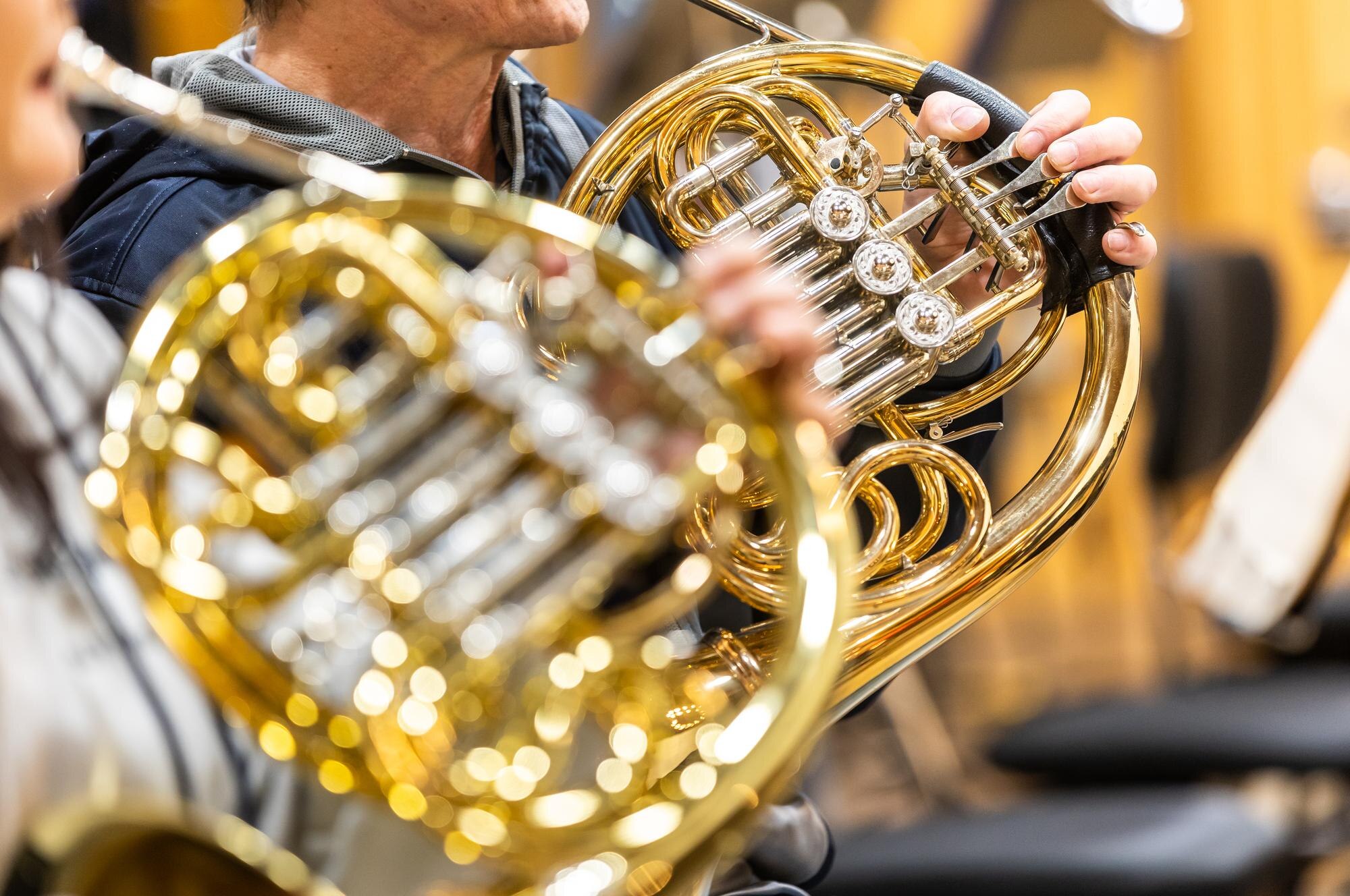
Violin, French horn and oboe are among the most challenging instruments to start. Producing a steady pitch or tone depends on control of your ear, lips or breath that you have not yet developed. Pipe organ, piano and drum kit offer more accessible first sounds, but advanced music brings demanding coordination and control.
This comparison uses four criteria: initial sound production, intonation, coordination and advanced technique. It is not an objective ranking. Each of the 11 entries explains what goes wrong first and what gets harder later, so you can tell which kind of difficulty you are signing up for.
The table uses a single scale of difficulty: Low, Moderate, High and Very high. These are comparative editorial judgments based on the descriptions below, not measured scores or an objective ranking. Intonation means the player's control of pitch during performance on a properly tuned instrument. Fixed-pitch instruments need no continuous pitch adjustment. Harp pedals select preset pitches, so pedal selection counts here as coordination, not intonation; tuning strings before playing is excluded. N/A means intonation does not apply to the unpitched drum-kit playing discussed here.
| Instrument | Initial sound production | Intonation | Coordination | Advanced technique |
|---|---|---|---|---|
| Violin | Very high | Very high | High | Very high |
| French horn | Very high | Very high | High | Very high |
| Oboe | Very high | Very high | High | Very high |
| Bassoon | High | High | Very high | Very high |
| Pipe organ | Low | Low | Very high | Very high |
| Concert pedal harp | Low | Low | Very high | Very high |
| Accordion | Low | Low | Very high | Very high |
| Bagpipes | High | High | High | Very high |
| Drum kit | Low | N/A | Very high | Very high |
| Double bass | High | Very high | High | Very high |
| Piano | Low | Low | Very high | Very high |
In This Article
- 1. Violin
- 2. French Horn
- 3. Oboe
- 4. Bassoon
- 5. Pipe Organ
- 6. Concert Pedal Harp
- 7. Accordion
- 8. Bagpipes
- 9. Drum Kit
- 10. Double Bass
- 11. Piano
- Key Takeaways
- Frequently Asked Questions
- Choose the Challenge You Enjoy
1. Violin
The violin's four strings, tuned G, D, A and E, run over a fretless fingerboard. A fingertip a millimetre off produces a sour note, so you have to hear the pitch before you place it. Playing a scale in tune requires precise fingertip placement on the fretless fingerboard.
The bow doubles the problem. Its speed, weight and contact point decide the tone, and a beginner's bow tends to squeak, skate or crush the string. Once the tone settles, advanced playing adds shifting, vibrato and double stops.
Paganini's 24 Caprices show where those skills lead. Caprice No. 1 throws the bow across all four strings in bouncing arpeggios.
2. French Horn
The modern double horn combines horns in F and B-flat. Valves change the tube length, but the lips choose which note of the harmonic series sounds. Horn parts sit high in that series, where neighbouring notes crowd close together, so a slight change in lip tension produces a cracked note or the wrong one entirely.
Your right hand sits inside the bell and shapes both tone and pitch, which adds a second correction to every note. The fear of missing a note lasts a whole career. The long second-movement solo in Tchaikovsky's Symphony No. 5 is exposed enough to test a professional's nerve as much as their lips.
3. Oboe
The oboe's double reed is two thin blades of cane vibrating through a tiny opening. It needs high air pressure but lets out very little air, so oboists often run out of usable breath while their lungs are still full. They exhale the stale air before inhaling again and have to plan both into every phrase.
The reed itself changes with humidity and wear. Many serious oboists scrape their own reeds to keep up with those changes. Beginners get unstable pitch and tone from the first day, and in an orchestra the oboist is the one who plays the A everyone else tunes to.
4. Bassoon
The bassoon folds about 8 feet of tubing back on itself. Its larger double reed also needs careful adjustment, but its airflow and pressure demands differ from the oboe's. Bassoon music uses bass and tenor clefs, occasionally treble.
Both thumbs work clusters of keys, the left thumb most of all. In the tenor register, players briefly "flick" vent keys during slurs so the note doesn't crack. Alternative fingerings change from one instrument and reed to the next, which keeps the upper range treacherous long after the clefs feel easy.
5. Pipe Organ
The pipe organ combines one or more keyboards, called manuals, with a pedalboard played by heels and toes. Bach's six trio sonatas, BWV 525–530, give each hand its own line and the feet a third. Three independent parts come from one body.
That coordination has to adapt to every new instrument. Stops, pedalboard layout and building acoustics all differ, and a large church can put an audible delay between pressing a key and hearing the pipe. You learn to trust your fingers over your ears.
Piano helps with reading and with keeping the hands independent, but organ touch is different. There is no sustain pedal, so organists join notes by swapping fingers on a held key and timing every release. Pedal technique needs regular practice on a suitable pedalboard, but a digital organ or a MIDI pedalboard connected to virtual-organ software can provide that at home.
6. Concert Pedal Harp
A concert pedal harp has 47 strings and seven pedals. Each pedal has flat, natural and sharp positions and changes the strings with that note name connected to its mechanism.
Harpists play with four fingers on each hand, leaving out the little fingers, and tuning all those strings is routine work before practice even begins. The hardest part is chromatic music. While both hands keep a run going, the feet have to reset pedals for notes that are still a bar away, and a pedal left in the wrong slot turns a whole passage sour. You are effectively doing two pieces of arithmetic at once and must not drop either.
7. Accordion
The right hand plays a piano keyboard or chromatic buttons. On a Stradella bass system the left hand finds single bass notes and preset chords among as many as 120 buttons it cannot see.
That same left arm drives the bellows, which control phrasing and volume. Every change of bellows direction is a chance to break a musical line, so beginners learn touch and air supply together. Classical players often add a free-bass system later, which gives the left hand single notes and turns it into a second melodic hand.
8. Bagpipes
The Great Highland bagpipe has a nine-note chanter and three drones, and the sound never stops. Since you can't separate two repeated notes with silence, you separate them with gracenotes and embellishments played fast and exactly.
Learners usually spend months on a practice chanter before touching full pipes. Then you have to coordinate fingerwork with blowing and squeezing to keep bag pressure steady while the drones stay in tune with the chanter. A wobble in pressure is heard by everyone within a few streets, because the full instrument is that loud.
9. Drum Kit
A basic rock beat can come together in one lesson, which makes the kit easy to begin. The difficulty is independence: two hands and two feet can each play a different rhythm at a different volume.
All four parts have to sit on the same pulse, and rushing or dragging drags the whole band with it. Advanced players add ghost notes and odd meters, and jazz brushwork replaces strokes with sustained sweeps that still carry the groove. At the top end, a foot can hold steady quarter notes while the hands phrase in threes over it, each limb counting its own pattern without letting the others pull it off.
10. Double Bass
The double bass has the violin's fretless pitch problem spread over a much bigger instrument. Its strings are tuned E, A, D and G, and in the lowest positions a fully stretched hand covers only about a whole tone. Jeff Bradetich's technical exercises include one-octave scales played without shifting. When a scale does require shifts, each is another chance to land out of tune.
The thick strings can have steel or synthetic cores, and using arm weight to help the fingers stop them reduces squeezing and fatigue. Plucking walking lines in jazz builds calluses, often after blisters. Low pitches also make intonation harder to judge, because the ear finds it harder to hear a small error down there.
Higher passages bring thumb position. Double bassists use French- or German-style bows, which differ in construction as well as hold: French bows are held overhand, German bows underhand. Orchestral playing leans on the bow, while jazz leans on the plucking hand.
11. Piano
Piano keys give you a stable pitch the moment you press them, so beginners play recognisable music within weeks. The difficulty waits in music with several voices at once.
In a Bach fugue, one hand may carry two voices. When they sound together, one voice may need to stand out while the other stays quiet. The player has to give simultaneous notes different emphasis, then sustain and release each voice independently. Which fingers bring out the melody depends on the hand and passage. Add pedalling that must clear the harmony without cutting off the line, and piano becomes a demanding test of voicing and coordination, despite its accessible start.
Key Takeaways
- Instruments where your ear guides finger placement (violin, double bass) are especially demanding in the first months, because every note can be out of tune.
- On horn, the player's lips vibrate; on oboe, breath makes the double reed vibrate. Both require trained control of lips and breath.
- Organ, harp, accordion and drum kit are coordination puzzles: the first notes come easily, and the difficulty grows as more limbs get separate jobs.
- Practical access matters too: full bagpipes need somewhere suitable for loud practice, and organ pedal technique needs a suitable pedalboard, including a home digital or virtual-organ setup.
- The piano is the clearest case of an easy start and a hard finish.
Frequently Asked Questions
What is the hardest instrument to play for beginners?
For beginners, violin, French horn and oboe are strong candidates: each requires trained control before pitch and tone become reliable. There is no single winner across all four criteria used here. Your answer depends on whether sound production, intonation, coordination or advanced technique gives you the most trouble.
What is the most difficult instrument to master?
For long-term study, the pipe organ illustrates how difficulty can grow: hands and feet must coordinate independent musical lines, while different consoles and acoustics require adaptation. Piano presents another sustained challenge in balancing several voices. These are different demands from producing a reliable first tone, not proof that either instrument is universally the most difficult.
Is clarinet hard to learn?
Clarinet is easier to start than oboe, because its single reed is more forgiving. The early hurdle is crossing the break between registers. Clarinet overblows at the twelfth rather than the octave, so the upper register needs different fingerings for notes that look like they should match.
Is a French horn harder than an oboe?
On the horn, crowded harmonics mean a small lip error lands on a neighbouring note. On the oboe, reed changes and back-pressure make pitch and tone unstable from the first day.
What's harder, guitar or trumpet?
Trumpet is usually harder at the start. You have to buzz your lips, build endurance and pick notes from the harmonic series, much as a horn player does. Guitar frets fix the pitch for you, though chord shapes and sore fingertips slow early practice.
Choose the Challenge You Enjoy
Pick by the stage you can stand to be bad at. Before you choose bagpipes or organ, sort out where you will practise. Among the hardest instruments to learn, the bagpipes are the one your neighbours will learn alongside you.