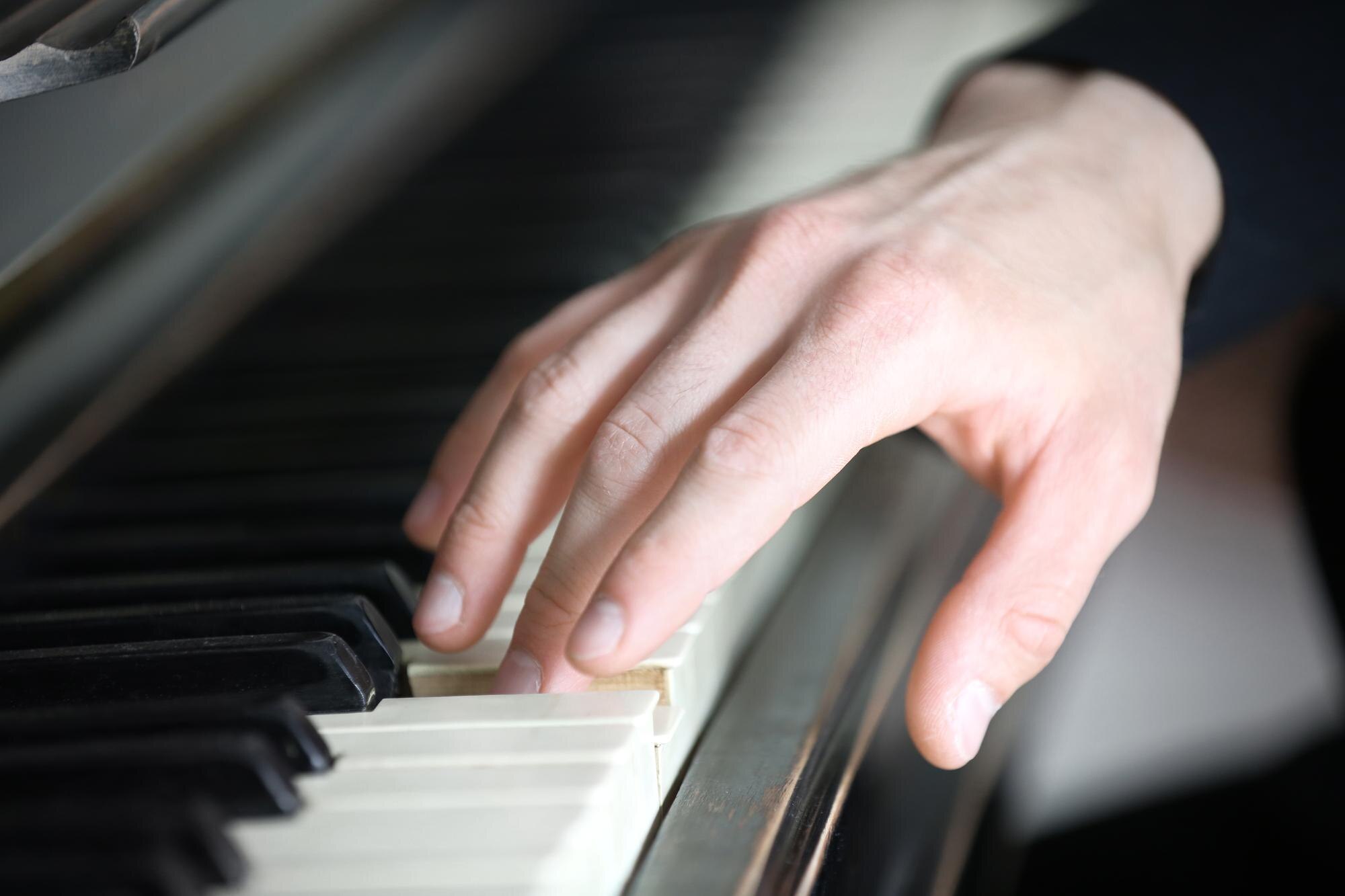
The chromatic scale contains the twelve pitch classes within an octave in the standard Western twelve-note system, played in order, each a half step from the next. In twelve-tone equal temperament, those half steps are equal. Nothing is skipped, so it has no built-in major or minor sound. At the piano that means pressing every key from one C to the next, white and black alike, in a row.
In This Article
- What the Twelve Notes Are
- Where the Word Chromatic Comes From
- Why Every Half Step Is the Same Size
- How to Spell the Notes With Sharps and Flats
- How to Play It on Piano
- How to Play It on Guitar
- Where You Hear Chromatic Lines
- Key Takeaways
- Frequently Asked Questions
- Start With One Even Octave
What the Twelve Notes Are
Starting on C, the pitches are C, C♯, D, D♯, E, F, F♯, G, G♯, A, A♯ and B. The next pitch is C an octave higher, and the cycle starts again. On the keyboard you play every key in order. Two pairs, E–F and B–C, are already a half step apart, so no black key sits between them.
Equal spacing alone does not establish a home note. A major scale mixes whole and half steps, giving its notes different relationships to the tonic. In C major, the half step from B up to C can sound like arriving. The chromatic scale has no distinctive interval pattern pointing to one tonic, but harmony, rhythm and phrasing can still give a chromatic passage a sense of home.
Where the Word Chromatic Comes From
Chromatic comes from the Greek chrōma, meaning "color." Ancient Greek theorists used it for one type of tetrachord: four notes spanning a perfect fourth, arranged as two small steps and one large gap.
Modern harmony turns that contrast around. A chromatic note squeezes into the space between two notes of the key, and its closeness to one neighbor creates a pull. Put G♯ in a C major passage and it sits a half step under A, leaning toward it. The key hasn't changed. The color has, and the ear wants that G♯ to move up.
Why Every Half Step Is the Same Size
Modern pianos use equal temperament, which divides the octave into twelve equal steps of 100 cents each. Each pitch vibrates about 1.0595 times faster than the one below it, and twelve of those steps double the frequency. Above A at 440 Hz, A♯ sits near 466 Hz.
Older tunings didn't share the steps out evenly. Quarter-comma meantone tuned its major thirds pure, and in the keys near C it sounded sweeter than a modern piano. That sweetness had to be paid for somewhere. One fifth, usually G♯–E♭, came out wider than pure, a beating, sour interval players called the wolf. A chromatic scale on such an instrument used half steps of two different sizes.
Equal temperament spreads that error across all twelve fifths, so every key is equally usable and equally slightly impure. When practicing, listen for even timing and touch. Pitch tuning alone does not guarantee an even response: the piano's action and voicing also matter.
How to Spell the Notes With Sharps and Flats
C♯ and D♭ name the same piano key, an example of enharmonic equivalence. On an equal-tempered piano, they sound identical, but their spellings communicate different musical roles. In chromatic scale exercises, teachers often use sharps going up and flats coming down, and the table below follows that habit. In real scores, a piece's key and harmony matter more than direction.
Get the spelling wrong and the page fights the player. Take a melody in F major that climbs A, B♭, C over a B♭ major chord. Spelled A♯, the middle note puts a sharp in a flat key and hides that it is the fourth degree of the scale. The sound is the same; the reading slows.
The same trap catches anyone who writes out a G chromatic scale with a sharp on every step and drops it into a flat key. As an exercise, an ascending chromatic scale in sharps is fine. In a score, spell each note the way the harmony around it would.
Ascending and descending chromatic scales from four pitches
| Starting pitch | Ascending chromatic scale (sharps) | Descending chromatic scale (flats) |
|---|---|---|
| C | C, C♯, D, D♯, E, F, F♯, G, G♯, A, A♯, B, C | C, B, B♭, A, A♭, G, G♭, F, E, E♭, D, D♭, C |
| D | D, D♯, E, F, F♯, G, G♯, A, A♯, B, C, C♯, D | D, D♭, C, B, B♭, A, A♭, G, G♭, F, E, E♭, D |
| F | F, F♯, G, G♯, A, A♯, B, C, C♯, D, D♯, E, F | F, E, E♭, D, D♭, C, B, B♭, A, A♭, G, G♭, F |
| A | A, A♯, B, C, C♯, D, D♯, E, F, F♯, G, G♯, A | A, A♭, G, G♭, F, E, E♭, D, D♭, C, B, B♭, A |
How to Play It on Piano
Piano finger numbers are 1 for the thumb, 2 for the index finger, 3 for the middle finger, 4 for the ring finger and 5 for the little finger, on either hand. For the right hand ascending, finger 3 takes every black key, the thumb takes most white keys, and finger 2 takes F and C. From C, the fingering is C (2), C♯ (3), D (1), D♯ (3), E (1), F (2), F♯ (3), G (1), G♯ (3), A (1), A♯ (3), B (1), C (2).
Descending with the right hand, reverse that sequence: C (2), B (1), B♭ (3), A (1), A♭ (3), G (1), G♭ (3), F (2), E (1), E♭ (3), D (1), D♭ (3), C (2).
The trouble comes twice per octave. At E–F and B–C there is no black key to give finger 3 a job, so the thumb plays E and B and finger 2 takes the next white key, F or C. Keep those steps as even as the rest of the line.
Set a metronome slow enough that those two crossings sound like every other note. Raise the speed only when the octave sounds even.
How to Play It on Guitar
This exercise assumes standard guitar tuning: E–A–D–G–B–E, from the lowest string to the highest. In first position, use one finger per fret, with fingers 1 to 4 covering frets 1 to 4. With open strings included, that gives you more than two octaves without moving your hand.
Play open low E, then F, F♯, G and G♯ on frets 1 to 4. Repeat that shape on the A and D strings: open string, four fretted notes, next string. The pattern becomes automatic quickly, and that habit is what causes trouble on the G string.
Most neighboring strings sit five half steps apart, but G and B sit only four apart. So on the G string you play open G, then G♯, A and A♯, and stop at fret 3, because the next note, B, is the open string after it. Your fourth finger, trained by three strings of habit, wants to drop onto fret 4 anyway. If it does, you play B twice. The awkward hitch in the guitar's chromatic scale is holding that finger back for one string, then letting it work again on B and high E.
Where You Hear Chromatic Lines
In program music, chromatic scale runs can imitate a sound outright. Rimsky-Korsakov's Flight of the Bumblebee uses rapid chromatic runs to suggest a buzz, swerving and doubling back. That motion does not mean the music has no key: Musicnotes' piano edition identifies A minor.
Chopin's Étude in A minor, Op. 10, No. 2, hides its difficulty from the listener. The right-hand third, fourth and fifth fingers play the rapid chromatic line while the thumb and index finger supply accompanying chord tones. The challenge is keeping that line smooth while the same hand plays the accompaniment.
Wagner slowed the effect down. Near the start of the prelude to Tristan und Isolde, the upper line rises G♯, A, A♯, B, one half step at a time, over harmony that keeps refusing to settle on a home chord. The prelude alone premiered in Prague on March 12, 1859; the complete opera premiered in Munich on June 10, 1865.
Key Takeaways
- A one-octave chromatic scale including both endpoints contains thirteen distinct pitches representing twelve pitch classes: the upper C is a different pitch from the lower C, but belongs to the same pitch class.
- Changing the starting pitch does not make the chromatic collection major or minor; a home note comes from musical context, not equal spacing alone.
- A chromatic note gets its direction from the note it resolves to.
Frequently Asked Questions
What is a chromatic scale?
A chromatic scale contains all twelve pitch classes within an octave, with each neighboring note a half step apart. It can be played ascending or descending.
Is chromatic the same as minor?
No. A natural minor scale has seven notes arranged in a pattern of whole and half steps that points to a home note. The chromatic collection uses all twelve pitches and has no major or minor quality of its own.
Why do some examples show thirteen notes instead of twelve?
Those examples repeat the starting note at the octave. C up to the next C is thirteen written notes, as in the table above, but only twelve distinct pitch classes.
Does an ascending chromatic passage always have to use sharps?
No, an ascending chromatic passage can use flats. The sharps-going-up convention suits exercises, but when the harmony calls for B♭ or E♭, a rising line should spell them that way.
Can a melody use every pitch and still have a key?
Yes, a melody can touch all twelve pitches and stay in one key. Chords and strong beats hold the home note in place while chromatic pitches decorate the line. In G major, a melody can move from G through G♯ to A: the G♯ is a passing note pulling a half step toward A, and the key stays G major.
Can practicing half steps help singers hear small pitch changes?
Yes, slow half-step practice helps singers notice small pitch changes. Singing the scale slowly against a piano shows you when you drift sharp or flat.
Start With One Even Octave
On piano, play one octave from C to C and back with the right-hand ascending and descending fingerings above, keeping the E–F and B–C crossings even. On guitar, follow the open-string pattern from low E through frets 1–4 on the E and A strings, then open D, fret 1 and fret 2 to reach E an octave higher. Reverse the route, keeping each step even. Then try C, C♯, D in a C major tune and listen to C♯ lead into D.