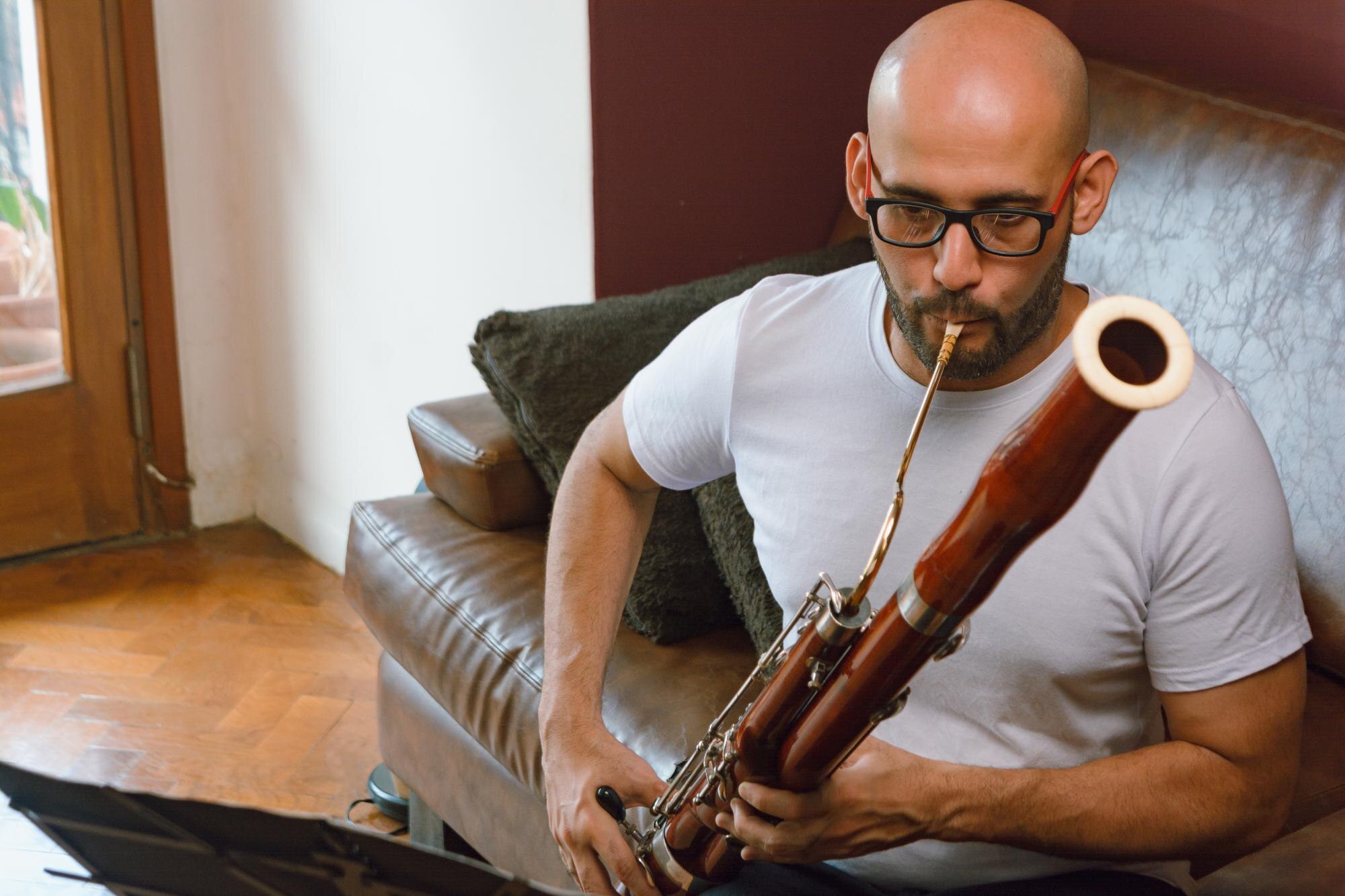
The bassoon is the orchestra's low double-reed woodwind. It has about 2.5 meters of tubing, folded in half so that a seated player can hold it and reach the holes. The folded maple tube stands roughly 1.3 meters tall, takes its sound from a cane reed, sounds at written pitch and covers more than three octaves. The folded construction helps explain the angled tone holes and the crowded keywork that keeps them within reach.
In This Article
- What a Bassoon Looks Like
- The Parts, From Reed to Bell
- How the Bassoon Makes Its Sound
- From the Dulcian to Modern Keywork
- The Contrabassoon and the Rest of the Bassoon Family
- Where the Bassoon Shows Up in Music
- Starting on the Bassoon
- Key Takeaways
- Frequently Asked Questions
- Listen for the Low Woodwind Voice
What a Bassoon Looks Like
From across a concert hall a bassoon looks like a reddish-brown pole with metal keys and a thin curved metal tube sticking out near the top, with the reed on its end. The player holds it diagonally across the body, with the weight on a seat strap or a neck strap.
The pole is really a doubled tube. The bore runs down to a U-bend at the bottom and back up to the bell, so the tubing lies side by side. That puts the finger holes near the hands. It also creates a problem: some holes have to be drilled at a steep slant through thick wood so they come out under a finger while still opening into the bore at the right point.
The Parts, From Reed to Bell
The instrument comes apart into five main sections. The replaceable reed sits outside that assembly.
Five main bassoon instrument sections: materials, connections and roles
| Bassoon section | Material and defining feature | Connection in the air path | Main role |
|---|---|---|---|
| Bocal (crook) | Curved metal tube; cork-wrapped lower end | Reed → bocal → wing joint | Carries the reed and channels air into the wooden body |
| Wing joint (tenor joint) | Maple; narrow bore and projecting wooden wing | Bocal → wing joint → boot joint | Forms the descending upper bore; carries finger holes and keys |
| Boot joint (double joint) | Maple; two parallel bores linked by a metal U-tube | Wing joint → U-turn → long joint | Reverses the bore direction at the instrument's bottom |
| Long joint (bass joint) | Maple; wider ascending bore with low-note keywork | Boot joint → long joint → bell | Forms the ascending bore and carries low-register tone holes |
| Bell | Maple; gently flared outlet | Long joint → bell → open air | Completes the bore and carries the low B-flat tone hole |
Sections are listed in the order air passes through them; the boot joint is also called the butt joint.
The table shows where the air goes. It doesn't show what the hands have to do. A bassoon has more holes than ten fingers can cover, so keys reach the extra ones, and a large share of that work lands on the left thumb.
On a German-system bassoon the left thumb runs the whisper key, which closes a small vent in the bocal to steady soft low notes. It also works the flick keys on the wing joint and the low D, C, B and B-flat keys on the long joint. In a single passage the thumb may have to hold the whisper key down, roll across to a low key and come back without a gap in the sound. Most of these keys sit out of sight behind the instrument.
How the Bassoon Makes Its Sound
The sound starts at the reed: two cane blades tied together, which vibrate against each other when the player blows. That vibration sets the air column inside the conical bore vibrating. Cane wears out, and it changes with humidity and heat, so a reed that worked on Monday can fail by Friday. Many professionals make their own reeds for that reason, scraping them to control how they respond.
At the bottom of the range the bassoon sound is round and buzzy, and the normal lowest note, B-flat1, is an octave above the lowest B-flat on the piano. In the middle register the tone is warm, which is why bassoons blend so easily with other instruments.
The upper register needs a responsive reed and faster, well-supported air. The player maintains a rounded embouchure rather than biting down as the pitch rises. High notes need not sound thin or strained: the bassoon can produce a sweet, nasal tone in this register.
Flicking is a separate technique used to help certain notes around middle C start cleanly rather than crack. The left thumb briefly opens a vent using one of the wing-joint flick keys; players may instead keep the appropriate key depressed for the note.
The written range is long enough that the music moves from bass clef into tenor clef, and occasionally treble, so the high notes don't need stacks of ledger lines.
From the Dulcian to Modern Keywork
The fold is older than the bassoon. The 16th-century dulcian, or curtal, had two connected passages drilled into a single block of wood. By the late 1600s makers had split the body into separate joints, and over the following centuries they added keys to improve tuning and extend the range.
Those keys created a conflict. Every hole is a compromise between the position that suits the acoustics and the position a finger can reach. Beginning in 1817, Carl Almenräder developed improvements to the bassoon's tuning and response, changing tone-hole positions and sizes as well as keywork. He later worked with Johann Adam Heckel; the two founded their bassoon factory on 11 March 1831. The Heckel workshop continued refining the bore and mechanism to improve the instrument's tonal balance, tuning and response. The result became the German system, now standard in most countries.
The French system, associated with Buffet Crampon, kept closer to the older design, with more holes covered directly by the fingers. Its tubing is also longer and more narrowly conical, and its tone holes are narrower than those of the German system. It remains mainly a French tradition, and its fingerings differ enough that switching systems means relearning.
The Contrabassoon and the Rest of the Bassoon Family
At the bottom of the bassoon family the contrabassoon sounds an octave lower, down to B-flat0, the second-lowest key on the piano. It has roughly twice the tubing of a bassoon, folded several times, and stands on a floor spike that takes its weight. Its music is written an octave above where it sounds.
Composers use that depth for comedy and menace. In Ravel's Mother Goose, the contrabassoon is the growling Beast in the conversation between Beauty and the Beast.
Above the standard bassoon are the tenoroon and the fagottino, both smaller and pitched higher. Today they mainly let children start before their hands can cover a full-size instrument.
Where the Bassoon Shows Up in Music
A symphony orchestra usually has two bassoons, sometimes with a contrabassoon. They carry the woodwind bass line, double the cellos and fill in the middle of chords. In the wind quintet the bassoon plays alongside flute, oboe, clarinet and horn. The bassoon is a double-reed member of the woodwind family; its metal keywork does not change that classification. Not all woodwinds use reeds: flutes and recorders do not.
The core solo works are Mozart's Bassoon Concerto in B-flat major, K. 191 (1774), and Weber's Bassoon Concerto in F major, Op. 75 (1811), which adds operatic drama and fast passagework. Prokofiev's Peter and the Wolf (1936) uses the low bassoon for the grumbling Grandfather, the role audiences expected the instrument to play.
Stravinsky went the other way. The Rite of Spring opens with a bassoon alone, starting on the C an octave above middle C and reaching D5. Played that high, the bassoon can be hard to identify. The Paris premiere on 29 May 1913, at the Théâtre des Champs-Élysées, turned into an uproar. The anger was aimed at the whole work and Nijinsky's choreography, but the bassoon solo was the first thing the audience heard.
Starting on the Bassoon
Whether a beginner can start on a full-size bassoon depends mainly on hand size. Some children start on clarinet or saxophone and switch later. Others begin on one of the smaller instruments mentioned above, or on a short-reach bassoon with extra keys that bring the farthest holes closer.
For a student bassoon, instrument bodies made of plastic handle temperature changes better than maple ones, and beginners generally use ready-made reeds instead of making their own.
None of that changes the stretch. The wing-joint holes are widely spaced, and the right hand has to cover its holes while the left thumb works the cluster described above. Early lessons address air, posture, embouchure and tonguing, alongside covering the holes with a natural hand position and light, curved fingers.
Key Takeaways
- The cane double reed supplies the vibration, and the top register depends on how well it responds.
- The folded bore puts 2.5 meters of tubing within reach, at the cost of slanted holes and a crowded left thumb.
- The German system moved holes for better tuning and added keys to reach them; the French system kept the older layout and its brighter tone.
- The family runs from the high, small fagottino down to the contrabassoon's B-flat0.
- In the orchestra the bassoon usually supports the bass line, and its exposed solos stand out against that role.
Frequently Asked Questions
What type of instrument is a bassoon?
A bassoon is a double-reed woodwind, related to the oboe and English horn. It covers bass and tenor parts, and its conical bore widens gradually toward the bell.
Who is a famous bassoon player?
Two well-known names are Klaus Thunemann, a German performer and teacher, and Maurice Allard, a French bassoonist. Allard played the French-system instrument.
Why is a bassoon so expensive?
Professional bassoons are expensive because they are made from maple seasoned for years and have complex keywork fitted largely by hand. Replacement reeds add an ongoing cost.
What is the difference between a bassoon and an oboe?
The oboe is a soprano-range instrument with a short, straight body and the reed fitted directly into the top. The bassoon is larger and lower, has a folded bore, and carries a wider reed on a curved metal bocal.
How much does a bassoon cost?
For new Fox bassoons in the U.S. retail market, Sweetwater and Saxquest list student models at approximately US$7,500–9,000, intermediate models at US$9,800–12,000 and professional maple models at US$18,650–34,355. These are ranges for the listed models, not market-wide price limits; prices change, and many students borrow a school instrument before buying.
What is another name for the bassoon?
In Italian the bassoon is the fagotto, in German the Fagott and in French the basson. The Italian and German names are often traced to a word for a bundle of sticks.
Listen for the Low Woodwind Voice
The bassoon combines a folded conical bore with a cane double reed. Its sound ranges from a round, buzzy bass to a sweet, nasal upper register. Play the opening of The Rite of Spring, and you'll hear what the instrument sounds like in its upper register.