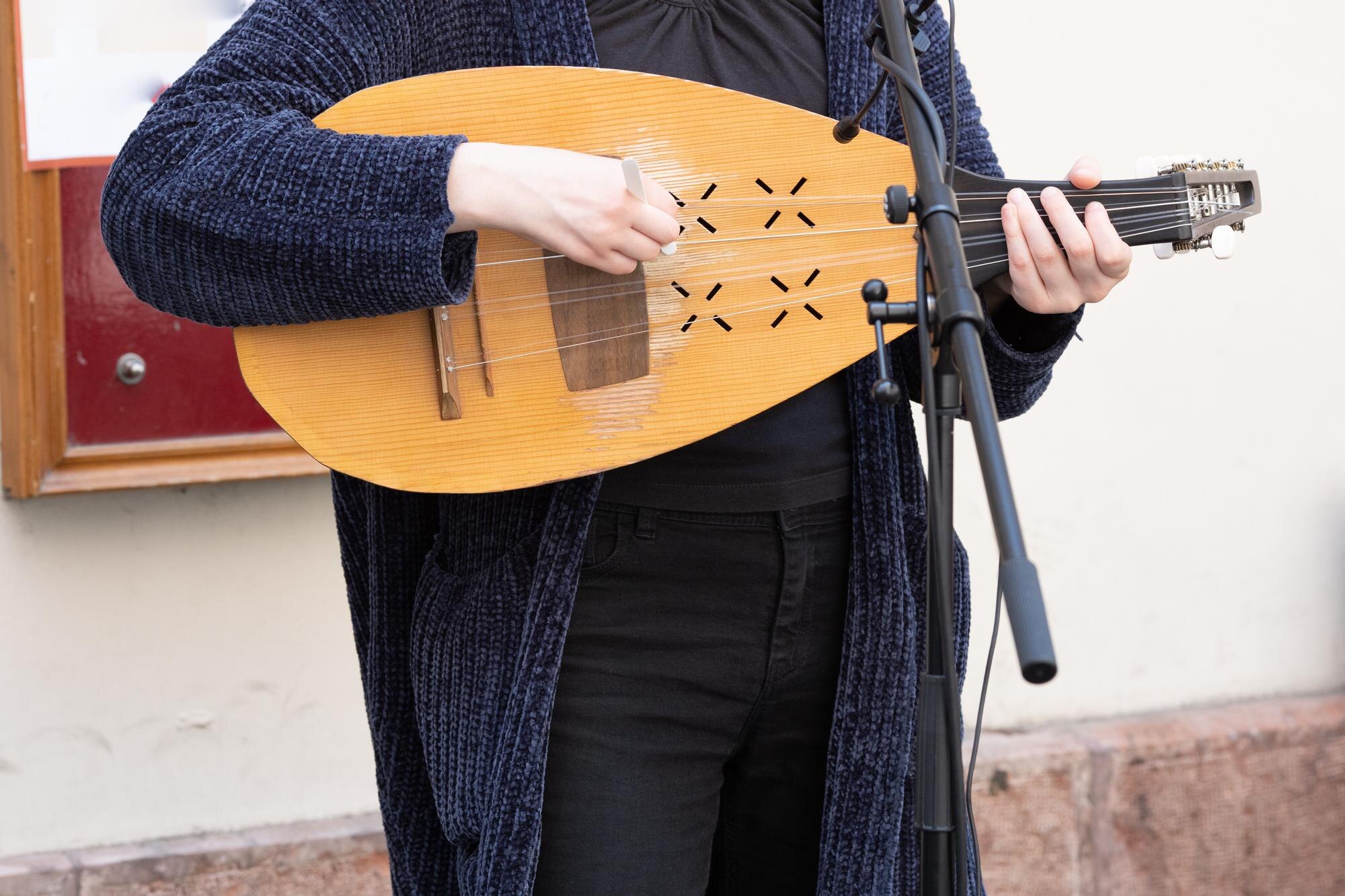
A lute is a plucked string instrument shaped like half a pear. It has a rounded back built from thin wooden ribs, a flat wooden top, a fretted neck and a pegbox bent sharply backward. It grew out of the Arabic oud and became a leading solo and accompanying instrument of the European Renaissance. In the Baroque era, lutes continued in solo music and bass-and-chord accompaniment, or continuo.
Two features run through everything below: the bowl-shaped body and strings arranged in courses, each containing one string or a pair played together.
In This Article
- Where the Lute’s Name and Shape Came From
- How a Lute Is Built
- Courses, Strings, and Tuning
- What the Lute Sounds Like
- Composers and Music Worth Hearing
- How It Differs From Guitar, Oud, Lyre, and Mandolin
- Key Takeaways
- Frequently Asked Questions
- Recognize the Shape, Hear the Tradition
Where the Lute’s Name and Shape Came From
“Lute” comes from the Arabic al-ʿūd, meaning “the wood,” which also gives English the word “oud.” Spanish laúd and Italian liuto come from the same root.
The instrument reached medieval Europe through Muslim Spain and Sicily, and it kept the oud’s bowl body. European players at first struck it with a quill plectrum. A quill suits one melodic line at a time.
In the late 1400s, players put the quill down. Plucking with the fingertips let one musician sound several independent parts at once, so a lute could carry music that had needed a group of singers. That change enabled more complex solo playing.
How a Lute Is Built
Makers bend thin wooden strips called ribs over a mold and glue them edge to edge. Because every rib is bent by hand, makers shape each lute individually, and the result is a pear shaped instrument with a light, resonant bowl.
A thin soundboard, usually spruce, covers the bowl. Its decorative rose is carved straight into that top, and the strings tie to a glued-on bridge with no tailpiece. The lute is lightly built, but bracing must resist the pull of the strings. Its tone also depends on the strings, bridge and soundboard.
Gut frets are tied around the neck, and a player can slide one slightly to correct intonation. The backward-bent pegbox presses the strings firmly over the nut and keeps a long row of pegs compact. That mattered once makers started adding courses.
Courses, Strings, and Tuning
A course is a set of strings played as one. Most courses are doubled, though the highest, called the chanterelle, is often a single string. Players count courses because the string total depends on how each course is strung.
The Renaissance Lute
A six-course Renaissance lute with a single chanterelle carries 11 strings. Common tunings were G–c–f–a–d′–g′ and A–d–g–b–e′–a′ from low to high, with absolute pitch varying. During the 1500s makers added bass courses, and seven- and eight-course instruments became common.
Those extra basses changed what a room heard. A fretted note stops when the finger lifts. An open bass course keeps ringing after the hand has moved up the neck, so one low note can hang under a whole phrase of melody.
Baroque Lutes and Extended Forms
French and German Baroque lutes commonly have 11 or 13 courses. Their upper six courses use D-minor tuning: A–d–f–a–d′–f′, low to high. Those six open courses form a D-minor chord; the additional bass courses descend scale-wise and usually sound open. England and Italy generally retained Renaissance tuning, often on extended instruments.
The theorbo and archlute go further. Each has a second pegbox carrying long, unfretted bass strings, and both served as continuo instruments, playing the bass-and-chord accompaniment under singers and ensembles.
What the Lute Sounds Like
The light body gives a soft tone with a crisp attack and a quick decay. Paired strings thicken that tone, because the two strings of a course never vibrate in perfect step.
That quick decay shaped the music. Lutenists broke chords into arpeggios and filled long notes with ornaments, keeping sound going where a voice would simply hold. Some bass courses pair a string with another an octave higher, so the low note speaks clearly. Historic strings were gut. Modern players also use synthetic substitutes.
All of this makes the lute quiet. Accompanying a singer in a small room, quiet is an advantage: the words come through.
Composers and Music Worth Hearing
Lute music was written in tablature, which shows courses and frets instead of pitches. Italian tablature used numbers and French tablature used letters.
Francesco da Milano (1497–1543) served the papal court in Rome, and people of his day called him “il divino.” In his fantasias one line enters, a second imitates it, then a third, until a single player sounds like several.
John Dowland (c. 1563–1626) spent years as lutenist to King Christian IV of Denmark. His lute pavan “Lachrimae,” printed in 1596, preceded the song version, “Flow, my tears,” published in 1600. Its falling opening figure connects the seven pavans that open Lachrimae, or Seaven Teares (1604), a collection of 21 pieces, not just those seven pavans. His lute accompaniments vary in texture, sometimes moving from four parts to two before expanding to six-part chords at a cadence.
Sylvius Leopold Weiss (1687–1750) was a Dresden court musician. He wrote demanding suites for the Baroque lute that use its full range, from the open basses up to the top course.
How It Differs From Guitar, Oud, Lyre, and Mandolin
The table sets out the construction. The prose after it covers how each instrument feels to play.
Lute instrument vs guitar, oud, lyre and mandolin: key differences
| Instrument | Body construction | Typical string layout | Frets | Playing technique | Best suited to |
|---|---|---|---|---|---|
| Renaissance lute | Rounded, rib-built bowl; bent-back pegbox | 6–10 courses; highest course usually single, others paired | Tied gut frets on neck | Finger-plucked; multiple independent musical lines | Renaissance fantasias, dances and lute-song accompaniment |
| Classical guitar | Waisted body; generally flat back | 6 single nylon or nylon-core strings | Fixed metal frets | Fingerstyle; fingers or nails pluck separate strings | Classical solo repertoire and chordal accompaniment |
| Arabic oud | Deep, rounded bowl; short neck | Commonly 11 strings: 5 pairs plus 1 bass | Fretless fingerboard | Plucked with a risha plectrum; slides and flexible intonation | Arabic maqam performance and improvised taqsim |
| Ancient Greek-style lyre | Soundbox with 2 arms supporting a crossbar | Commonly 7 single strings in reconstructions | No fingerboard or frets | Open strings plucked with fingers or plectrum; unwanted strings damped | Reconstructed ancient Greek music and vocal accompaniment |
| Mandolin | Compact body; arched or flat back | 8 steel strings in 4 pairs | Fixed metal frets | Pick-driven melodies, tremolo and chord chops | Bluegrass, Italian folk and classical mandolin repertoire |
The Renaissance lute uses paired courses and tied frets, unlike the classical guitar’s single strings, the oud’s fretless neck, the lyre’s open-string frame and the mandolin’s paired steel strings.
A guitarist picking up a lute notices the pairs first. On a doubled course, a stopped note requires pressing both strings, and the right hand must pluck the pair cleanly. Single courses do not present that extra challenge. The waisted, flat-backed guitar also sits differently against the body than the lute’s rounded bowl.
The oud keeps the bowl but drops the frets. With nothing under the finger to mark a pitch, the left hand slides freely between notes. The lute’s tied frets fix each pitch in place.
A lyre has no neck at all. Its strings run from a crossbar over an open frame, each sounding one note, and the hand damps the strings it does not want. The mandolin answers the quick-decay problem the opposite way from the lute: its pick-driven tremolo keeps steel strings sounding, where lutenists used ornaments. The Neapolitan mandolin shares the lute’s bowl back.
Of the four, the oud is the lute’s ancestor, and the lyre belongs to a separate family.
Key Takeaways
- Moving from quill to fingertips in the late 1400s enabled more complex solo music with independent musical lines.
- Its quick decay explains the arpeggios and ornaments in its music.
- Count courses, not strings: the total shifts with how each course is strung.
- Open bass courses gave Baroque lutes and theorbos their resonant low end.
- Early-music performers keep the repertoire in use.
Frequently Asked Questions
Why don’t people play the lute anymore?
People do still play it. Interest declined quickly after 1700 in France, England and the Italian-speaking states, but the lute remained in use in German-speaking regions and parts of eastern Europe until near the end of the 1700s. The 20th-century early-music revival brought it back, and lutenists now perform, record and teach.
What country is the lute from?
No single country can claim it. The oud came from the Arab world, and early lute instruments developed in Europe after arriving through Spain and Sicily. Italy and Germany later became important centers for both making and composing.
Are lutes hard to play?
Lutes are manageable, but they take patience. Keeping paired courses in tune takes time, and players need a light plucking touch and the ability to read tablature. Guitarists bring useful left-hand experience, although lute technique still requires adjustment.
How many strings did a lute have?
There was no fixed number. The six-course Renaissance lute described above has 11 strings, and later instruments added bass courses. Whether a course carries one string or two also changes the count.
What is a lute?
In everyday use, a lute is the European bowl-backed, fretted instrument descended from the oud. Musicologists also use “lute” for a broader family of necked string instruments that includes the guitar and the Chinese pipa.
Recognize the Shape, Hear the Tradition
The lute’s repertoire ranges from da Milano’s interwoven fantasias to Dowland’s songs and Weiss’s Baroque suites. It served both solo players and musicians accompanying singers and ensembles. Dowland’s accompaniments show that variety within individual songs, moving between independent lines, thinner textures and fuller chords.