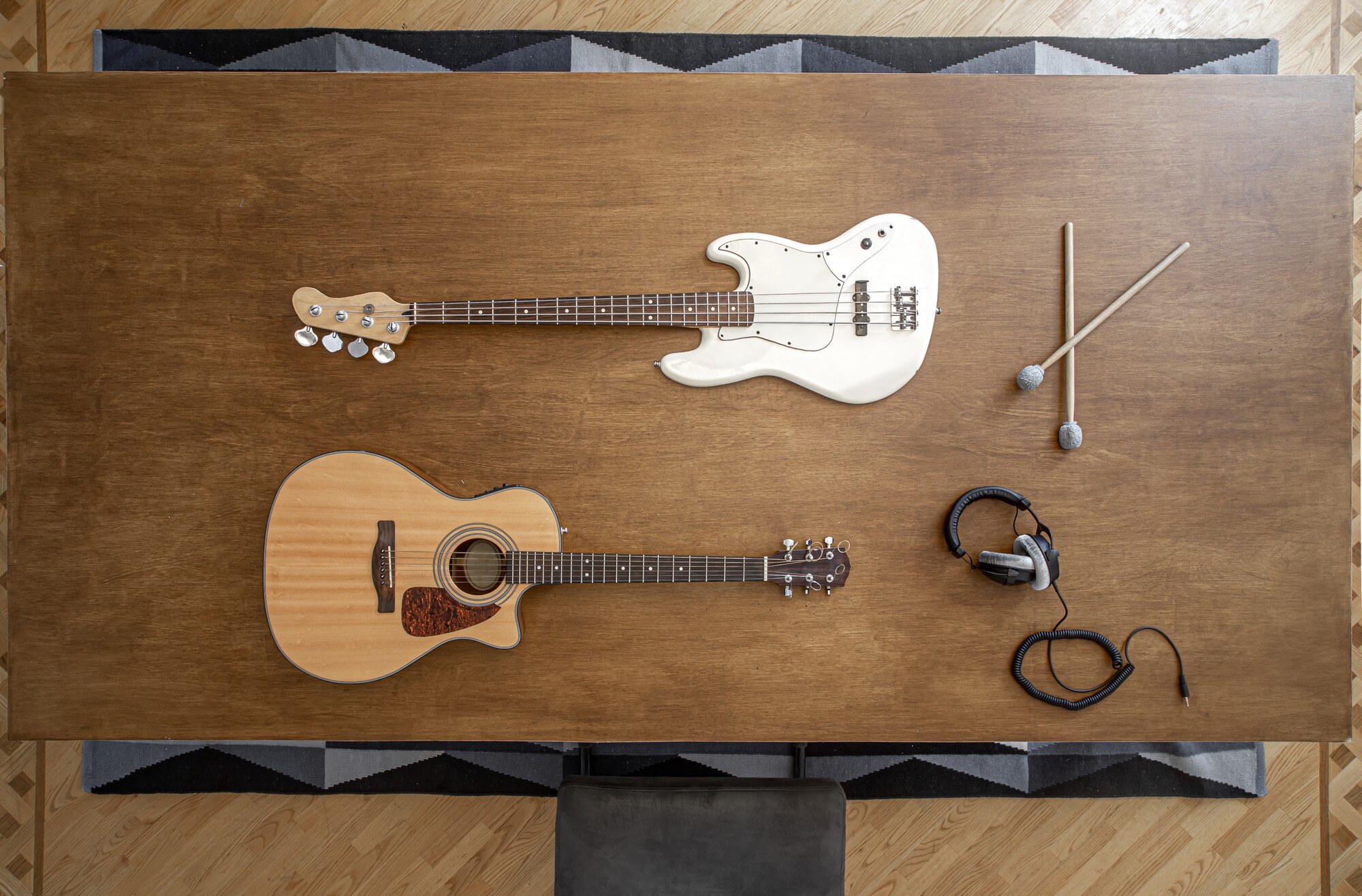
The parts of a guitar fall into three zones: the headstock at the far end, the neck your fretting hand wraps around, and the body that rests against you. Each part does one of three jobs. It holds and tunes a string, it changes how much of the string vibrates, or it turns that vibration into sound.
In This Article
- The Basic Map: Headstock, Neck, and Body
- The Headstock and Tuning Machines
- The Neck, Fretboard, and Frets
- String Names and Numbering
- Parts of an Acoustic Guitar Body
- Electric Guitar Parts and Controls
- Pickguard, Strap Buttons, and Cutaways
- Key Takeaways
- Frequently Asked Questions
- Identify Your Guitar From Top to Bottom
The Basic Map: Headstock, Neck, and Body
Acoustic and electric guitars share the top two zones and split at the body. An acoustic body is a hollow box. The strings shake its top, and the top moves air you hear directly. An electric body is usually solid and makes little sound on its own, so pickups read the strings' motion and send a signal to an amplifier.
That one difference explains nearly every row where the two columns below disagree. Guitar anatomy above the body is almost identical on both types. The guitar body parts are where the designs go separate ways.
| Zone | Acoustic guitar | Electric guitar |
|---|---|---|
| Headstock | Tuning machines, string posts, sometimes truss rod cover | Tuning machines, string posts, often truss rod cover |
| Neck | Nut, fretboard, frets, position markers, neck heel; truss rod where fitted | Nut, fretboard, frets, position markers, neck heel, truss rod |
| Strings | Run from tuning machines to bridge anchors or a tailpiece | Run from tuning machines to bridge anchors, through-body anchors or a tailpiece |
| Body | Soundboard, soundhole, rosette, bridge, saddle, back and sides; bridge pins and bridge plate on pin-bridge designs, tie block on classicals; pickguard, strap buttons and cutaway vary | Pickups, selector switch, volume and tone knobs, bridge with saddles, output jack, strap buttons; separate tailpiece, pickguard, cutaways and vibrato arm vary |
The Headstock and Tuning Machines
The headstock ends the neck and carries the tuning machines. Each machine pairs a knob with a gear that turns a metal post, and the string wraps around that post. Twist the knob one way and the post winds on more string, stretching it tighter, so the pitch climbs. Twist it back and the tension eases, so the pitch drops.
Layout varies by maker. Gibson-style guitars often put three tuners on each side. Fender-style electrics usually line all six up along one edge.
Where the headstock meets the fretboard, each string crosses the nut, a slotted strip that sets string spacing and height. For an open string, the vibrating length runs from nut to saddle. For a fretted note, it runs from the pressed fret to the saddle.
The Neck, Fretboard, and Frets
From the nut down to the body, the parts of a guitar neck decide which note each string plays. The neck heel is the thicker part at the body end of the neck, forming part of the joint that secures the neck to the body. Under your fingers lies the fretboard, a strip of wood on the neck's front, commonly rosewood, maple, or ebony. Thin metal wires called frets cross it.
Press a string just behind a fret and you feel it come down onto the wire, not the wood. That wire becomes the new end of the vibrating length. A shorter string sounds a higher note, one half step per fret.
Between the frets you'll see position markers, usually at frets 3, 5, 7, 9, and 12, with the pattern repeating higher up. The 12th fret often gets a double marker because it sounds the open string an octave higher. Side dots on the neck's edge show the same positions, so you can find them while looking down at the guitar from above.
Hidden inside the neck runs the truss rod, which resists the strings' pull. An adjustable rod sets neck relief, the slight forward bow a neck needs. Adjustment access may be at the headstock, often under a small cover, or at the body end of the neck. On many acoustics, you reach that end through the soundhole.
String Names and Numbering
Standard tuning runs E–A–D–G–B–E from the thickest string to the thinnest, and the numbers run the other way. The thin high E is the 1st string and the thick low E is the 6th, with B, G, D and A numbered 2 through 5 in between. The numbering follows pitch, not position, so the highest-sounding string comes first. In playing position, the 1st string sits nearest the floor. Many players remember the open-string order with the phrase "Eddie Ate Dynamite, Good Bye Eddie."
Parts of an Acoustic Guitar Body
The parts of an acoustic guitar body work as one chain. An open string vibrates between the nut and saddle; a fretted string vibrates between the pressed fret and saddle. That motion passes through the saddle into the bridge. The bridge is glued to the soundboard, the thin top of the body, often spruce or cedar. So with every vibration the bridge rocks the soundboard, and the moving top pushes air.
The back and sides close the box around that air. Air trapped inside resonates with the top and escapes through the soundhole, whose edge is decorated by the rosette. Some acoustics, including archtops, use f-shaped holes instead of one round opening.
Bridge Close-Up
The bridge is the wooden block below the soundhole. Set into it is the saddle, a narrow strip the strings rest on. The saddle marks the far end of the vibrating length, opposite the nut.
How strings anchor depends on the guitar. Most steel-string acoustics use bridge pins to keep the strings' ball ends seated against the bridge plate beneath the soundboard, rather than wedged inside the holes. Nylon-string classical guitars normally have their strings tied around a tie block on the bridge.
Electric Guitar Parts and Controls
An acoustic soundboard vibrates to produce audible sound directly. Electric pickups instead convert string vibrations into an electrical signal, which an amplifier and speaker turn into amplified sound. They sit beneath the strings and use magnets and coils of wire. In some designs, the coils surround metal pole pieces, with a separate magnet underneath the bobbin. A vibrating steel string disturbs the magnetic field, and the coil turns that disturbance into a small electrical signal. Single-coil pickups tend to sound brighter. Humbuckers use two coils wired to cancel hum and usually sound thicker.
Flip the selector switch and you choose which pickup, or which combination, sends that signal. The neck pickup generally sounds rounder and warmer, and the bridge pickup sounds sharper. Roll the tone knob down and the treble drains away, so a bright chord turns dark and muffled. Inside are electric guitar parts with plain jobs. The tone knob is a potentiometer, a variable resistor, working with a capacitor that removes treble. The volume knob is another potentiometer. The signal leaves through the output jack, along a 1/4-inch cable to the amplifier.
Electric Bridge Close-Up
Electric bridges often give each string its own saddle. Stratocaster-style bridges allow individual saddle-height adjustment; Tune-o-matic bridges use two thumbwheels to raise or lower the whole bridge. Moving saddles forward or back sets intonation: how accurately fretted notes stay in tune. Some guitars anchor the strings in a separate tailpiece behind the bridge.
Some bridges include a tremolo system. Pushing its vibrato arm, or whammy bar, bends the pitch of all the strings together.
Pickguard, Strap Buttons, and Cutaways
A cutaway is a scoop cut out of the body beside the neck heel. Without one, the body's upper shoulder gets in the way of your hand near the highest frets. With one, your fingers can reach them.
Strap buttons anchor a strap. Electrics usually have two. Many acoustics have only one at the bottom, and the other end of the strap is tied near the headstock.
The pickguard is usually a plastic plate that protects the finish from pick scratches. On many electrics it also holds the pickups and controls. A guitar without one shows why it matters. Willie Nelson's nylon-string Martin, Trigger, has a hole worn right through its top beside the soundhole after decades of being played with a pick.
Key Takeaways
- Turn one tuner a quarter turn while plucking its string and listen as the pitch follows the tension.
- Press a string behind the 5th fret and look where it touches: the fret wire, never the marker.
- Find out how the strings anchor: bridge pins, tied strings, or a metal bridge with separate saddles.
- Locate truss rod access at the headstock or body end of the neck; on many acoustics, look through the soundhole.
- On an electric, plug in, flip the selector and roll the tone knob down to hear what each control does.
Frequently Asked Questions
What is the head of a guitar called?
The head of a guitar is called the headstock. It carries the tuning machines and the string posts.
What are the dots on a guitar neck called?
They are called position markers, or fret markers. They mark landmark frets, listed in the neck section, so you can find your place quickly. They have no effect on the sound.
What are the metal strips on a guitar called?
The metal strips are frets. Unlike the dots, they change the note: a pressed string stops vibrating at the wire, as the neck section explains.
What are the twisty things on a guitar called?
They are tuning machines, also called tuners, tuning pegs or machine heads. Each one turns a geared post that sets its string's tension and therefore its pitch.
What is the difference between a guitar's bridge and saddle?
The bridge supports the saddle or saddles where the strings rest. It may also anchor the strings, but some guitars use a separate tailpiece. The saddle marks the body end of each string's vibrating length.
Identify Your Guitar From Top to Bottom
Start at the headstock and follow one string down to its saddle, naming each part of a guitar along the way: tuner, nut, frets, bridge. Then find the soundboard and soundhole on an acoustic, or the pickups and controls on an electric. Once you can name every stop on that route, you know how your guitar works.