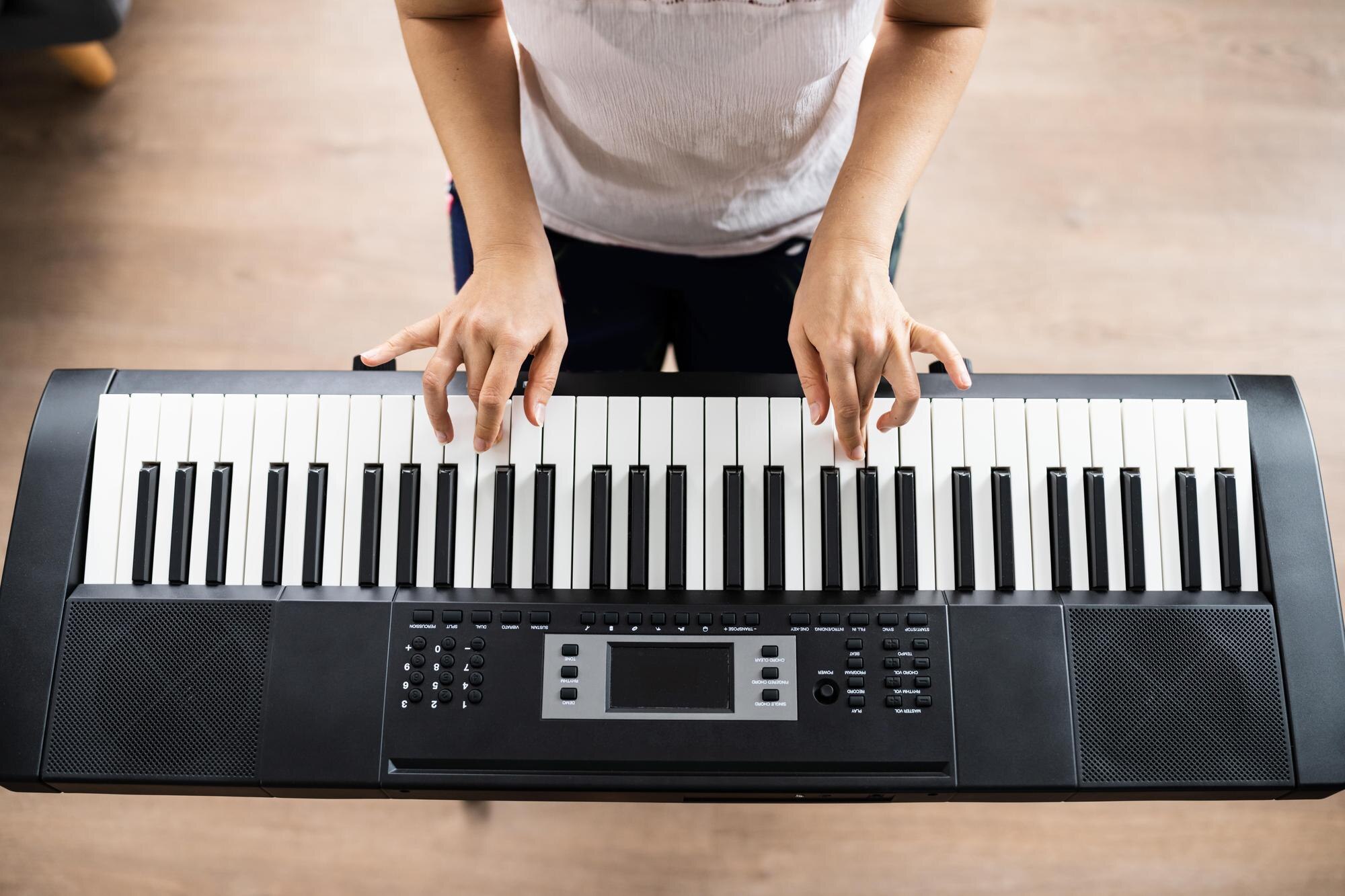
How many keys on a piano? A standard modern piano has 88 keys: 52 white and 36 black, from a low A to a high C. Nearly every upright and grand built today shares that range. That is an odd number to settle on. It is not a whole number of octaves, it starts and ends on different notes, and no committee chose it. The 88-key range became standard, but demand for extra notes continued: Bösendorfer developed its 97-key Imperial for Busoni’s Bach organ transcriptions. Older pianos, a few extended concert models and most smaller digital keyboards break the rule.
In This Article
- Why the Count Is 88
- How the White and Black Keys Are Arranged
- How the Piano Keyboard Grew to 88 Keys
- Uprights, Grands, and Key Count
- Pianos With More Than 88 Keys
- Digital Keyboards With Fewer Keys
- Key Takeaways
- Frequently Asked Questions
- Choose the Range You Need
Why the Count Is 88
The bottom key, A0, vibrates at about 27.5 Hz, not far above the roughly 20 Hz floor of human hearing. Played alone, it sounds less like a pitch than a growl. Your ear identifies the note mostly from its overtones, and the fundamental is closer to something felt than heard. Go much lower and the growl becomes rumble with no clear note in it.
The top key, C8, sits at about 4,186 Hz. It speaks as a bright, short ping that dies almost as soon as it sounds. Above it, notes on such short, stiff strings lose body, and listeners find it harder to hear them as pitches in a melody.
Between those two edges sit a little over seven octaves. Nearly all piano repertoire from the late 19th century onward fits inside them. Once composers wrote to that range, their music kept it in place.
How the White and Black Keys Are Arranged
Piano keys repeat in a pattern of 12: seven white, five black. The unevenness, two black keys and then three, comes from the scale the keyboard was built around.
The white keys play the natural notes A through G, and those notes are not evenly spaced. Most neighbors are a whole step apart, but E to F and B to C are only a half step. A black key fills each whole-step gap with the half step in between. Between E and F, and between B and C, there is no gap to fill. So the black row breaks there.
That break makes the keyboard readable by touch. C sits immediately left of each two-black-key group, so a player can find any note without counting from the end. Across the full span of seven octaves plus a minor third, middle C, or C4, is the 40th key from the left. It sits slightly left of center because the range reaches further up from it than down.
How the Piano Keyboard Grew to 88 Keys
Bartolomeo Cristofori built the first pianos in Florence around 1700. His surviving 1720 piano at the Metropolitan Museum of Art has 54 keys; by the late 18th century, five octaves, or 61 keys, was the usual range. As composers explored a wider compass, builders continued adding notes.
Frame strength was one constraint on development. Builders seeking a more powerful sound needed structures that could withstand greater string tension. Wooden frames limited how far they could go.
Iron helped overcome that constraint. Alpheus Babcock patented a one-piece cast-iron frame in Boston in 1825. Iron framing enabled stronger stringing, greater volume and more stable tuning; it helped the piano develop but did not determine its final key count. Many pianos stopped at 85 keys, with A as their highest note, and some are still around. The move to 88 added three treble notes, A♯7, B7 and C8. By the late 19th century, 88 keys had become standard. It has barely moved since.
Uprights, Grands, and Key Count
A spinet under 4 feet tall and a concert grand about 9 feet long normally have identical key counts. The bigger case buys longer bass strings and a larger soundboard, which give fuller tone and more volume but no extra notes. Grand piano keys and upright keys cover the same span.
You feel the difference in the action. Grand hammers strike the strings from below, and gravity pulls them back down after each blow. Upright hammers swing sideways toward vertical strings, and springs have to bring them back. Most grands also have a double-escapement action, which lets a note sound again before its key has risen all the way.
Under your fingers, that means a grand's repeated notes reset almost on their own. An upright needs the key to come further up before it will sound again.
Pianos With More Than 88 Keys
Bösendorfer's Model 225 has 92 keys, F0–C8; its 290 Imperial has 97, C0–C8. Both extend the bass only. Stuart & Sons has built 108-key pianos spanning C0–B8, adding notes at both ends.
The extra keys provide playable notes beyond the standard range. Bösendorfer identifies works by Busoni, Bartók and Ravel that need its additional bass notes. Extra strings can also contribute sympathetic resonance when their dampers are lifted, even without their keys being played.
Digital Keyboards With Fewer Keys
Common digital sizes include 25, 49, 61, 73, 76 and 88 keys. Smaller boards usually drop notes at the ends while keeping full-width keys, though some compact controllers use mini keys. Typical layouts and documented examples follow; endpoints depend on the model and octave/transposition settings. C4 means middle C. Best uses are suggestions.
| Keys | Lowest–highest note | Octave span | Best use |
|---|---|---|---|
| 25 | C–C; illustrative setting C3–C5 | 2 octaves | Melodies, bass lines, production |
| 49 | C2–C6 example | 4 octaves | Chords and production |
| 61 | Typically C2–C7 | 5 octaves | Introductory pieces |
| 73 | E1–E7 or C1–C7 | 6 octaves | Portable stage playing |
| 76 | Typically E1–G7 | 6 octaves + minor third | Wider two-hand parts |
| 88 | Standard A0–C8 | 7 octaves + minor third | Sustained piano study |
Range examples come from Roland’s AT-75, Korg’s KROME and Pa5X, and Yamaha’s CP73 specifications. Check your model: these are not universal layouts, and the 25-key setting is illustrative rather than a fixed default.
Key count tells you a piano's range; check its action specifications to understand its touch. The Alesis Recital, for example, has 88 full-size keys, so its range is complete. Alesis specifies semi-weighted keys with adjustable touch response.
The mismatch runs the other way too. Some 73- and 76-key stage pianos are fully weighted despite the shorter range.
Key Takeaways
- The 88-key range, A0 to C8, covers nearly all piano music from the late 19th century onward.
- The groups of two and three black keys come from the half steps at E–F and B–C.
- Stronger frames helped the piano develop; composers and builders also shaped its expanding range.
- A bigger case changes tone and volume, not usually key count.
- On digital instruments, range and action are separate specs.
Frequently Asked Questions
How Many White Keys Does a Piano Have?
A standard piano has 52 white keys. They play the natural notes A through G, and both end keys are white.
How Many Black Keys Does a Piano Have?
A standard piano has 36 black keys. They play the sharps and flats in alternating groups of two and three. Add them to the 52 white keys and you reach 88.
Do I Need 61 or 88 Keys?
A 61-key keyboard can serve introductory exercises and pieces within its range. For sustained piano study, especially classical music, choose 88 keys with a weighted hammer action.
How Many Keys Does a Piano Keyboard Have?
Electronic keyboards commonly have anywhere from 25 to 88 keys. Digital pianos meant to replace an acoustic usually offer the full 88.
Does a Physically Larger Grand Piano Always Have More Keys?
No. Baby grands and concert grands normally have 88 keys. Check the model’s specifications for an extended keyboard rather than judging by its length.
Choose the Range You Need
Before choosing a shorter keyboard, compare its lowest and highest notes with the music you want to play. An octave-shift control moves the available pitches up or down; it does not widen the range available at once. Check the full range of both hands throughout the passage to see whether they will still fit.