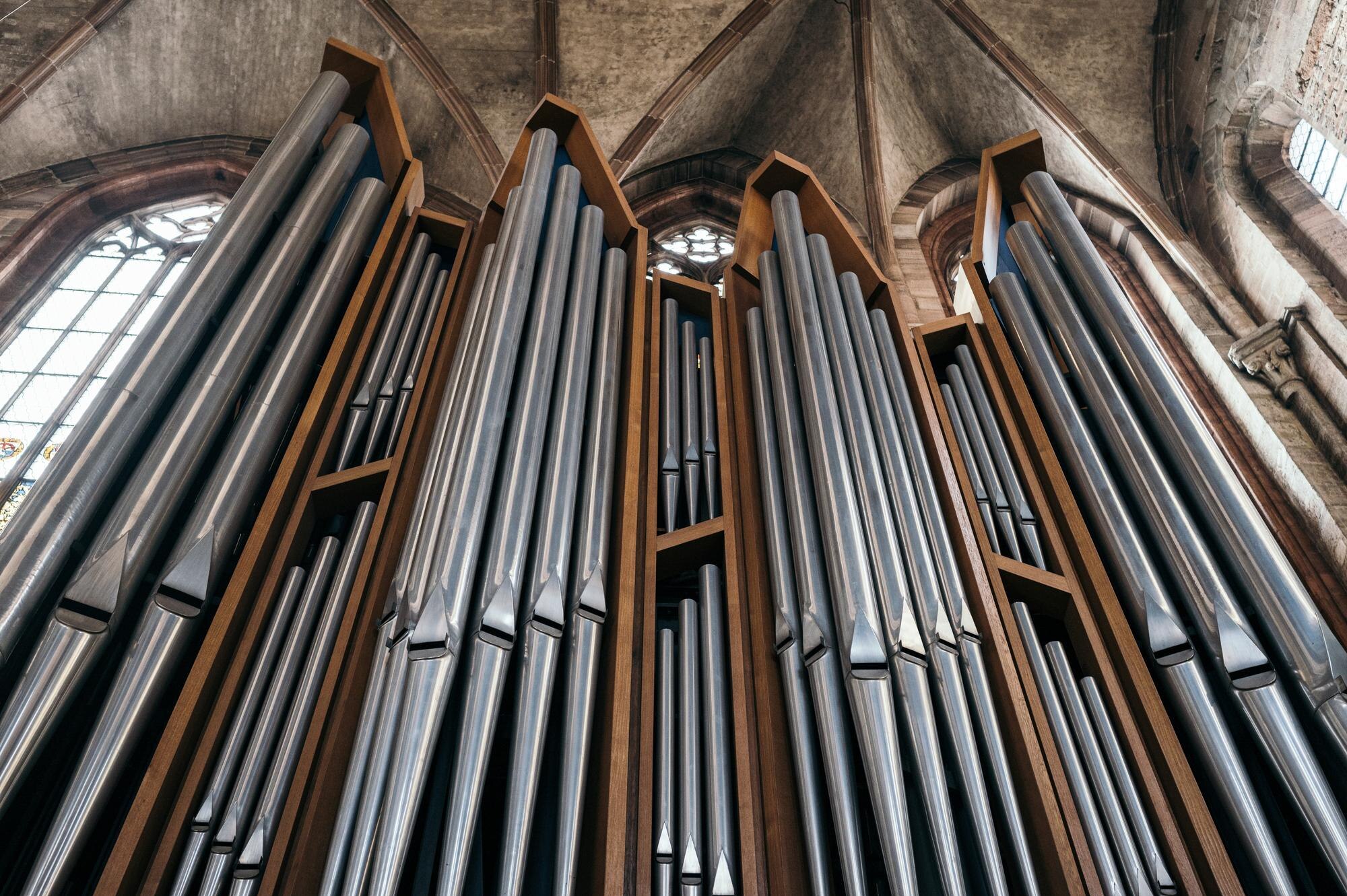
An organ is a keyboard instrument that can hold a note without letting its sound fade. In a pipe organ, pressurized air feeds the pipes the player selects, producing anything from a thin flute-like voice to a bass you may feel through the floor. The force comes from sustained sound: the pipes keep speaking until their air is cut off.
In This Article
- How Air Becomes Sound
- How the Player Controls the Sound
- What Stops Add to Each Note
- How Pipe Length Sets the Pitch
- Why the Sound Feels So Powerful
- How Organs Developed Into Different Types
- Where You Can Hear Famous Organs
- Key Takeaways
- Frequently Asked Questions
- Listen for the Pipes Behind Each Note
How Air Becomes Sound
That air supply is traditionally called wind. An electric blower commonly supplies it, while a reservoir steadies the pressure as the player demands more notes. Wind travels to windchests, chambers beneath the pipes. Key action connects keys to valves, admitting air to the selected pipes when a key is pressed. Stop selection determines which sets of pipes are available; combination action lets the player recall preset groups of stops using controls such as pistons.
Once inside, the wind meets one of two sound-making mechanisms. In a flue pipe, air crosses a narrow opening and excites the air column, much as breath does in a recorder. In a reed pipe, it makes a thin metal tongue vibrate against a matching opening; a resonator above shapes the sound.
Neither needs another strike to keep going. A struck note begins to die away; an organ note can keep pressing back at you.
How the Player Controls the Sound
The console puts that sustained sound under the player's hands and feet. Its hand keyboards are manuals; its foot keyboard is the pedalboard. Each manual usually controls a division, a distinct grouping of pipes. Couplers allow one keyboard to control another division's resources too.
On a three-manual console, a player might carry a melody on the upper keyboard, accompany it on the middle one, then move a hand to the lower keyboard for a contrasting phrase. The feet carry an independent bass line. This is what makes playing the organ demanding: a hand can change keyboards without the bass being allowed to stumble.
Pressing harder does not make a conventional pipe-organ note louder. The player changes the selected pipes or uses a swell enclosure, a chamber with movable shutters around a division. A foot opens those shutters to release more sound into the room. The fingers keep playing.
What Stops Add to Each Note
A stop makes a particular set of pipes available. A rank is a series sharing one tonal character, usually with a pipe for every note. Many stops select one rank; some select several. The chosen combination is the registration.
Suppose a player adds a mixture during a held passage. Several higher-pitched ranks join each note: the melody stays put, but its edge brightens. That brilliance helps a large combination remain clear instead of becoming an indistinct roar.
The contrast depends on what was sounding before. Principal stops, also called diapasons, give the characteristic clear organ tone. Flutes sound rounder; strings have a narrower, brighter color. Reed names such as Trumpet and Oboe suggest their character without promising exact orchestral imitations. Adding a stop changes the voice, not the tune.
How Pipe Length Sets the Pitch
An 8-foot stop label describes pitch level through the approximate length of an open pipe at the bottom of the keyboard. Comparable open pipes of 8 feet, 4 feet and 2 feet can sound successive Cs, each an octave above the last. Actual dimensions vary with design and tuning. Within a rank, the pipes shrink as the notes rise.
Closing the top changes the bargain. A stopped flue pipe sounds approximately an octave below a comparable open pipe of the same length because its air column resonates differently. Its overtones, the higher-frequency components accompanying the fundamental, change too, often giving a hollow, flute-like sound. The acoustic trick is simple: close the top, and a shorter pipe can supply the lower note.
Why the Sound Feels So Powerful
That lower pitch gives the sound its weight. A 16-foot stop sounds an octave below normal keyboard pitch; a 32-foot stop goes another octave lower. At low C, the latter reaches approximately 16 Hz, near the lower limit of human hearing. Its overtones help you recognize the note even when the deepest component registers partly as physical sensation.
The room adds duration. Reverberation consists of repeated reflections that continue after the source stops. In a large church or concert hall, those reflections blend the pipes and prolong a chord. In organs built for such rooms, placement affects how that blend reaches listeners.
The effect depends on the instrument and building. With enough bass reaching your seat, that low C is more than a pitch to identify: it can be a shudder felt through the floor.
How Organs Developed Into Different Types
The hydraulis, credited to Ctesibius of Alexandria in the third century BCE, used water to help regulate air pressure. Its name can mislead: water did not flow through the pipes to make music. Air did. The water supported the wind supply, tackling the same need for steady pressure described above.
That distinction connects the ancient machine to later pipe organs. Organs became central to European church music and reached a major flowering in the Baroque era, alongside increasingly varied pipework and console controls. Johann Sebastian Bach's organ works remain closely associated with that tradition.
Other organ instruments sustain sound without conventional pipework. Reed organs and harmoniums use free reeds, vibrating tongues moving through closely fitted openings. The Hammond organ, introduced in 1935, generates tones with electromechanical tonewheels. Digital designs use electronic sound generation, often recorded pipe sounds or mathematical models. A building full of pipes is no longer necessary.
Where You Can Hear Famous Organs
The great organ at Notre-Dame de Paris and the Royal Albert Hall organ in London put pipe sound into a cathedral and a concert hall. The Wanamaker organ in Philadelphia occupies a department-store building. Its department-store performances brought organ music into the same space as shoppers: a full organ could sound above people going about an ordinary purchase.
That unexpected setting makes the point especially clearly: architecture is part of what you hear. A seat some distance from the pipes lets their voices combine; sitting close to one division can emphasize it over the others. Choose music with changes of registration to hear more than the instrument's loudest voice.
Key Takeaways
- Follow the wind supply to understand how a pipe speaks.
- Watch the player's feet as well as the hands to follow independent parts.
- Treat a change of registration as a change of voice.
- Read stop lengths as pitch clues, not exact measurements of every pipe.
- Give the room's reverberation time to reveal itself after a release.
Frequently Asked Questions
Is the organ difficult to play?
Yes, coordinating independent hand and foot parts takes practice. Piano experience helps with keyboard reading, but pedal technique and registration need separate learning.
Is an organ a piano?
No, an organ and a piano produce sound differently. A piano's hammers strike strings, so its notes decay even while the keys remain down.
What is the most famous organ music?
Bach's Toccata and Fugue in D minor, BWV 565, is among the most recognizable organ works. Its dramatic opening is familiar from films and popular culture.
What is an organ instrument?
An organ is a keyboard instrument capable of sustaining tones and combining distinct tone colors. An organ musical instrument can therefore be identified by how it controls sound, without assuming that every example contains pipes.
Can one key sound several pipes at once?
Yes, one key can sound several pipes when the appropriate stops are selected. A mixture can supply that layered effect through a single stop control.
Listen for the Pipes Behind Each Note
For your first focused listen, choose a performance with quiet passages and full-organ sections. Follow one melody through a registration change. If its pitch stays steady while its color changes, you have heard the player alter the resources behind the notes.
Then pay attention to a chord's release. The lingering sound belongs to the room after the pipes stop speaking; separating those two sounds helps you understand why the same instrument can feel clear nearby and blended farther away. If you want to hear individual colors, favor quieter contrasts. If you want to understand the organ's scale, include the bass-heavy passages too. Use contrast, not maximum volume, as your guide.