Indian classical music builds melody through raga and rhythm through recurring cycles called tala. Its two main branches are Hindustani, associated chiefly with northern India, and Carnatic, associated chiefly with southern India. In a concert, a sustained note can hang above the drone before a drum stroke gives it a sudden landing. Follow that movement from held pitch to rhythmic arrival: it connects the history, forms and instruments below.
In This Article
- How the Traditions Developed
- What a Raga Lets You Hear
- How the Rhythmic Cycle Works
- What Happens in a Hindustani Performance
- Why Compositions Matter in Carnatic Music
- Which Instruments Make Which Sounds
- Key Takeaways
- Frequently Asked Questions
- Choose a Recording and Listen Closely
How the Traditions Developed
Classical music in India developed through religious practice and regional cultures, with courts providing patronage. The Vedas preserve sacred chanting; Bharata’s Natya Shastra discusses music alongside drama and dance. Sharngadeva’s 13th-century Sangita Ratnakara addresses musical theory before the modern traditions became clearly differentiated. These texts trace ancient Indian music through ideas about how sound works and what performers do with it.
Performance gives that history a human scale. Tansen sang at the Mughal emperor Akbar’s court; Akbar’s court historian Abu’l-Fazl singled him out among the imperial musicians. Tansen is closely associated with dhrupad, a form whose sustained notes expose each shift of pitch. Court patronage put such vocal skill before powerful listeners. Across South Asia, encounters with Persian and Islamic court cultures helped shape Hindustani music, while Carnatic music developed a strong composition-centered heritage in the south. The music Indian audiences hear today carries those centuries of exchange into living performance.
What a Raga Lets You Hear
A raga is a melodic framework with characteristic phrases, important notes and conventions for moving between them. Its identity lies in those movements: two ragas can use similar notes yet differ in how a musician approaches and connects them. A singer’s slide is part of the musical meaning, not decoration added afterward.
Yaman, traditionally associated with evening in Hindustani music, makes that distinction audible. Its raised fourth offers a bright point of tension against the tonal center. A singer can linger there, then move into a familiar phrase that settles the line. That evening association gives you a setting; the performance gives it a particular emotional weight. Follow the return of one phrase and you begin to recognize the raga through sound.
How the Rhythmic Cycle Works
Tala organizes rhythm into a repeating cycle with internal divisions. Hindustani teental has 16 beats grouped 4+4+4+4. Its first beat, sam, is a meeting point toward which a performer can steer a phrase, even while crossing the cycle’s divisions.
Those divisions can also be visible. Carnatic Adi tala commonly has eight beats grouped 4+2+2, and performers often mark its structure with hand gestures. The hands preserve the framework as the melody and percussion grow denser.
In teental, that density can make the next arrival feel briefly out of reach. The singer stretches a phrase; the tabla answers with strokes that press against it. Then both land on sam. The cycle snaps shut.
What Happens in a Hindustani Performance
An instrumental alap explores the raga without a fixed metrical cycle. Notes have space around them, and a slide can occupy your attention for its whole length. Jor introduces a steady pulse: the space begins to tighten. In jhala, rapid rhythmic activity, often driven by drone-string patterns on plucked instruments, turns that pulse into a race of repeated attacks.
A gat, a composition within a tala, usually brings percussion into the exchange. Its recognizable melody gives improvisation something to depart from and return to. The drama shifts from the gathering pulse to the timing of those returns.
Vocal forms offer different kinds of drama. Dhrupad joins sustained tonal exploration to disciplined rhythmic work, often accompanied by pakhawaj. Khayal develops a composition through expansive improvisation and elaborate melodic passages. Thumri, commonly described as semiclassical, brings words to the foreground: a singer can turn a short phrase over repeatedly, changing its expressive weight.
Why Compositions Matter in Carnatic Music
Carnatic improvisation grows from a strong composed repertoire. The Carnatic Trinity—Tyagaraja, Muthuswami Dikshitar and Syama Sastri—created kritis that remain central to concerts. A kriti is a song whose sections support expressive delivery and elaboration; its text often expresses devotion.
Tyagaraja’s Endaro Mahanubhavulu opens with a salutation that translates as “Many are the great souls; my salutations to them all.” The song is in Sri raga. Its act of reverence gives the musical line a purpose: the singer addresses others, and each return to the words renews that address.
A varnam may open a concert, presenting characteristic raga movements with rhythmic precision, while kritis generally supply much of the program. Ragam-tanam-pallavi makes development itself the main event. Raga exploration leads into pulsed tanam, then into work around a composed melodic line within a tala. That short line becomes an anchor for increasingly elaborate invention.
Which Instruments Make Which Sounds
Choose an instrument first by the kind of movement you want to follow. Plucked strings reveal the attack of a note; bowed strings and wind instruments let you follow its sustained shape. Percussion draws attention to timing, while the drone supplies a pitch reference beneath the changing melody, without a sequence of changing chords. These sounds also appear beyond classical performance. Folk music is rooted in regional and community traditions, while Bollywood music is made for Hindi cinema and draws on many styles. Both can use classical influences without following the extended raga development described above. The table separates those roles and gives each sound a listening target.
Indian classical music instruments: sounds, roles and listening cues
| Instrument | Main classical tradition | Musical role | Characteristic sound | Best listening focus |
|---|---|---|---|---|
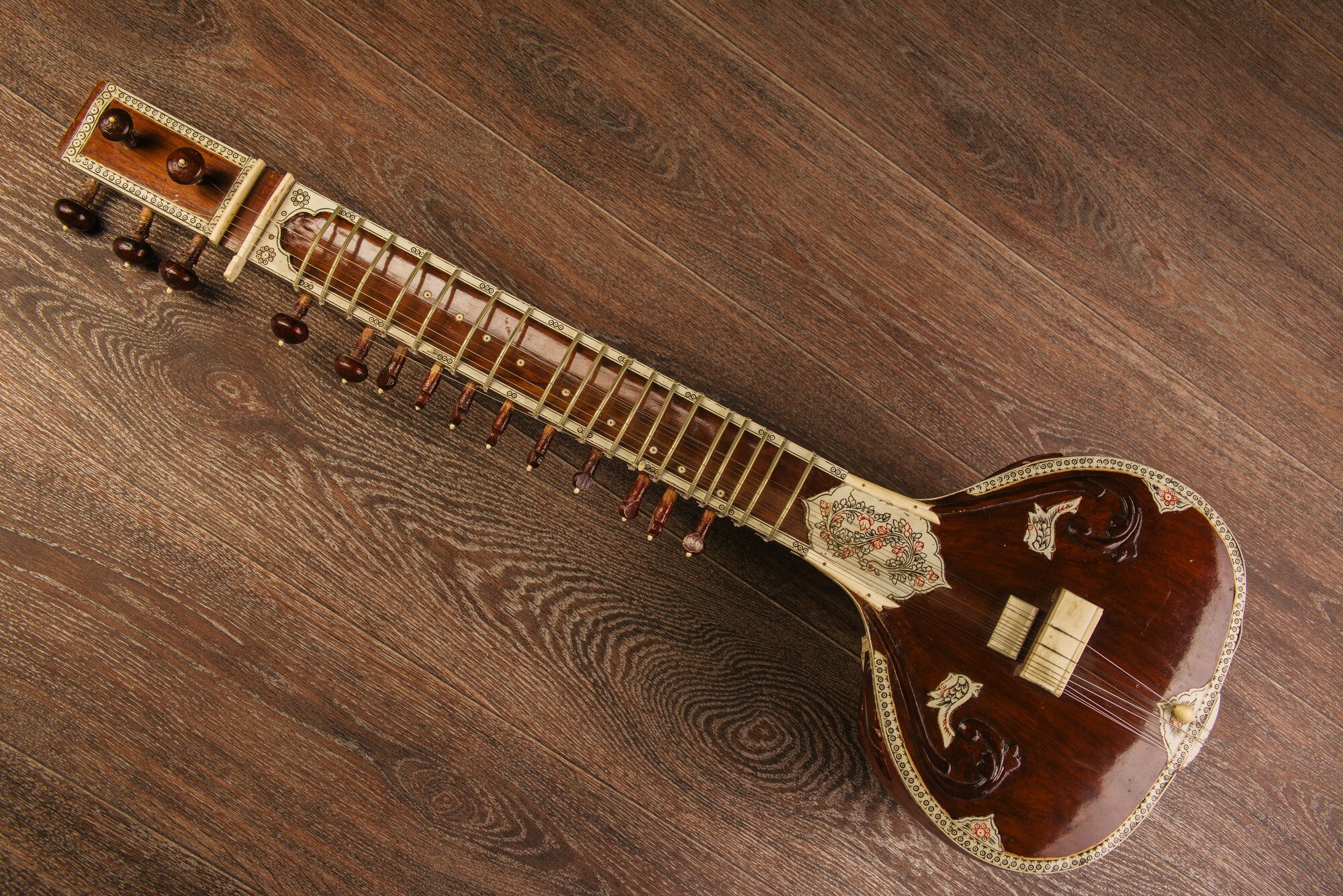
| Sitar | Hindustani | Melody | Bright plucked notes with a buzzing edge and sympathetic-string resonance | Hear notes bend upward after the initial pluck |
| Sarod | Hindustani | Melody | Metallic plucked attack with smooth, fretless slides | Follow slides connecting pitches without separate plucks |
| Saraswati veena | Carnatic | Melody | Rounded plucked tone with buzzing sustain | Listen for gamaka: pitch bends and oscillations shaping a phrase |
| Violin | Carnatic; also Hindustani | Melody and melodic accompaniment | Sustained bowed tone with connected pitch slides | Compare the violin’s answering phrases with a vocalist’s line |
| Bansuri | Hindustani | Melody | Airy bamboo-flute tone with flowing, breath-shaped phrases | Hear pauses for breath and contrasts between low and high registers |
| Shehnai | Hindustani | Melody | Penetrating double-reed tone with a nasal edge | Follow long held notes and ornamented turns |
| Tabla | Hindustani | Percussion | Crisp strokes on the smaller drum; bending bass tones on the larger drum | Track the repeating tala cycle and contrasting drum syllables |
| Mridangam | Carnatic | Percussion | Resonant bass strokes and sharp, pitched treble strokes | Hear rhythmic exchanges and the tani avartanam percussion solo |
| Tanpura | Hindustani and Carnatic | Drone | Continuous overlapping plucked tones with a buzzing halo | Identify the repeating pitch reference beneath melody; it does not carry the tune |
Key Takeaways
- Follow a returning phrase to begin recognizing a raga.
- Keep the cycle in mind when percussion and melody pull apart.
- Use a composition’s returns to follow the performer’s departures.
- Folk and Bollywood music can share classical influences while belonging to distinct traditions.
- Choose a sound you enjoy, then give one performance your attention.
Frequently Asked Questions
What is Indian music called?
Indian music has no single name covering all its forms. You may hear classical Indian music called Shastriya Sangeet; Marg Sangeet is a related historical term associated with the learned or classical tradition.
What is the most famous Indian classical music?
There is no single universally recognized “most famous” work or genre. Ravi Shankar’s sitar performances brought the northern tradition to many international listeners, while familiar compositions and vocal genres vary by region and audience.
What are 10 famous ragas in Indian classical music?
Ten well-known ragas are Yaman, Bhairav, Bhairavi, Darbari Kanada, Malkauns, Bageshri, Kalyani, Shankarabharanam, Kharaharapriya and Todi. The selection spans both traditions, where a shared or similar name does not always indicate the same melodic framework.
Who are 10 famous Indian classical musicians?
Ten widely known musicians are Ravi Shankar, Ali Akbar Khan, Vilayat Khan, Bhimsen Joshi, Kishori Amonkar, Zakir Hussain, M. S. Subbulakshmi, Anoushka Shankar, Kaushiki Chakraborty and Bombay Jayashri. Compare Ali Akbar Khan’s sarod with Subbulakshmi’s singing: the sarod’s pluck gives a phrase a distinct edge, while a sung line carries vowels through its changing pitches.
What are the key differences between Carnatic and Hindustani music?
Carnatic music places compositions centrally, while Hindustani genres often give extended raga development greater prominence. Beyond the regional differences above, ornamentation and rhythmic development differ: Carnatic gamaka can be essential to a note’s identity, while northern genres have characteristic slides, oscillations and rapid passages. Teaching conventions also differ.
What are some traditional Indian musical instruments?
Traditional instruments include the strings, winds and drums in the table, plus the pakhawaj, associated especially with dhrupad. For contrasting sounds, compare the bansuri’s breath-shaped phrases with the shehnai’s penetrating double-reed tone.
Choose a Recording and Listen Closely
Choose voice if words and breath hold your attention; choose an instrumental performance if you want to follow pitch without lyrics. Kaushiki Chakraborty offers an entry into Hindustani singing, and Bombay Jayashri into Carnatic singing. For sitar, Anoushka Shankar’s classical raga performances suit listeners drawn to plucked strings; her catalog also includes cross-genre projects.
For a first recording today, choose M. S. Subbulakshmi singing Tyagaraja’s Endaro Mahanubhavulu. The composition discussed above gives you something specific to follow: the return of its salutation. Play the whole track before comparing versions. Keep your attention on her voice, then replay it for the accompaniment. This is a direct way into Carnatic music through one singer and one composed song.