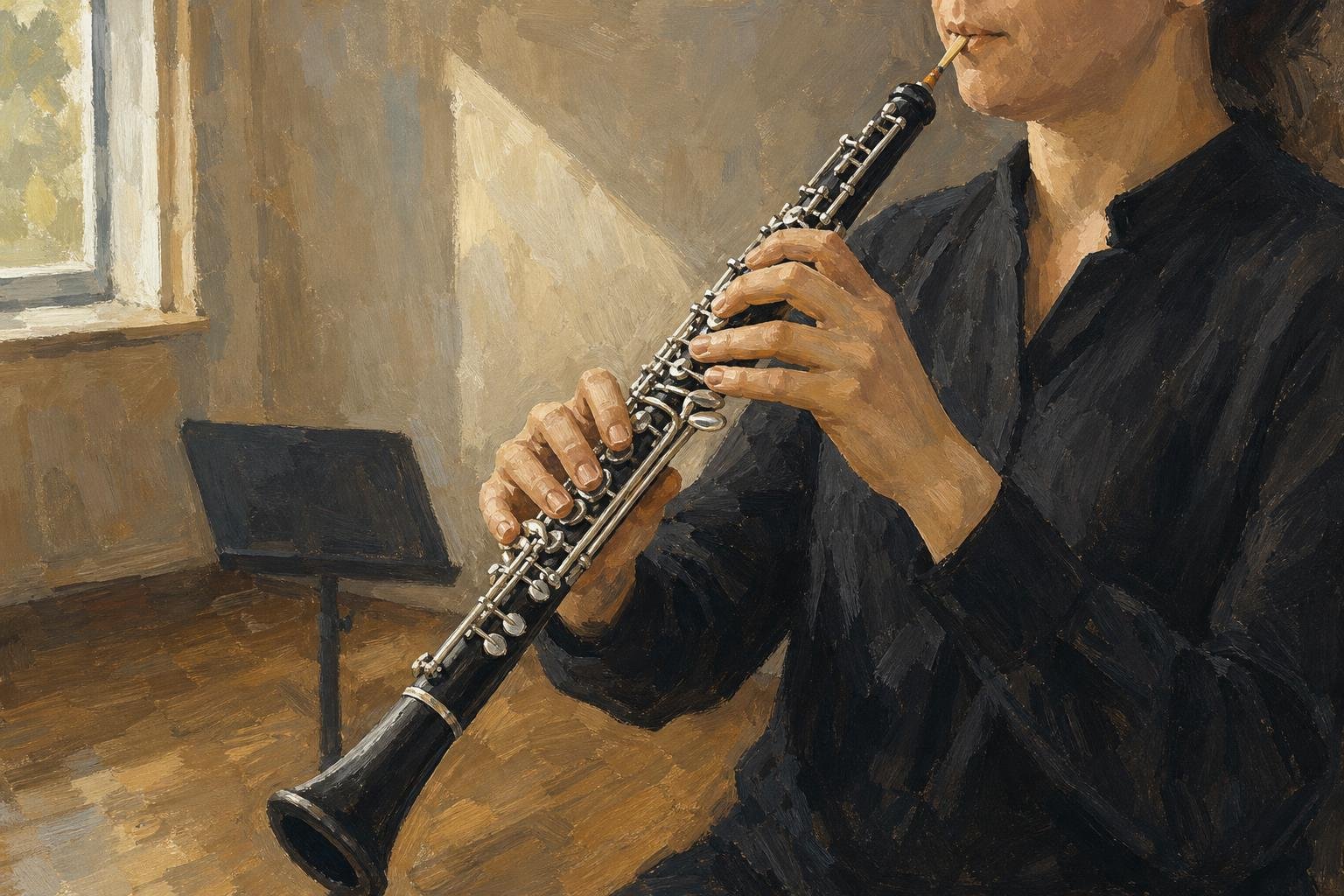
The oboe instrument is a double-reed woodwind whose clear, penetrating voice can cut across an orchestra. Its sound begins with two small blades of cane vibrating together as the player blows between them. That tiny opening gives the instrument much of its character, and makes learning to control the reed central to playing it.
In This Article
- What Does an Oboe Look Like?
- How Do Its Parts Work?
- What Gives It Its Distinctive Sound?
- Where Will You Hear It in an Orchestra?
- How Did the Oboe Develop?
- What Does a Beginner Need to Learn and Maintain?
- How Much Should You Budget?
- Key Takeaways
- Frequently Asked Questions
- Listen Closely Before Choosing Your Instrument
What Does an Oboe Look Like?
The modern oboe has a slender, usually dark body covered with silver-colored keys. A gently flared bell finishes the bottom; a thin reed projects from the top, without the separate mouthpiece you see on a clarinet. For storage, the body separates into an upper joint, a lower joint and the bell.
The body is often grenadilla wood. Resin student models provide a synthetic alternative, particularly where temperature and humidity vary, and some instruments combine materials. Around that body, the keywork forms a close-fitting network of levers and finger plates.
How Do Its Parts Work?
The reed’s two shaped cane blades are bound onto a small metal tube called a staple, which fits into the upper joint. Air passing between the blades makes them vibrate and sets the air column inside the instrument into motion. Small changes in the reed’s shape or condition can change how readily a note starts.
That air column occupies a conical bore: a passage that gradually widens toward the bell. Near the top, it can measure only about 0.16 inch across. Opening tone holes changes the effective length of the vibrating column and therefore its pitch.
The keys bring otherwise awkwardly placed holes within reach of your fingers. Octave keys help notes speak in the higher register. The mechanism serves the air column, not the other way around.
What Gives It Its Distinctive Sound?
The oboe sound is rich in upper harmonics, the higher-frequency components that accompany a note’s fundamental pitch. They give its tone an audible edge: an orchestral melody can remain distinct without the oboist simply playing louder. In a slow phrase that edge can sound plaintive; in quick articulation it becomes crisp.
Low notes have a weighty, reedy buzz. Higher notes sound narrower and more piercing, with less of that low-register weight. The standard range runs from B-flat below middle C to roughly three octaves above it; the upper limit depends on the player and instrument.
Hearing an oboe sustain a note also reveals changes within a single pitch. The player’s embouchure, or lip position and pressure around the reed, shapes its color. Breath support and the mouth’s internal shape contribute too. One held note need not stay the same shade throughout.
Where Will You Hear It in an Orchestra?
Before the music begins, the oboe normally gives the orchestra its tuning A. A4 = 440 Hz is a common reference pitch. The oboist sounds the note and the other players match it: its stable, clearly audible tone gives the ensemble a reference everyone can hear. The oboist must still control that pitch carefully.
Once the orchestra is playing, the same clarity makes the oboe a prominent solo voice. In the second movement of Tchaikovsky’s Symphony No. 4, its solo carries an expressive melody directly to the listener.
For more extended listening, Mozart’s Oboe Concerto in C major, K. 314, pairs singing phrases with agility. Richard Strauss’s Oboe Concerto in D major, written in 1945, demands long, flowing phrases. Compare how clean articulation works in Mozart with the sustained breath control Strauss requires.
How Did the Oboe Develop?
The oboe developed in 17th-century France from the shawm, an earlier double-reed instrument with a loud, coarse voice suited to outdoor playing. Its French name, hautbois, means “high wood.” French makers reshaped the body and reed for a more controlled sound suited to indoor ensembles, including music at the court of Louis XIV.
That move indoors changed what players needed: a voice that could blend with an ensemble while retaining its clarity. The oboe became established in orchestras during the Baroque period. Later makers added keys and refined the mechanism, making fingering more reliable across different musical keys. The modern instrument’s elaborate keywork grew from that practical need.
What Does a Beginner Need to Learn and Maintain?
Your first task is to coordinate steady air with relaxed, controlled lips. The oboe uses relatively little air, but the reed creates substantial resistance. Biting to force a note out works against that control; a teacher can show you how to support the sound and release unused air between phrases. Suitable reeds make the task easier.
After playing, remove the reed and swab moisture from the body with an oboe-specific swab. Follow its instructions: the narrow passage can trap an unsuitable or incorrectly used swab. Let the reed dry in a ventilated reed case, wipe moisture from the exterior and put the instrument away.
Avoid sudden temperature changes, especially with wood. Bent keys, leaking pads and persistent mechanical faults belong with a qualified repair technician, not a beginner’s repair kit.
How Much Should You Budget?
For a new oboe in 2026, budget about $1,800–$4,100 for a student model or $3,600–$5,600 for an established intermediate model. Professional models generally start around $6,000. Prices vary by model, seller and condition.
The useful distinction is what each level lets you play and what care it requires.
Choosing an oboe: student, intermediate and professional options
| Oboe option | Best for | Pros | Cons |
|---|---|---|---|
| Student oboe — resin body | Beginners; school ensembles; players needing a durable first instrument | Resin avoids wood-body cracking; lighter keywork on simplified models | Simplified keywork may omit low B-flat or left-hand F, limiting the available range or fingerings |
| Student oboe — wooden body | Beginners who can maintain a wooden instrument and control storage conditions | Grenadilla body offers a traditional wooden-oboe response; available with beginner-focused keywork | Wood can crack with moisture or temperature stress; student keywork may limit advanced passages |
| Intermediate oboe | Advancing students tackling orchestral parts, auditions and more demanding repertoire | Typically adds left-hand F and low B-flat; some models include a third-octave key | Keywork is not standardized by level; the specific keys matter more than the category name |
| Professional oboe | Conservatory students, orchestral players and advanced soloists | Expanded keywork; options can include third-octave, low B-flat resonance and additional trill mechanisms | Higher purchase cost; complex mechanisms require specialist adjustment; wooden bodies need careful moisture management |
F. Lorée, Marigaux, Howarth and Yamaha are well-known manufacturers. A model’s response matters more than its badge. For a used instrument, a teacher or repair technician’s assessment can expose worn mechanisms before they become an expensive repair bill.
Servicing belongs in the budget, but reeds are the recurring cost that is easy to overlook. The purchase price buys the instrument, not a lasting supply of playable reeds.
Key Takeaways
- Choose a first instrument for dependable response and comfortable keywork.
- Treat reed suitability as part of learning, not a separate accessory decision.
- Build drying and swabbing into every practice session.
- Leave mechanical repairs to a specialist.
- Reserve money beyond the purchase price for ongoing playing costs.
Frequently Asked Questions
Is the Oboe the Hardest Instrument to Play?
The oboe is demanding to learn, especially because of reed control. A changing reed response can make identical fingerings feel different from one session to the next. Guidance helps you separate a technique problem from a reed problem.
How Much Does a Decent Oboe Cost?
In 2026, a decent new student oboe costs about $1,800–$4,100, while an established intermediate model costs about $3,600–$5,600. For a beginner, decent means that it seals properly and responds consistently. Reeds and servicing add to that total.
What’s the Difference Between an Oboe and a Clarinet?
An oboe uses a double reed, while a clarinet uses one reed attached to a mouthpiece. The clarinet has a largely cylindrical bore. The common B-flat clarinet also transposes, while the standard oboe plays at concert pitch.
What Is Another Name for the Oboe?
Hautbois is the French name and the source of the English word “oboe.” The English horn is a lower-pitched relative, not another name for the same instrument.
Why Is the Oboe So Beautiful?
Its vocal quality and expressive changes within a phrase give the oboe much of its appeal. A clearly defined tone can make even a quiet melody feel personal and direct.
Is the Oboe Harder Than the Clarinet?
The oboe’s reed control is often less forgiving for beginners than the clarinet’s. Clarinet players face their own difficulties with register changes and tone control. Neither instrument removes the need for regular practice.
Listen Closely Before Choosing Your Instrument
Begin with the Tchaikovsky solo mentioned above, then arrange a first lesson. Follow how the melody moves through a phrase, and decide whether that voice is one you want to work toward yourself.
In the lesson, concentrate on producing one steady tone before worrying about a tune. Feel the reed’s resistance and learn how your lips affect its response. A teacher can help you recognize the difference between supporting a note and squeezing it into existence. If you enjoy that close control over a sustained sound, the oboe offers a reason to persist through its early difficulties. Make the first lesson your next step.