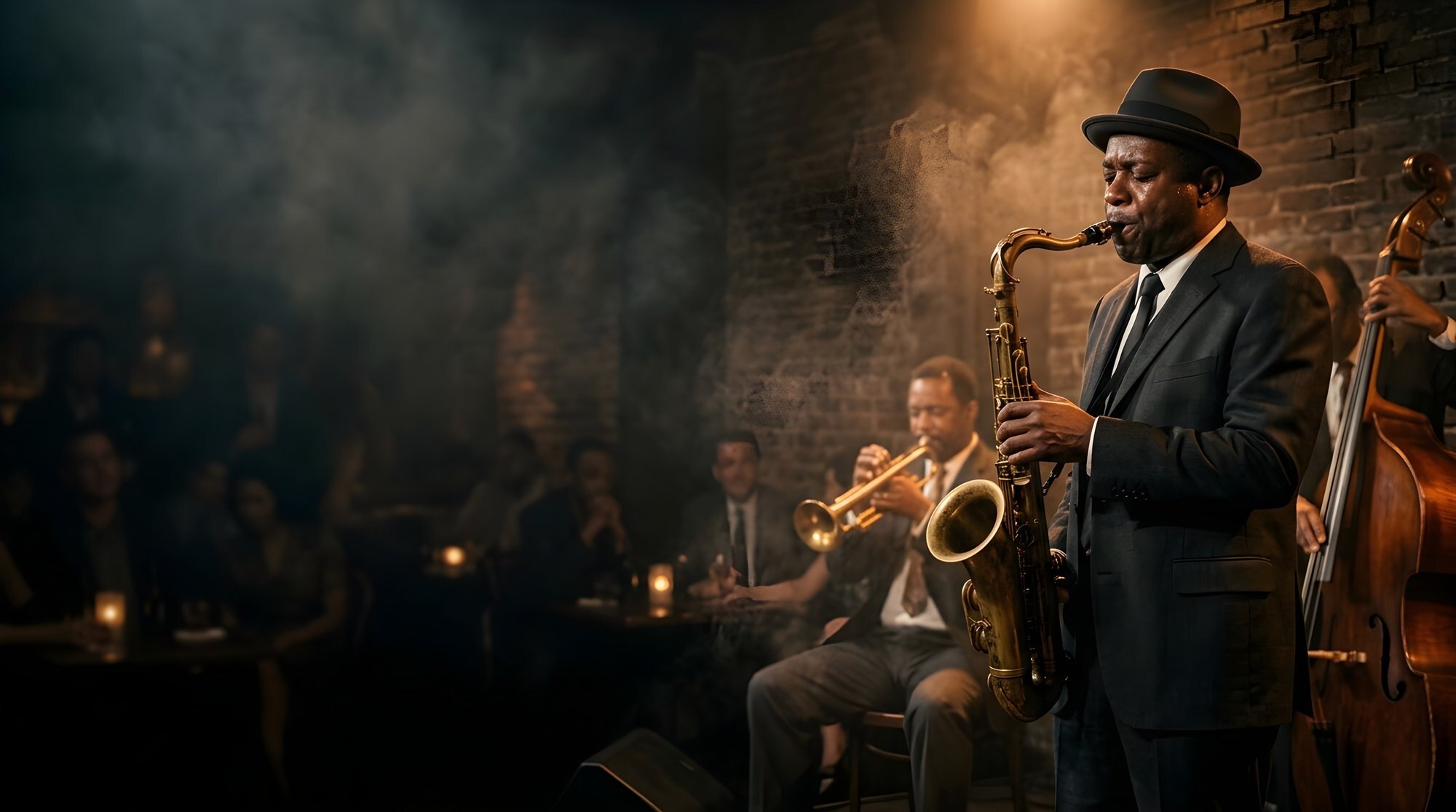
Bebop jazz is the small-group jazz language Charlie Parker and Dizzy Gillespie helped shape in the United States during the early to mid-1940s: quick-turning melodies, adventurous harmony, and solos that pull against a steady beat. In their fast performances, saxophone and trumpet race through a tune together, then separate into sharply individual voices.
That change from shared melody to personal invention gives the music its drama. The sections below follow it from the sound itself to the clubs where musicians developed it, the borrowed foundations of their tunes, and recordings where you can hear the exchange at work.
In This Article
- What Bebop Sounds Like
- How the Music Took Shape
- How Musicians Built New Tunes
- The Artists Who Shaped the Sound
- What the Rhythm Section Does
- Recordings to Begin With
- How to Follow a Performance
- Key Takeaways
- Frequently Asked Questions
- Listen for the Musical Conversation
What Bebop Sounds Like
A horn line skitters across the beat, catches an accent, and keeps going where you expected it to stop. The bass continues its steady tread underneath. Then the horn leaves a gap, and a piano chord or drum accent snaps into the opening. Bebop gets much of its energy from that friction between a dependable pulse and phrases that refuse to sit squarely on it.
Those phrases often contain streams of eighth notes, but the notes do not arrive with equal weight. One gets a hard accent; another becomes a passing flicker. A phrase can begin between beats and cross a bar line without pausing. Its ending may land early, leaving the rhythm section to carry the next beat alone. The line has momentum even when the player falls silent.
That momentum also comes from harmony. A soloist reaches beyond a chord’s basic notes, drawing out a brighter or harsher sound, or briefly suggests another chord against the one underneath. The tension makes the eventual arrival matter. A short phrase can carry that whole movement: a note that rubs, a turn, then release.
A typical group puts saxophone or trumpet in front of piano, bass, and drums, sometimes with two horns sharing the melody. Compared with the section-by-section writing of a big band, this setting exposes small decisions. A pianist’s abrupt chord is right there beside the horn. Nothing needs to be loud to change the direction of the music.
How the Music Took Shape
The players brought swing-era experience into this smaller, more exposed setting. Parker developed his ideas in Kansas City and on the road; Gillespie worked in major dance bands. They knew how to carry a solo through a popular song and how to make a blues phrase speak. Their experiments stretched that working knowledge into sharper accents and more demanding harmonic movement.
After regular jobs, New York musicians gathered at Minton’s Playhouse and Monroe’s Uptown House in Harlem. At Minton’s, pianist Thelonious Monk and drummer Kenny Clarke were part of the house band in 1941. An after-hours session put a visiting horn player alongside musicians who could answer an unexpected phrase immediately. The club offered room to pursue an idea beyond the arrangements and schedules of dance-band work.
That freedom had teeth. A familiar song could become a test of how confidently someone handled the chords, especially when the accompaniment changed the accents beneath them. The musicians shared a working vocabulary, but they also pushed one another. Horn phrasing, piano voicings, and drum patterns developed through the same exchanges, then traveled with the players into other bands and sessions.
Much of that exchange happened beyond the reach of commercial records. The American Federation of Musicians’ recording ban began in 1942 and restricted instrumental recording during a crucial stretch of the music’s development. The surviving records catch portions of the process; they cannot reproduce every late-night experiment.
By the mid-1940s, recordings carried the new language to a wider audience. Its names, “bebop,” “rebop,” and the shorter “bop,” drew on scat-style syllables associated with its rhythmic phrases. The words have a percussive bite. Small-group performances increasingly rewarded concentrated listening to individual invention, while swing continued and the dance-band musicians’ command of the beat remained inside the new music.
How Musicians Built New Tunes
The musicians often put a new melody over chords they already knew. The term for that is a contrafact. Think of the melody as the part you could sing and the chord changes as its supporting route: replace the first, keep the second, and a familiar song becomes the foundation of a different composition.
Parker’s “Ornithology,” recorded in 1946, follows the changes of “How High the Moon.” His “Ko-Ko,” recorded in 1945, draws on “Cherokee.” In “Ko-Ko,” the introduction and closing material make the connection less obvious than it would be in an ordinary performance of the older song. The borrowed route supports a new musical identity, with its own demands on the players.
Borrowing had a business side as well as a musical one. Under U.S. copyright practice, a chord progression by itself generally does not receive copyright protection. Writing a new melody over existing changes could therefore produce a separately credited composition instead of a recording of the original song with royalties owed for that composition. That distinction gave players a financial reason to write, although the borrowing itself did not guarantee income or settle every copyright question.
The musical advantage was immediate. At a session, players could use George Gershwin’s “I Got Rhythm” changes without learning a fresh harmonic sequence. These “rhythm changes” offered shared terrain beneath melodies that could sound fiercely unfamiliar to an outsider. The musicians knew where the turns were. They could spend their attention on what to do at each turn.
The 12-bar blues provided another durable foundation. Both kinds of framework repeat in cycles; the larger pattern is the tune’s form, and one complete trip through it is a chorus. A soloist might take several choruses, changing the route through the same harmonic landmarks each time. One phrase can return with a new ending. An expected resolution can be delayed. The repeated structure gives those choices consequences: you remember where the player went before and hear the next chorus answer it.
The Artists Who Shaped the Sound
Charlie Parker’s alto saxophone made speed sound like speech. His lines joined fluent harmonic movement to emphatic rhythmic placement and a deep command of the blues. Follow the ends of his phrases: even a rush of notes tends to arrive with punctuation. The strength comes from where he places the arrival, not simply from how much he fits before it.
Dizzy Gillespie’s trumpet cuts through the ensemble with brilliant articulation and a commanding upper register. Against Parker’s flowing alto, its attacks give the shared melodies a hard edge. Gillespie also carried the language into composition, arranging, and bandleading. His work with percussionist Chano Pozo brought Afro-Cuban rhythmic ideas into modern jazz, extending the rhythmic possibilities of the bands he led.
Those possibilities depended on players who could shape the spaces around a horn. Monk’s piano made space itself conspicuous: a sharply placed note, an unexpected accent, a chord that stayed rough at the edges. His composition “’Round Midnight” became a lasting part of the jazz repertoire. The song’s lyrical reach and the bite of his accompaniment belong to the same musician; his early involvement at Minton’s did not make his voice interchangeable with anyone else’s.
Bud Powell brought a different kind of pressure to the piano. His right hand often ran in single-note lines, while the left supplied selective chords. The balance gave a pianist the forward drive of a horn solo without a heavy layer of continuous accompaniment. Dense lines could move clearly because the hands had different jobs. That division helped establish a model later jazz pianists could adapt.
The drummers changed the terms of the conversation too. Clarke helped make cymbal timekeeping central and freed the bass drum for accents. Max Roach developed responsive phrasing with clear musical organization across the kit. A horn player could push a phrase across the beat because someone else made the beat unmistakable; the drummer could then answer without sacrificing that foundation. Their inventions shaped what the soloists were able to attempt.
What the Rhythm Section Does
A walking bass line usually places one note on each beat. That sounds simple until you attend to where the notes lead: the bassist outlines the harmony while keeping the performance moving through its form. Even when a horn phrase crosses bar lines, the bass supplies a dependable sense of position. Its regularity creates room for other players to be irregular.
The pianist uses that room to accompany selectively. Musicians call this comping, short for accompanying. A chord can meet the end of a soloist’s phrase, arrive ahead of it, or leave the player suspended for a moment. The accompaniment has its own rhythm. A rest followed by one pointed chord can exert more pressure than a chord on every beat.
That pressure also passes through the drums. The ride cymbal commonly carries the recurring time pattern while the snare and bass drum add comments against it. A drummer can echo a horn’s accent or place an accent where the horn has left space. The pattern keeps going, but the surface changes beneath the solo.
“Dropping bombs” names the unexpected bass drum accents associated with this approach. Their force depends on placement: a low thud arrives against the lighter cymbal pulse, sometimes making the next horn note feel newly exposed. The cymbal has kept time. The bass drum has made the beat hit your body.
Recordings to Begin With
Each of these recordings exposes a different part of the exchange. The first two put Parker and Gillespie’s coordinated horn playing in front; the others bring blues phrasing and the piano’s role closer to the surface.
In their 1945 recording of “Shaw ’Nuff,” the horns hit the turns together with startling precision. The melody packs abrupt changes of direction into a shared line; trumpet and alto can sound almost fused until their different attacks show through. When the solos begin, that unity breaks into individual phrasing. You have heard the players agree on the tune’s demands. Now you hear each decide how to move through them.
“Salt Peanuts,” also recorded by Gillespie and Parker in 1945, interrupts its instrumental bustle with the repeated vocal phrase of the title. The hook is blunt and memorable. Around it, the instrumental lines twist through rhythmic detail, making the contrast part of the joke. The performance does not set technical command aside for humor; the exactness of the playing gives the joke its timing.
Parker’s 1948 “Parker’s Mood” draws its force from the blues. John Lewis plays piano, Curley Russell bass, and Roach drums. Parker gives individual notes weight through tone and placement, leaving the accompaniment room to register between phrases. The recording makes the connection between bop vocabulary and older blues expression audible in the shape of the alto line itself.
Monk’s 1947 recording of “Well, You Needn’t” turns a repeating melodic figure into something insistently recognizable. Against that reference point, his chord attacks create friction. The piano refuses to become a soft cushion under the horns: its spacing helps determine the character of the ensemble. The tune’s identity remains present in the accompaniment even when another instrument occupies the foreground.
Powell’s “Un Poco Loco,” recorded in 1951 with Russell and Roach, concentrates the exchange into a piano trio. A persistent rhythmic character holds the performance together while Powell’s lines move intensely above it. Roach makes that persistence active, answering and pressing against the piano. Recorded after the style’s initial emergence, it shows the trio language still developing, with a compact idea sustaining a demanding performance.
How to Follow a Performance
Many small-group performances follow a head–solos–head structure. The head is the composed melody, heard near the beginning and again near the end. Between those statements, the players improvise over the underlying form. The opening gives everyone something definite to depart from; its return lets you hear the distance they have traveled.
The distance can be considerable. During a solo, the original melody may disappear while its harmonic framework continues to cycle beneath the player. A fragment becomes an insistent repeated idea, then opens into a longer phrase. Another player takes over with a different density or tone. The structure stays available, but the foreground changes hands.
A handover is a useful place to focus. Does the next solo pick up the previous player’s energy or reduce it? Does the pianist leave more space for this horn? A single change in accompaniment can make the new solo feel like a reply, even without a quoted melody. Introductions, brief exchanges with the drummer, and arranged endings give individual performances further turns within the basic map.
The head’s return brings those turns back into a shared statement. A rapid run earns its place if it creates momentum or leads into a convincing next idea; a held note can do the same work. The drama lies in how one choice changes what follows. The players have to keep making those choices together.
Key Takeaways
- Follow the tension between a steady pulse and phrases that move across it.
- Treat a familiar chord cycle as the ground on which a solo develops.
- Give the accompaniment credit for changes in a performance’s direction.
- Use the returning melody to hear how the solos have transformed the tune.
- Let the differences between the recordings guide what you explore next.
Frequently Asked Questions
The names and labels can still raise practical questions. These answers distinguish the style’s identity from the roles of its individual players.
Who Is the Father of Bebop Jazz?
Charlie Parker is often called the father of bebop jazz because of his influence on improvisation. The title singles out his impact, but it does not describe how the music was made: Gillespie’s trumpet language and the rhythm-section innovations were central to its development too.
Who Are Some Famous Bebop Artists in Jazz?
Charlie Parker, Dizzy Gillespie, Bud Powell, Thelonious Monk, Kenny Clarke, and Max Roach are major bebop artists. They offer different entry points into the music: Powell makes the piano’s split between line and accompaniment especially clear, while Clarke and Roach reveal the drummer’s creative role.
What’s the Difference Between Bebop and Jazz?
Bebop is a style within jazz, not a separate musical tradition. Its small-group interplay differs from the arranged section writing of much swing-era big-band music. The shared song forms help explain why a familiar standard can support such a different sound.
What Is Bebop?
Bebop is a jazz style centered on harmonically adventurous improvisation and intricate rhythmic phrasing. Its identity lies in how players develop a line against the underlying pulse and chords. Ensemble size alone cannot identify it.
What Is Bebop Music?
Bebop music is jazz in the bop style, with composed themes often framing improvised solos. The distinction between theme and foundation is particularly revealing: a new melody can sit over an older song’s changes, as the contrafacts discussed above demonstrate.
Are All Performances in This Style Played at Fast Tempos?
No, bebop musicians also played ballads, blues, and medium-tempo pieces. “Parker’s Mood” supplies the clearest counterexample among these recordings. Its expressive weight comes from the handling of notes and space, not a race through the melody.
Listen for the Musical Conversation
Begin with “Shaw ’Nuff” if the opening description of two horns moving at speed appeals to you. Keep the composed melody in mind as the players separate into solos; the contrast gives you an immediate way into the performance. If blues phrasing interests you more, “Parker’s Mood” offers a less crowded starting point.
For piano, choose Monk for the force of a placed chord or Powell for the drive of a single-note line. Stay with the feature that catches your attention instead of making every instrument a separate assignment. One recording is enough to begin. Let a phrase you remember determine what you play next, and build your understanding from the musical choices you can already hear.