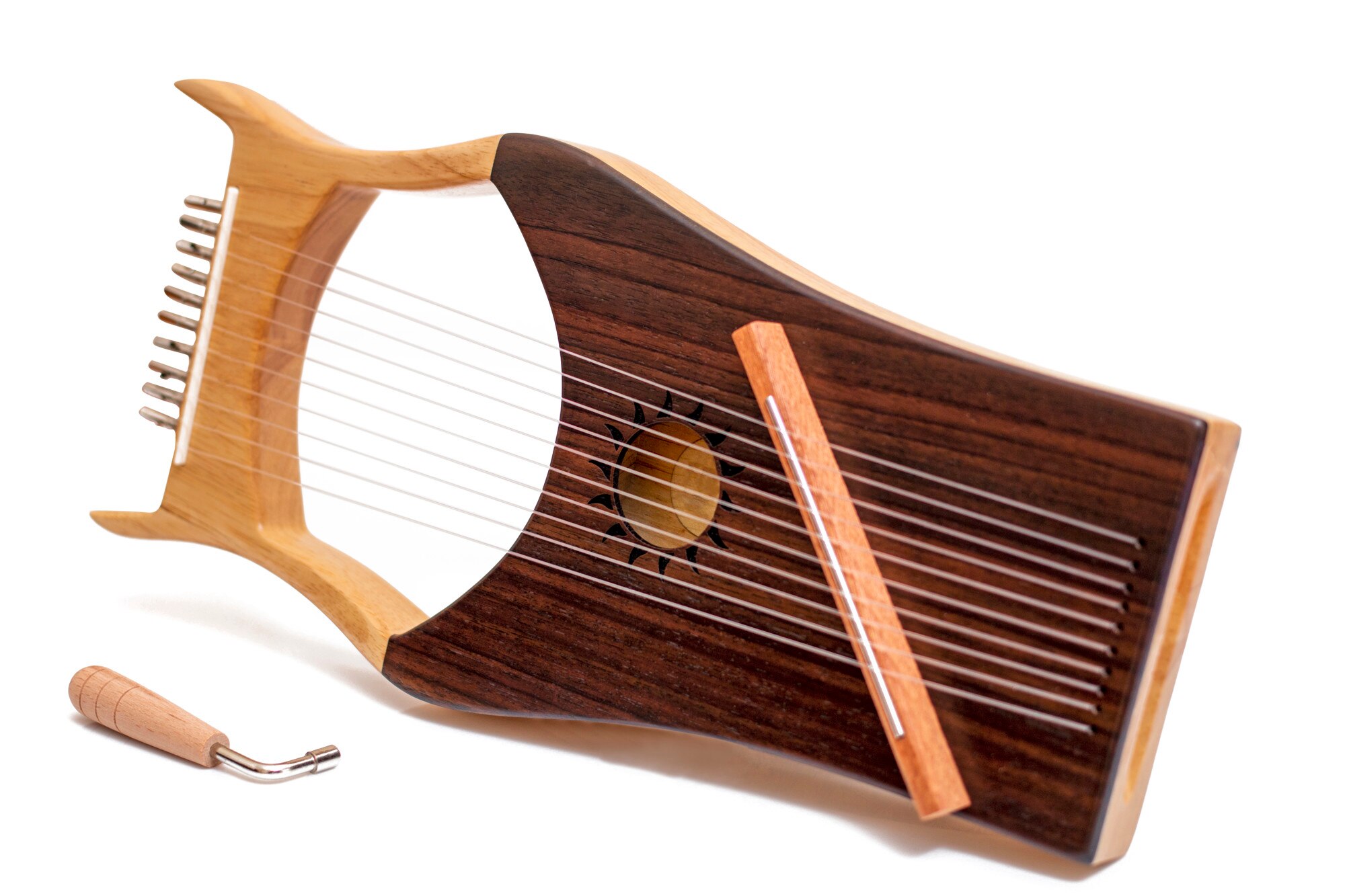
A lyre is a plucked string instrument. On a traditional hollow-bodied lyre, the strings run from a crossbar, which two arms hold up, down over a hollow soundbox. Pluck a string and the soundbox helps project its vibration; the tone and sustain vary with the instrument's construction and strings. Modern solid-body or plate lyres instead have strings over a solid wooden body. For a beginner, the right lyre is the one whose range and tuning suit the music you want to play. The instrument's long history explains why both of those matter.
In This Article
- Where the Lyre Came From
- Hermes, Apollo, and Orpheus
- The Major Lyre Types and Their Names
- What a Lyre Sounds Like
- Lyre, Harp, and Lyre Harp
- What to Look For in a Listing
- Learning to Play: Tuning and Plucking
- Key Takeaways
- Frequently Asked Questions
- Choose for Sound and Playability
Where the Lyre Came From
The oldest well-preserved lyres come from the Royal Cemetery at Ur in southern Iraq, which Leonard Woolley excavated in the 1920s. They were buried about 4,500 years ago. Most of the wood had rotted. Surviving decoration and fittings, including bull's heads, helped researchers reconstruct some shapes; other evidence came from impressions in the soil and plaster casts of cavities left by decayed wood. Not every instrument's outline was defined by inlay: one lyre's soundbox and rear upright left impressions instead.
The design they recovered had two arms, a crossbar and a soundbox. Lyres also became central to education and poetry in ancient Greece, but a shared frame alone does not establish a direct route from Ur to Greece and northern Europe. In 2012 archaeologists reported a burned wooden bridge fragment from High Pasture Cave on Scotland's Isle of Skye. The Scottish Archaeological Research Framework identifies it as most likely from a lyre. A bridge supports the strings and transmits their vibrations to the body. The find provides evidence of Iron Age stringed music on Skye, not proof that an entire instrument survived unchanged.
Hermes, Apollo, and Orpheus
The Greeks credited the invention to a god who was only hours old. The Homeric Hymn to Hermes says he was born at dawn and playing the lyre by midday. He found a tortoise, scooped out its shell and stretched strings across the hollow. By evening he had stolen Apollo's cattle.
Apollo tracked the thief down and demanded his herd back. Hermes played for him instead. Apollo wanted the instrument more than he wanted the cattle, so Hermes handed over the lyre to end the quarrel, and from then on Apollo was the god most closely tied to it.
Orpheus carried his lyre much further. He went down into the underworld and played until Hades and Persephone agreed to release Eurydice, on one condition: he must not look back at her on the way out. He looked, and she was gone. Stories like these made the lyre stand for poetry and song. The word "lyric" and the constellation Lyra both keep its name.
The Major Lyre Types and Their Names
The everyday lyre Greek players called the chelys was built the way the myth describes. It had a tortoise-shell body covered with hide. It was light and quiet, an instrument for learning and for playing at home.
The kithara was its professional counterpart. It had a large wooden body and, like most classical examples, seven strings. A kithara player usually struck the strings with a plectrum in the right hand, while the fingers of the left hand plucked single strings or damped the ones that should stop ringing. Playing one meant managing both hands at once, one sounding notes and the other silencing them.
Lyres reached the far north as well. The seventh-century Sutton Hoo ship burial in England held a wooden lyre, which has been reconstructed with six strings.
Ethiopia still has a living lyre tradition. The krar, with five or six strings, plays secular music. The ten-string begena accompanies prayer and meditation, and pieces of leather placed under its strings make every note buzz deeply. That buzz is the whole point of the begena. It turns each plucked note into a low hum that suits slow, devotional singing far better than quick melody.
What a Lyre Sounds Like
Some modern lyres have a soft, clear, bell-like tone, but that is not the sound of the whole family. A plucked note rings until it fades or the player stops it. String length, tension and mass per unit length determine its pitch; on hollow-bodied lyres, the soundbox shapes how those vibrations radiate. Check the lowest specified note for range and a recording for how strongly it sounds.
String material helps shape the color: nylon and gut can sound warm and round, while metal can sound brighter. Sustain also depends on the instrument's construction. On a long-sustaining lyre, each new note can overlap the last one, so damping helps keep a fast tune clear. Listen to the particular model rather than predicting its sound from string material alone.
Lyre, Harp, and Lyre Harp
The difference is in how the strings meet the body. A harp's strings are anchored in its soundboard and rise away from it at an angle, so every string pulls the board outward. A lyre's strings run parallel to the soundboard. On a hollow-bodied lyre, they pass over a bridge that stands on the top, between the crossbar and the body. Their tension presses the bridge down into the soundboard, and the bridge passes each vibration into the box.
Many modern instruments are sold as lyre harps. A modern lyre with its strings running over a bridge is a lyre, whatever the label calls it. If the strings go straight into the soundboard at an angle, the instrument works like a small harp.
What to Look For in a Listing
When comparing a seven-string lyre with a model of 16 to 21 strings, look beyond the count. Check the complete note list, lowest and highest pitches, tuning, string material, body construction (hollow or solid), body wood, dimensions and weight. These tell you whether the model supplies your music's notes and is comfortable to hold.
String Count and Range
String count alone does not tell you the range or available notes. Seven consecutive diatonic notes span just under an octave, but pentatonic tunings can spread seven strings further. Thomann lists its seven-string TLH-07 as D4–E4–G4–A4–B4–D5–E5: more than an octave, but without F or C. Sixteen to 21 consecutive diatonic notes span more than two octaves, offering room for wider melodies and accompaniment. Check the complete note list against your music; more strings also mean more tuning.
Tuning
Beginner listings include both diatonic tunings, such as C major, and pentatonic tunings, which use five note names per octave. Each open string supplies one pitch. On a diatonic model without semitone mechanisms, notes outside the stated scale require retuning; adding strings does not necessarily add sharps or flats. A pentatonic model may omit notes even a simple tune needs. Compare the full note list, including octave numbers, with your music, and follow the maker's tuning instructions.
Sound Demonstrations
A plain recording made in a quiet room, without heavy effects, shows what the instrument actually does. On a seven-string lyre, listen for buzzing and for whether each note rings cleanly. On a 21-string model, listen to the balance: whether the low strings carry or fade under the high ones, and how much the sustain builds up when several strings ring together.
Learning to Play: Tuning and Plucking
New strings stretch, so expect to retune often in the first weeks. Use the tuning wrench with a clip-on tuner or a tuning app.
Pluck with the pads of your fingers for a round tone. Stopping notes is the harder half of the skill. On a hollow-bodied lyre, once a few strings are ringing, the soundbox hums against your body and you can feel it in the wood. Laying your palm or a fingertip flat on a string stops that note, while other strings can continue ringing. Learning when to lay that hand down is what makes a melody sound clear.
Key Takeaways
- Match the complete note list and range to your tunes and any accompaniment.
- Check whether the tuning is diatonic or pentatonic; a key label alone is not enough.
- Trust a plain recording over any product name.
Frequently Asked Questions
Is "lyre" pronounced like "leer" or "liar"?
It is pronounced like "liar." In American English it rhymes with "fire." "Leer" is not the standard pronunciation.
What is a lyre in the Bible?
It is usually the Hebrew kinnor. David played the kinnor to calm King Saul, and the Psalms name it as an instrument of worship. Older English translations often call it a harp.
Is the lyre the oldest instrument?
No. Bone flutes found in caves in Germany are tens of thousands of years older. The Ur finds put lyres among the oldest surviving stringed instruments, though harps turned up in those same burials.
What is another name for a lyre?
Today it is often sold as a lyre harp or music lyre. Historical names refer to particular forms: the Greek chelys and kithara, the Ethiopian krar and begena, and the Hebrew kinnor. None of these works as a general name for every lyre.
What is the difference between a lyre and a harp?
A lyre's strings run parallel to the soundboard over a bridge, while a harp's strings rise from the soundboard at an angle. You play both by plucking. The difference in build changes how the body takes on string tension and how it carries sound.
What is a lyre?
A lyre is a plucked string instrument whose strings stretch from a crossbar on two arms down over a body, which may be hollow or solid. Modern players use it for early music, folk music and meditation. Its sound varies by type: the begena buzzes, while some modern concert lyres project strongly enough for ensemble playing.
Choose for Sound and Playability
Before buying, choose a tune you want to learn and check that the listing supplies every note in the right octave. If you want accompaniment, check that the lower notes you need are available too. Then listen for their strength and clarity in an unprocessed recording of that model.