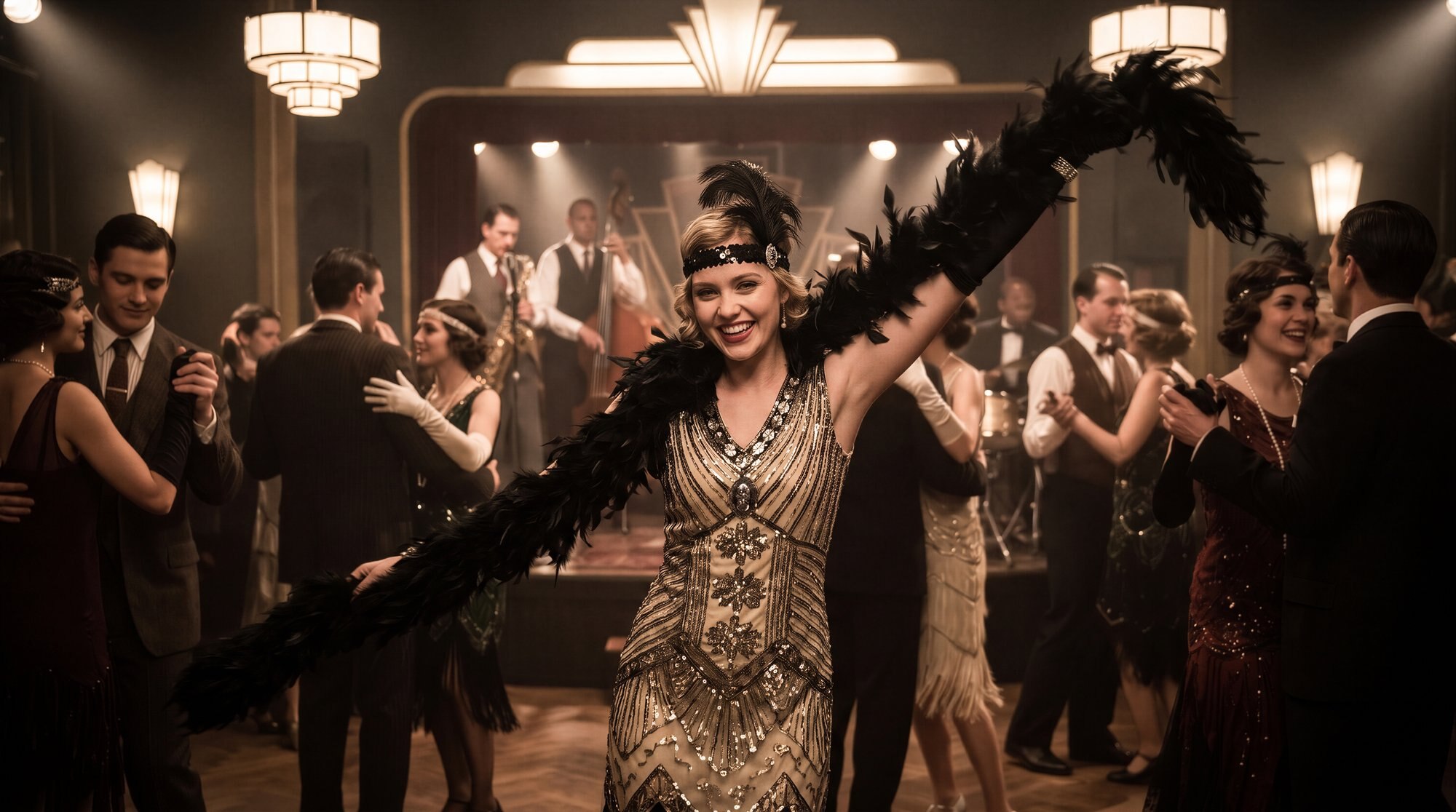
The Jazz Age was the cultural period associated with the 1920s, when jazz became a mass entertainment and a sound of changing American life. On Louis Armstrong’s “West End Blues,” a trumpet breaks into a quick run, hangs on a note, then tumbles onward: the decade’s excitement is audible before anyone starts singing.
In This Article
- How Jazz Reached Chicago and New York
- What Made the Music Different
- Why Prohibition Changed Nightlife
- Harlem’s Creativity and Racial Barriers
- Dancing and Changing Expectations for Women
- How Writers Defined the Era and Its Ending
- Key Takeaways
- Frequently Asked Questions
- Read the Era Beyond Nightlife
How Jazz Reached Chicago and New York
Jazz developed in New Orleans from African American traditions, including blues and ragtime. Brass bands and social dances gave musicians room to improvise around familiar tunes. No single player invented it; players learned by answering one another.
The Great Migration carried Black Southerners north for work and relief from racial oppression. Armstrong followed in 1922, joining King Oliver’s band in Chicago. Oliver and Armstrong played interlocking cornet parts, with clarinet moving above them and trombone underneath. The rhythm section kept dancers moving while the horns pulled in different directions. Chicago and New York became centers where Southern musicians could find audiences and paid work: the jazz era traveled with its players.
What Made the Music Different
That collective sound gave way, in Armstrong’s Hot Five and Hot Seven recordings, to a stronger focus on the individual soloist. His opening on “West End Blues” in 1928 stands alone, without the band: a held trumpet note launches quick ascending figures, followed by phrases that stretch across the expected beat. Then the ensemble enters. Jazz Age music could fill a dance floor and still stop a listener short.
Commercial records carried those performances beyond the musicians’ home cities. The jazz that 1920s audiences heard on discs came in compact takes, constrained by short playing times; recording equipment also affected the instrumental balance. A performance that changed nightly now had a repeatable shape. On this record, Armstrong later sings without words, his voice answering the clarinet with an ease quite different from that opening trumpet burst.
Why Prohibition Changed Nightlife
Prohibition banned the manufacture, sale and transportation of intoxicating liquor for beverage purposes nationwide beginning in 1920. Drinking continued behind speakeasy doors, and jazz bands helped bring customers through them.
At Connie’s Inn, which opened in a Harlem basement in 1923, entertainment meant descending below street level. Such businesses sold an evening out as well as an illegal drink. Their association with jazz gave the music a reputation for defying respectable behavior.
Jazz in the 1920s also sounded in theaters and public dance halls, where alcohol was not necessarily the attraction. Speakeasies ranged from modest rooms to expensive establishments; money and local connections determined which doors opened.
Harlem’s Creativity and Racial Barriers
Harlem’s musical life belonged to the wider Harlem Renaissance, alongside literature and visual art. Duke Ellington began his celebrated Cotton Club engagement in 1927. Black performers could enter to work, but Black customers were excluded under the club’s regular admission policy. A successful musician could command the stage without enjoying the rights of a paying guest.
At the Savoy Ballroom, opened in 1926, interracial dancing was welcome. Couples shared a floor where a turning dancer had to make room for the next pair. The exchange happened through feet as well as instruments. These were different kinds of access, separated by the policies at the door.
Dancing and Changing Expectations for Women
The Charleston became a national craze after appearing in the Broadway musical Runnin’ Wild in 1923. Knees turned inward and outward; feet kicked forward and back. The movement made older ideals of restrained social dancing difficult to maintain.
Later in the decade, Harlem dancers developed the Lindy Hop through exchanges with one another and responses to the music. Partners moved apart and came together again, making space for individual steps within a shared dance.
Bobbed hair and shorter skirts helped make the flapper recognizable on that floor. Clothes could announce independence, but paying for an evening out still depended on income, and family expectations could determine whether a young woman went at all. Racial discrimination imposed further limits on where she could dance.
How Writers Defined the Era and Its Ending
F. Scott Fitzgerald’s Tales of the Jazz Age (1922) helped popularize the label. In The Great Gatsby (1925), lavish parties draw crowds to Gatsby’s house, but the crowd does not become a community that supports him. Wealth supplies the spectacle; class barriers and private disappointment shape its aftermath.
The Roaring Twenties overlaps with this cultural period of consumer expansion and social conflict. The Wall Street crash supplied its conventional endpoint, but dance halls still needed music afterward. Swing brought renewed momentum in the following decade. Jazz history therefore extends beyond the rise and collapse of the twenties’ prosperity.
Jazz Age timeline: cultural boundaries and jazz’s continuing history
| Timeline milestone | Date or period | Jazz Age cultural significance | Jazz music’s development |
|---|---|---|---|
| Jazz’s early roots | 1890s–1910s | Musical foundations predate the conventional 1920s cultural era | New Orleans musicians combine blues, ragtime and brass-band traditions |
| First commercial jazz recordings | 1917 | Recorded jazz reaches audiences before the Roaring Twenties | Original Dixieland Jass Band records “Livery Stable Blues” and “Dixie Jass Band One-Step” |
| Conventional Jazz Age opening | Around 1920 | Postwar consumer culture expands; US Prohibition begins January 17, 1920 | Jazz gains audiences through records, dance halls and urban nightlife |
| Fitzgerald’s defining title | 1922 | F. Scott Fitzgerald publishes Tales of the Jazz Age, helping popularize the period’s label | “Jazz Age” describes a wider cultural moment, not a new musical genre |
| Conventional Jazz Age ending | October 1929 | Wall Street crash: Black Thursday, October 24; Black Tuesday, October 29 | Jazz performance and recording continue |
| Jazz after the Jazz Age | 1930s; swing breakthrough in 1935 | The Great Depression follows the 1920s boom; US Prohibition ends December 5, 1933 | Big-band swing flourishes; Benny Goodman’s August 1935 Palomar Ballroom engagement becomes a landmark |
Key Takeaways
- Follow musicians’ journeys to connect Southern origins with Northern audiences.
- Compare ensemble passages with solos to hear the music changing.
- Treat admission policies as part of a venue’s history, alongside its performers.
- Use the timeline to separate cultural turning points from musical development.
Frequently Asked Questions
When Was the Jazz Age?
The Jazz Age usually means roughly 1920 through the October 1929 crash. Broader accounts begin after World War I, so its boundaries are cultural conventions rather than exact musical dates.
Why Are the 1920s Called the Jazz Age?
The decade takes its name from jazz’s prominence in entertainment and its association with changing social behavior. Dancing made that association visible: a new sound accompanied new ways of moving in public.
Did F. Scott Fitzgerald Coin the Term “Jazz Age”?
Fitzgerald is often credited with coining “Jazz Age,” but he is more securely described as its popularizer. His collection named above establishes his role without proving he was the phrase’s first user.
How Did Radio Bring Jazz to Audiences Outside Nightclubs?
Radio brought live music and dance-band programs into listeners’ homes. Ellington’s Cotton Club broadcasts carried the band beyond the club’s restricted audience. Station schedules and sponsors still shaped what listeners heard.
Was Flapper Culture Representative of All American Women?
No, flapper culture was a conspicuous image, not most women’s everyday experience. Films and advertising circulated it widely, while rural life and limited incomes often meant different responsibilities and opportunities.
Read the Era Beyond Nightlife
Fletcher Henderson’s “The Stampede” offers a good first recording: the horns move in tight, arranged bursts, then give individual players room to break away. Choose it if you want to hear how an ensemble frames a solo. For the social history, read The Great Gatsby next and follow what happens to the people who attend its parties.
That pairing gives you a practical starting point without requiring a survey of the whole decade. Music-focused readers can continue with Armstrong’s recordings; readers drawn to nightlife can compare the two Harlem venues discussed above. Keep admission and employment separate: getting hired to entertain did not guarantee being welcomed as a customer.