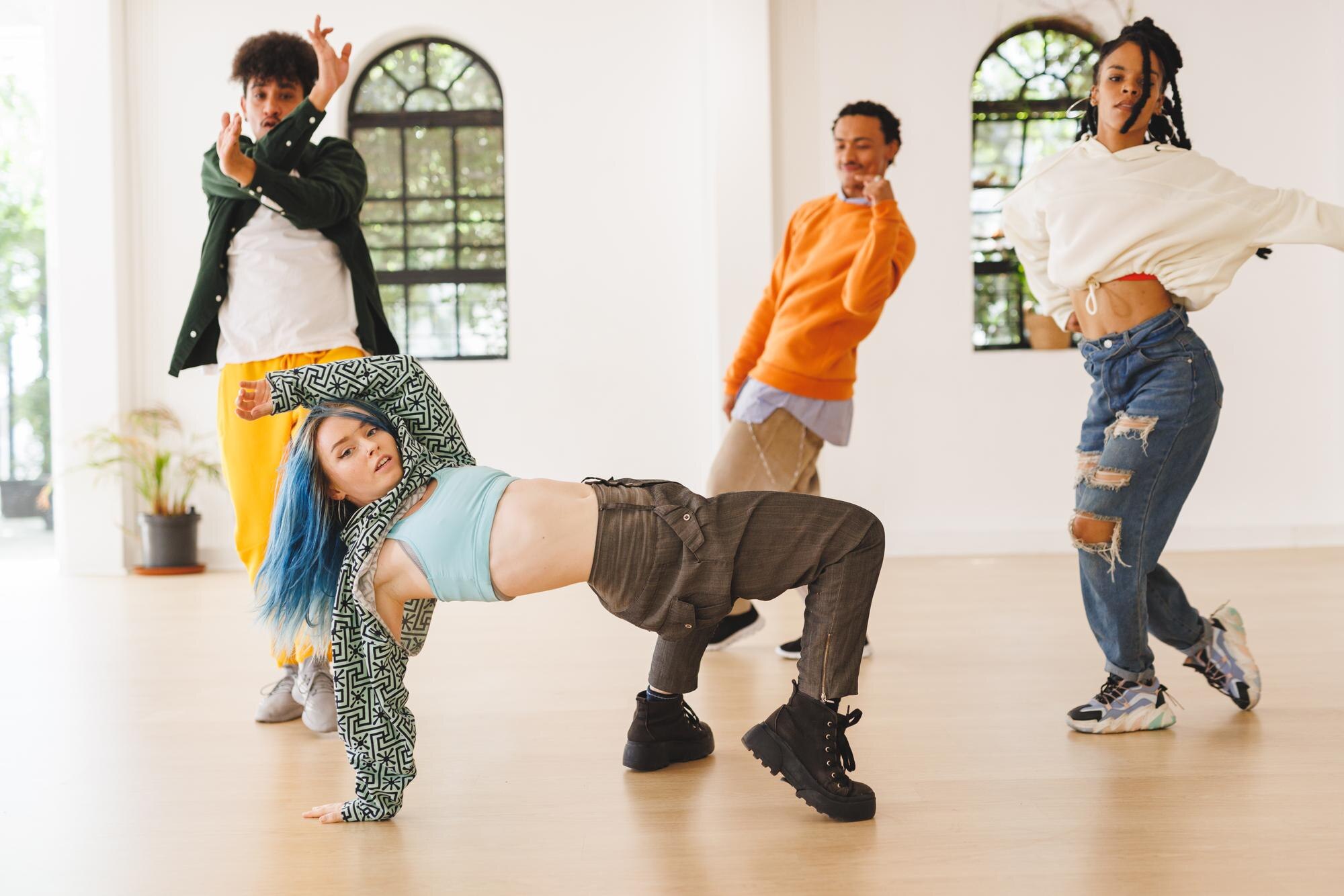
Hip hop dance is the set of street and social dances people do to hip hop music, from the spinning floor work of breaking to the bouncing party steps of the 1990s. Dancers ride the drum beat, often make up their moves on the spot, and dance for a circle of people who know what they are seeing. It grew within Black and Latino communities at Bronx parties in the 1970s, when teenagers took the floor during the drum breaks of funk records. Locking and popping, two California styles danced to funk, are close relatives with separate histories.
In This Article
- Where It Started: The Bronx in the 1970s
- Breaking: The First Hip Hop Dance
- Locking and Popping: Funk Styles From California
- The Party Dances of the 1980s and 1990s
- Films and Performances That Spread the Dance
- Music Videos, Freestyle and Choreography
- First Moves to Practice at Home
- Key Takeaways
- Frequently Asked Questions
- Start With Groove and Cultural Context
Where It Started: The Bronx in the 1970s
On August 11, 1973, Cindy Campbell organized a back-to-school party in the recreation room of 1520 Sedgwick Avenue in the Bronx, with her brother DJ Kool Herc playing the records. Herc, a Jamaican-born DJ, saw that the crowd danced hardest during the break, the short stretch of a funk or soul record where the vocals drop out and the drums carry the song. He bought two copies of the same record and switched between turntables to stretch that break out. The dancers got more of what they wanted.
The young people who took the floor during those extended breaks became known as break boys and break girls, or b-boys and b-girls. Their dance became breaking. They danced in a circle called a cypher, taking turns in the middle while everyone else watched. The same parties fed the rest of hip hop culture: DJs cutting records, MCs talking and later rapping over the beats, and graffiti writers whose names covered the trains that crossed the city. Dance was part of the culture from the first night.
The setting mattered. The South Bronx of the 1970s had lost housing and jobs. Parks, community centers and apartment building rec rooms gave teenagers a place to compete without money. Crews formed around neighborhoods. Rivalries between them were settled the way the parties taught: in battles on the dance floor, crew against crew, with the crowd deciding who won.
Breaking: The First Hip Hop Dance
Breaking came straight out of those extended breaks. Early b-boys and b-girls borrowed from what they saw around them, and dancers have often named James Brown's footwork and kung fu films as early influences. Over the 1970s the dance moved from upright steps toward the floor. Its vocabulary settled into four parts.
Toprock is the standing part, a set of rhythmic steps a dancer uses to enter the circle and show style. Downrock, or footwork, happens on the hands and feet close to the floor; the six-step, a circular pattern of six foot placements around the hands, is the standard first lesson. Power moves are the spinning, acrobatic moves such as windmills and headspins. Freezes are held poses that stop the motion, ideally on a hit in the music.
Difficulty alone has never won a round. Audiences look for musicality, for clean transitions from toprock to floor work to freeze, and for a dancer with a character of their own. Those qualities resist numbers, and that tension came to a head when breaking made its debut as a medal event at the 2024 Paris Olympics. A dance born in park battles had to fit a judging panel's scoresheet.
The crews built that standard long before any panel did. Rock Steady Crew formed in the Bronx in 1977 and became the best-known breaking crew in the world. The New York City Breakers, a rival crew, took breaking onto stages and television in the early 1980s. Copying another dancer's move, known as biting, was looked down on, as Rock Steady Crew member Mr. Freeze recalled in The Progressive. Originality did not necessarily mean inventing an entirely new move. In modern competition, for example, Hip Hop International's breaking criteria define originality through individual presence and style, alongside foundation, execution, musicality and other qualities.
Locking and Popping: Funk Styles From California
Locking and popping did not come from the Bronx parties. Both grew up on the West Coast, danced to funk music, in a scene that ran alongside early hip hop. Popping developed during the 1970s. People often file them under hip hop street dance, and many dancers learn all of these styles. Practitioners usually call locking and popping funk styles and keep their history as a separate thread.
Locking
Don Campbell developed locking in Los Angeles. Around the signature move sit points, wrist rolls and big, playful arm movements, often with a grin and a bit of comedy. Campbell formed the group The Lockers, which put the style in front of a national audience in the 1970s. He also danced on the television show Soul Train, where viewers saw the lock itself: a burst of fast movement that stops dead mid-motion, holds for a beat, then snaps back into action.
Popping
Boogaloo Sam helped develop and popularize popping in Fresno, California, and founded the crew that became the Electric Boogaloos. Its origins are disputed: PBS SoCal's history documents competing accounts crediting other Fresno pioneers and accounts tracing its roots to earlier Bay Area boogaloo funk dances. Popping dancers mix the pop with related techniques such as boogaloo rolls, waving and tutting, and a strong popper keeps each one clean and on the beat. The pop is the core. It is a quick contraction of the muscles in the arms, chest, neck or legs, timed so tightly to the snare that the body jerks as if the drum had struck it.
The Party Dances of the 1980s and 1990s
Hip hop party dance developed through the 1980s and 1990s, drawing on a longer Black social-dance tradition. Some steps, including the Smurf, were already being danced in the early 1980s. Clubs and house parties helped spread an upright, social vocabulary meant for dancing with friends. This is the style many people picture when they hear the words hip hop dance, and teachers often call it hip hop party dance, social dance or hip hop freestyle.
New York dancers did much of the shaping. The Brooklyn crew Elite Force, along with dancers Buddha Stretch and Link, helped popularize this vocabulary by dancing it, teaching it and giving the steps consistent names. Naming changed how the steps moved. A step with a name could travel from one party to another and be taught in a class.
Many of those names came from songs, people or cartoons. The Running Man and the Roger Rabbit became iconic dance moves of the period, along with the Cabbage Patch, the Kid 'n Play kickstep, the Wop and the Smurf. Each had a shape anyone at a party could pick up by watching.
What made them dancing was the groove underneath. The footwork is a layer on top of a steady bounce or rock in the body. Without that groove, the same hip hop dance moves look like exercise. With it, they look like a response to that particular song.
Films and Performances That Spread the Dance
Three movies released in 1983 and 1984 changed the history of hip hop dance outside New York. In Flashdance (1983), members of Rock Steady Crew appear in a short street scene. That brief sequence showed audiences who had never seen breaking what it looked like.
The following year brought two films built around street dance. Beat Street (1984) was set in New York and featured Rock Steady Crew and the New York City Breakers. Breakin' (1984) was set in Los Angeles and leaned on West Coast popping and locking. Both reached international audiences, and young dancers in Europe, Asia and Latin America learned moves by watching the films over and over. Local scenes formed in many countries in the years that followed.
The films also blurred the lines. By putting breaking, popping and locking on screen together under labels like breakdancing, they taught audiences to treat distinct styles as one thing, which is where much of the habit of filing funk styles under hip hop comes from. Mainstream interest in the United States faded after the mid-1980s fad. The crews kept dancing anyway, and each style kept its own lineage.
Music Videos, Freestyle and Choreography
Music videos became the next big window into the dance, and they show one slice of it. A video routine is choreography: counts set in advance, timed to a specific song, staged for a camera. It can be excellent dancing. It still leaves out the cyphers, battles and parties where the dance is improvised and shared.
Freestyle is the older practice. A dancer in a cypher hears the music, chooses moves on the spot and responds to the people around them.
The circle values that spontaneous response. When dancers there say "that's hip hop," they usually mean a moment nobody could have rehearsed: a freeze that caught a drum hit no one expected, or a step thrown straight back at the dancer who just left the middle.
First Moves to Practice at Home
You need a few feet of clear floor, sneakers, a floor that is smooth but not slippery, and a song with a steady drum beat. A late-1980s or 1990s rap track works well, because many of the party dances were built on music like that.
The Bounce
Most hip hop dancing rests on a bounce. Stand with your feet about hip-width apart and soften your knees down on each beat, letting your chest drop slightly with them. That is a down bounce. An up bounce reverses it, with the body lifting on the beat. Stay with one for a full song until it feels automatic.
The Two-Step
The two-step puts that bounce to work by adding weight transfer. Step your right foot to the side, bring your left foot to meet it, then step left and bring the right foot in. Keep the bounce going underneath. Moving your full weight from one foot to the other is the skill every later step depends on.
The Running Man
The Running Man looks like running in place while sliding backward. Lift one knee, and as you put that foot down, slide the standing foot back. Switch legs and repeat. Go at half the speed of the beat until the slide feels smooth, then match it.
The Roger Rabbit
The Roger Rabbit also travels backward, this time with alternating kicks. Start with your weight on your left foot. Hop lightly on that foot as you lift and kick your right foot backward. Bring the right foot down behind the left to take your weight as the left foot lifts and kicks backward. Repeat on the other side, keeping a small hop in the supporting leg rather than simply stepping backward. It feels like skipping in reverse. Keep the steps small at first so you stay balanced.
A Toprock Step
For a taste of breaking without the floor work, practice a basic toprock. Cross one foot in front of the other on the beat, step back to center, then cross the other foot. Let your arms open and your shoulders move with it.
Once each step feels comfortable, pair two of them: eight counts of down bounce straight into eight counts of Running Man. Film it on your phone and play it back with the sound up. Count the steady beats aloud and check the down-bounce section: your lowest position should line up with each counted beat. If it consistently comes afterward, practice the bounce alone more slowly.
Key Takeaways
- Hip-hop dance belongs to a wider culture shaped by music, community, and individual expression.
- Breaking and party dances share cultural connections but have distinct movement vocabularies.
- Popping and locking should not be presented as interchangeable names for hip-hop.
- Beginners can start with groove and weight transfer before building combinations.
- Music videos show one expression of the dance, not its entire social tradition.
Frequently Asked Questions
What are the different types of hip-hop dance?
The main types are breaking and hip hop party dance, with locking and popping often grouped alongside them. Breaking is the original dance of hip hop, built from toprock, footwork, power moves and freezes. Party dance includes the upright social steps popular during the 1980s and 1990s, such as the Running Man. Locking and popping are West Coast funk styles with their own histories.
When did hip-hop begin?
Hip hop's symbolic birthday is August 11, 1973, when Cindy Campbell organized a party at 1520 Sedgwick Avenue in the Bronx, with her brother DJ Kool Herc as DJ. The culture grew through the rest of the 1970s in the Bronx and across New York City.
What are some popular hip-hop dances?
Popular hip hop dances include the Running Man, Roger Rabbit, Cabbage Patch, Kid 'n Play kickstep, Wop and Smurf, associated with the party scenes of the 1980s and 1990s. They did not all emerge together: the Smurf, for example, dates to the early 1980s. From breaking, the six-step, windmill and headspin are among the best known.
What are the 10 basic hip-hop dance steps?
No official list of ten exists, but beginner classes commonly teach the bounce, the rock, the two-step, the Running Man, the Roger Rabbit, the Cabbage Patch, the Kid 'n Play kickstep, the Wop, the Smurf and a basic toprock step. Teachers vary in which ones they include and in what order.
How is freestyle different from learning choreography?
Freestyle is made up on the spot, while choreography is set in advance. A choreographed routine sets moves to counts and music in advance. A freestyler chooses moves in response to the music and the people nearby, as dancers do in a cypher or battle. Most dancers practice both, using choreography to drill timing and freestyle to develop their own style.
Start With Groove and Cultural Context
If you came to dance, your first job is the down bounce. Put on a song with a hard, steady drum loop and hold the bounce from the first bar to the last, knees dropping on every beat, until your body keeps time without you thinking about it. That bounce sits under every party step in this article. Add the two-step next, then one named step such as the Running Man. If breaking pulls you more than the party styles, practice toprock before trying any floor work. If popping or locking appeals, find a teacher who trains those funk styles by name. Whatever class you choose, pick a teacher who says which style they teach and where it came from.