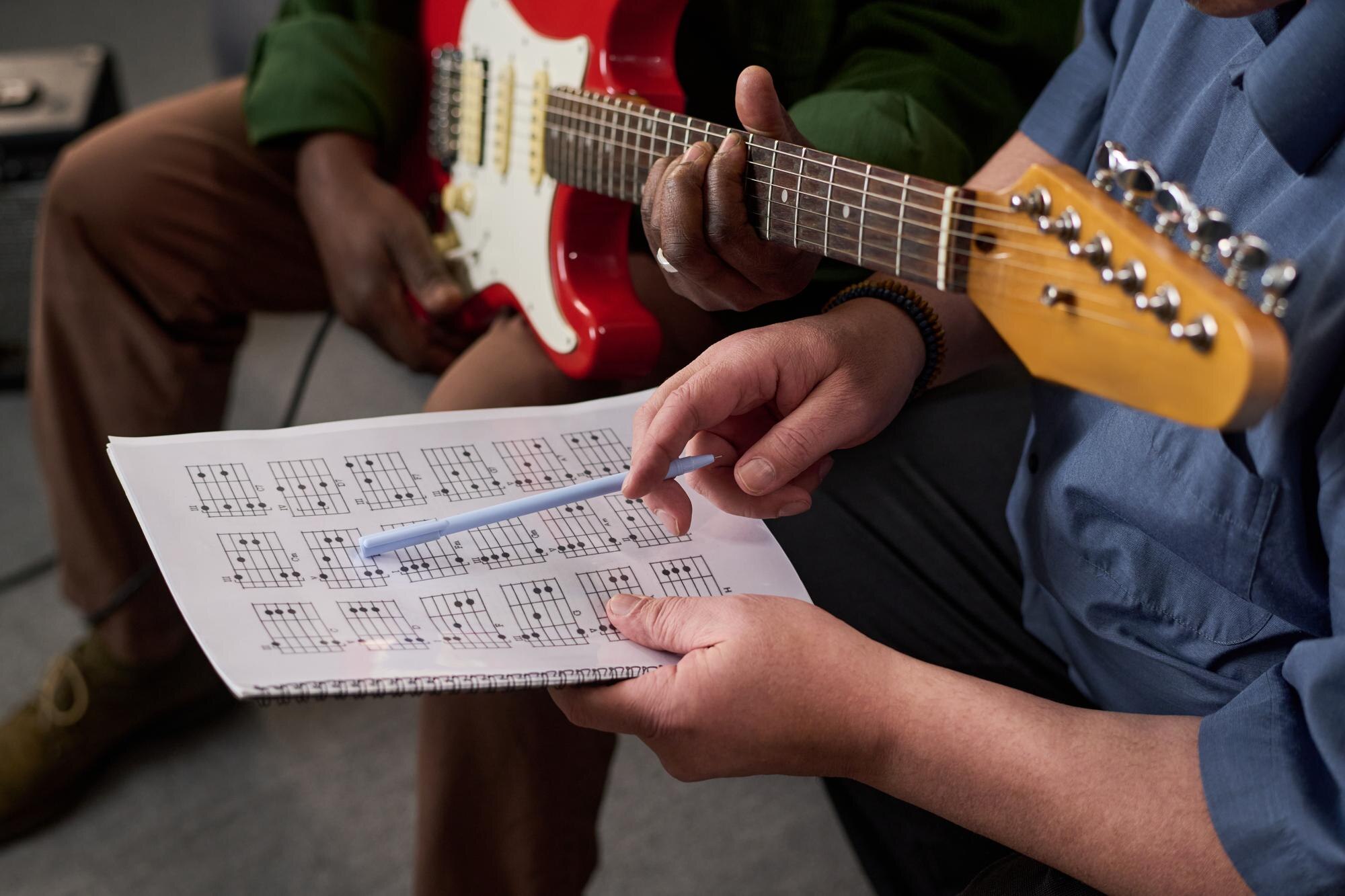
The 12 bar blues is a chord pattern twelve measures long, built from three chords, that starts over from the top each time it ends. In the key of A those chords are A, D, and E, and one trip through the cycle takes 48 beats at four beats per bar. Because nearly every blues player carries the same map, two musicians who have never met can step onto a bandstand, agree on a key with a nod, and play a whole song without another word.
The twelve sections below take that map apart one piece at a time, and each ends with something to put under your fingers.
In This Article
- 1. The Twelve-Measure Cycle
- 2. The Three Chords Named I, IV, and V
- 3. The Basic Chart, Bar by Bar
- 4. Three Four-Bar Lines
- 5. Seventh Chords on Every Change
- 6. The Quick Change in Bar Two
- 7. The Turnaround in the Last Bars
- 8. Counting Measures as Well as Beats
- 9. The Shuffle Rhythm
- 10. Moving the Pattern to Other Keys
- 11. A First Solo Over the Changes
- 12. Two Recordings to Follow
- Key Takeaways
- Frequently Asked Questions
- Make the Pattern Feel Familiar
1. The Twelve-Measure Cycle
A measure, also called a bar, is a short group of beats. In most blues each measure holds four beats, and twelve measures make one complete pass through the chords. Musicians call that pass a chorus. A song is several choruses in a row: a singer usually sings one verse per chorus, and a soloist might take two or three choruses before handing off.
That makes the 12 bar blues form a container, and a song only fills it. It doesn't tell you which notes to sing or how many times to go around, and it isn't a scale. It fixes one thing: where the chords sit.
The first skill that matters is physical. Play along with a record for a few choruses and you start to feel bar 12 lean forward, wanting to fall into the next bar. Then the downbeat of bar 1 lands, solid, like the bottom stair you knew was there.
That's the chorus turning over.
2. The Three Chords Named I, IV, and V
Blues players describe the chords with numbers. This shorthand, called Roman numeral analysis, counts up the major scale of the key and names each chord by the scale step it starts on. In A major the scale runs A, B, C♯, D, E, F♯, G♯. A is step 1, D is step 4, and E is step 5, so the chords are I (A), IV (D), and V (E). Upper-case numerals mean major chords.
The numbers earn their keep on a loud stage. Nobody hears a chord name shouted over a drummer in full swing, so a bandleader holds up four fingers as bar 4 ends, and the whole band lands on the IV together. A setlist scribble reading "12 bars blues in A" is often the only chart a pickup band gets. It's enough, because "go to the IV" means the same move in every key, and the guitarist and pianist can follow it without reading a single chord name.
Learn the shape as I, IV, and V. The letters are just the key you happen to be in tonight.
3. The Basic Chart, Bar by Bar
Here are the 12 bar blues chords in their plainest arrangement, in A, written as three lines of four bars:
| First bar of line | Second bar | Third bar | Fourth bar |
|---|---|---|---|
| 1: A (I) | 2: A (I) | 3: A (I) | 4: A (I) |
| 5: D (IV) | 6: D (IV) | 7: A (I) | 8: A (I) |
| 9: E (V) | 10: D (IV) | 11: A (I) | 12: A (I) |
Read it as a story of where the harmony sits. You start at home on A for a long stretch, move to D, come home, and then the E in bar 9 creates the strongest pull of the whole cycle before D and A settle it. Bar 12 leads straight back to bar 1.
For guitar, use these open chord shapes: A (x02220), D (xx0232), and E (022100). Each code reads from the lowest-pitched string to the highest: low E, A, D, G, B, high E. A number tells you which fret to press, 0 means play the string open, and x means do not play that string. These are fret numbers, not finger numbers.
For A, press the D, G and B strings at fret 2. For D, press G at fret 2, B at fret 3 and high E at fret 2. For E, press A and D at fret 2 and G at fret 1. Let the strings marked 0 ring open.
Play four even downstrokes per bar, with the chord change falling exactly on beat one of the new bar. Use section 8's spoken counting method to keep your place.
Bar 5 is where that rule gets tested. Arrive late and you're still strumming A while the bass has already moved to D, and for a full beat the whole room hears the clash.
4. Three Four-Bar Lines
The three lines in that chart work like sentences. The first states an idea over the I chord. The second repeats it while the harmony shifts to IV and back. The third answers it, moving through V and IV before returning home. Traditional blues lyrics follow the same plan, called AAB.
Robert Johnson's "Sweet Home Chicago" shows it plainly. He sings "Oh, baby, don't you want to go" over I with a quick change to IV and back, repeats the same line as the harmony moves to IV, and then answers with "Back to the land of California, to my sweet home Chicago" as the harmony moves through V and IV and resolves to I. Same question twice, one answer.
Inside each line the singer usually fills about two bars and leaves the other two open. An instrument answers in that gap, a trade called call and response. That makes each line a self-contained 4 bar blues phrase with a call and a reply built in, and hearing the chorus as three of those is far easier to hold in your head than twelve separate bars.
5. Seventh Chords on Every Change
Most blues players replace the plain chords with dominant seventh chords, which add a fourth note a whole step below the root's octave. In A, the three chords become:
- A7: A, C♯, E, G
- D7: D, F♯, A, C
- E7: E, G♯, B, D
The G in A7 doesn't belong to the A major scale, and that slightly unsettled sound is a large part of what makes a blues sound like a blues. In classical tonal harmony, a familiar resolution is V7 to I: in A major, E7 resolves to A. In the blues, the home chord A7 has the same dominant-seventh quality as E7, but serves as home rather than requiring that resolution. Its seventh can remain part of the home sound.
On guitar, the open shapes are A7 (x02020), D7 (xx0212), and E7 (020100). On piano, hold the root in your left hand and play the four chord notes in your right. Keep the chart from section 3 exactly as it was and swap each chord for its seventh version. The only thing that changes is the color.
6. The Quick Change in Bar Two
The quick change moves to the IV chord in bar 2, then returns to I for bars 3 and 4. In A, the first line becomes A7, D7, A7, A7. Everything after bar 4 stays as it was.
That early visit to D7 gives the opening line more motion and previews the move coming in bar 5. A large share of recorded blues uses this version of the 12 bar blues chord progression, and bands rarely announce which version they're playing. You find out in bar 2.
Watch the bass player. If the bass drops to D on the second downbeat, it's the quick change.
7. The Turnaround in the Last Bars
A turnaround is the move at the end of the chorus that sends the music back to bar 1. The chart in section 3 stayed on A for bars 11 and 12. The common alternative changes bar 12 to E7, so the strong V chord sits right before the cycle restarts:
- Bars 9–12: E7, D7, A7, E7
That one change makes the return to bar 1 feel inevitable, and it tells everyone another chorus is coming.
Try a simple chromatic walkdown over these last two bars. In bar 11, play G on beat 1, F♯ on beat 2, F on beat 3, and E on beat 4. Strum E7 on beat 1 of bar 12 and hold it for four beats, then return to A7 on beat 1 of the next chorus. Each descending step is a half step.
On the final chorus, players usually skip the turnaround and finish on the I chord, so the song ends at home.
8. Counting Measures as Well as Beats
Counting beats keeps you in time, and counting bars keeps you in the right place. Use the bar number as the first count of each measure: "ONE-two-three-four, TWO-two-three-four, THREE-two-three-four," and so on up to twelve. Say it aloud while you strum, even though it feels slow.
Practise first with the basic chart from section 3: no quick change and no V chord in bar 12. Bar 5 is its first move to IV, and bar 9 is its only V chord. If you lose your place, stop playing chords, keep listening, and rejoin on V at bar 9. Count bars 9, 10, 11, and 12 before returning to bar 1. With the variations, IV also appears in bar 2 or V in bar 12, so those chords alone no longer identify your place.
This habit pays off late in a song. After six or seven choruses the cycles blur together unless you're tracking them.
9. The Shuffle Rhythm
A great deal of blues uses a shuffle, a rhythm in which each beat splits into a long note and a short note. Divide each beat into three quick parts and play on the first and third. The result has a lilt that even eighth notes don't have.
Guitarists usually play the shuffle as a two-string figure. On A7, play the open A string with the D string at the 2nd fret (E), then at the 4th fret (F♯), and rock between the two in the long-short rhythm. Move the same figure to the D and G strings for D7 and to the low E and A strings for E7. Pianists can play the same rocking fifth-to-sixth motion in the left hand.
Set a metronome slow enough that the long-short feel stays even. Once it does, your third finger starts to bounce on and off that 4th fret without you deciding to, and the whole figure rolls forward on its own.
10. Moving the Pattern to Other Keys
The 12 bar blues progression keeps the same bar positions in every key. Only the letter names change. Find the I chord, count up the major scale to steps 4 and 5, and fill in the chart from section 3.
- Key of E: E7, A7, B7. Guitarists favor it because the low E and A strings ring open.
- Key of G: G7, C7, D7.
- Key of B♭: B♭7, E♭7, F7. Horn sections often prefer flat keys like this one.
B♭ is the one that catches guitarists out. Halfway through a set the singer turns and says "B-flat," the horn players look relieved, and every open shape you know is useless. You get one count-off to find three chords.
Barre shapes rescue you. Put the I as a barre chord rooted on the low E string, B♭7 at the 6th fret. The IV sits at the same fret with its root on the A string, E♭7, and the V is two frets higher on that string, F7 at the 8th fret. That grid of three positions works in any key the singer calls.
11. A First Solo Over the Changes
The usual starting scale for a blues solo in A is the A minor pentatonic: A, C, D, E, G. Add E♭ and you have the A blues scale: A, C, D, E♭, E, G. The same notes work over all three chords, which is why beginners can solo before they know any theory about chord tones.
The C in that scale clashes with the C♯ inside A7. That rub is part of the blues sound. Guitarists often bend the C slightly sharp, and pianists sometimes play C and C♯ together or slide from one to the other.
Here is a simple phrase plan over one chorus in A. Use the basic chart with seventh chords and the section 7 turnaround: A7 in bar 11, then E7 in bar 12, with no quick change in bar 2.
- Bars 1–2 (A7): play C–D–E♭–E, then land on A and hold it into bar 2.
- Bars 3–4 (A7): answer with G–E–D–C, end on A, and rest.
- Bars 5–6 (D7): repeat the phrase from bars 1–2. Over D7, the C is the chord's own seventh and the final A is its fifth, so the same notes now sound settled.
- Bars 7–8 (A7): play nothing and let the accompaniment fill the space.
- Bars 9–10 (E7, D7): play E–G–E–D over E7, then D–C–A over D7.
- Bars 11–12 (A7, E7): land on A on beat one of bar 11, hold it for that bar, then rest while the accompaniment plays E7 in bar 12.
This is the call and response from section 4 with you supplying both parts. Short phrases, clear landing notes on A or E, and real rests sound more like blues than a constant stream of notes.
12. Two Recordings to Follow
Robert Johnson recorded "Sweet Home Chicago" in 1936, playing guitar and singing alone. It follows the twelve-bar shape with a turnaround and metrically regular measures. That makes it a good test of section 8: count the bars and listen for the V chord.
For the band version, use B. B. King's "Every Day I Have the Blues" from Live at the Regal, recorded at the Regal Theater in 1964. Count each twelve-bar vocal chorus and listen for the moves to IV and V and the return to I. Use this performance rather than another recording of the song: arrangements differ.
Use Johnson's 1936 recording and King's Live at the Regal performance. For each, locate bar 1 of the first complete vocal chorus, count twelve bars, and write down the chord changes you hear. Do not assume the first sung syllable falls on beat 1.
Key Takeaways
- The form repeats twelve measures; it is not a scale or a whole-song length.
- I, IV, and V describe chord relationships that transfer between keys.
- Learn the basic chart before adding quick changes or turnarounds.
- Count measures as well as beats to stay oriented through repeated cycles.
- Identify the form by listening to a specific recording, not just recognizing a song title.
Frequently Asked Questions
What are some famous 12-bar blues songs?
Robert Johnson's "Sweet Home Chicago" and B. B. King's recordings of "Every Day I Have the Blues" are two well-known 12-bar blues songs. The pattern also runs through early rock and roll, including Chuck Berry's "Johnny B. Goode" and Elvis Presley's version of "Hound Dog." Arrangements vary from version to version, so count the bars of the one you're hearing.
Does an introduction count toward the twelve measures?
Sometimes. An instrumental introduction can be a complete twelve-bar chorus, the last four bars of the form, or a separate passage. Count from an identifiable bar 1 in the chord pattern, not automatically from the first sung word: the vocal may enter after the progression has already begun.
Do all the chords in the pattern have to be seventh chords?
No, the pattern works with plain major chords, and some styles use them. The seventh chords from section 5 give the sound most people associate with the blues. Minor blues uses minor chords on I and IV.
Can a turnaround fit into just the last measure?
Yes, a turnaround can live entirely in bar 12. The shortest version puts the V chord in bar 12 alone. A tighter version plays I for the first two beats of bar 12 and V for the last two, which leaves bar 11 entirely on the home chord.
Is every blues song built on the twelve-bar form?
No, plenty of blues uses other lengths. Eight-bar blues such as "Key to the Highway" and sixteen-bar blues are also common. Some Delta and boogie players stay on one chord for long stretches and ignore fixed bar counts altogether.
Make the Pattern Feel Familiar
Your first assignment: play three consecutive choruses of the basic chart in section 3, using the plain A, D and E open chords. Set a metronome to a comfortable tempo, play four downstrokes per bar, and count aloud using section 8's method. Keep the chart visible; add neither the quick change nor the E7 turnaround. Aim to make every chord change on beat one and return from bar 12 to bar 1 without pausing. If you miss a change, note the bar number after the attempt. Repeat the assignment until you complete all three choruses without losing your place.