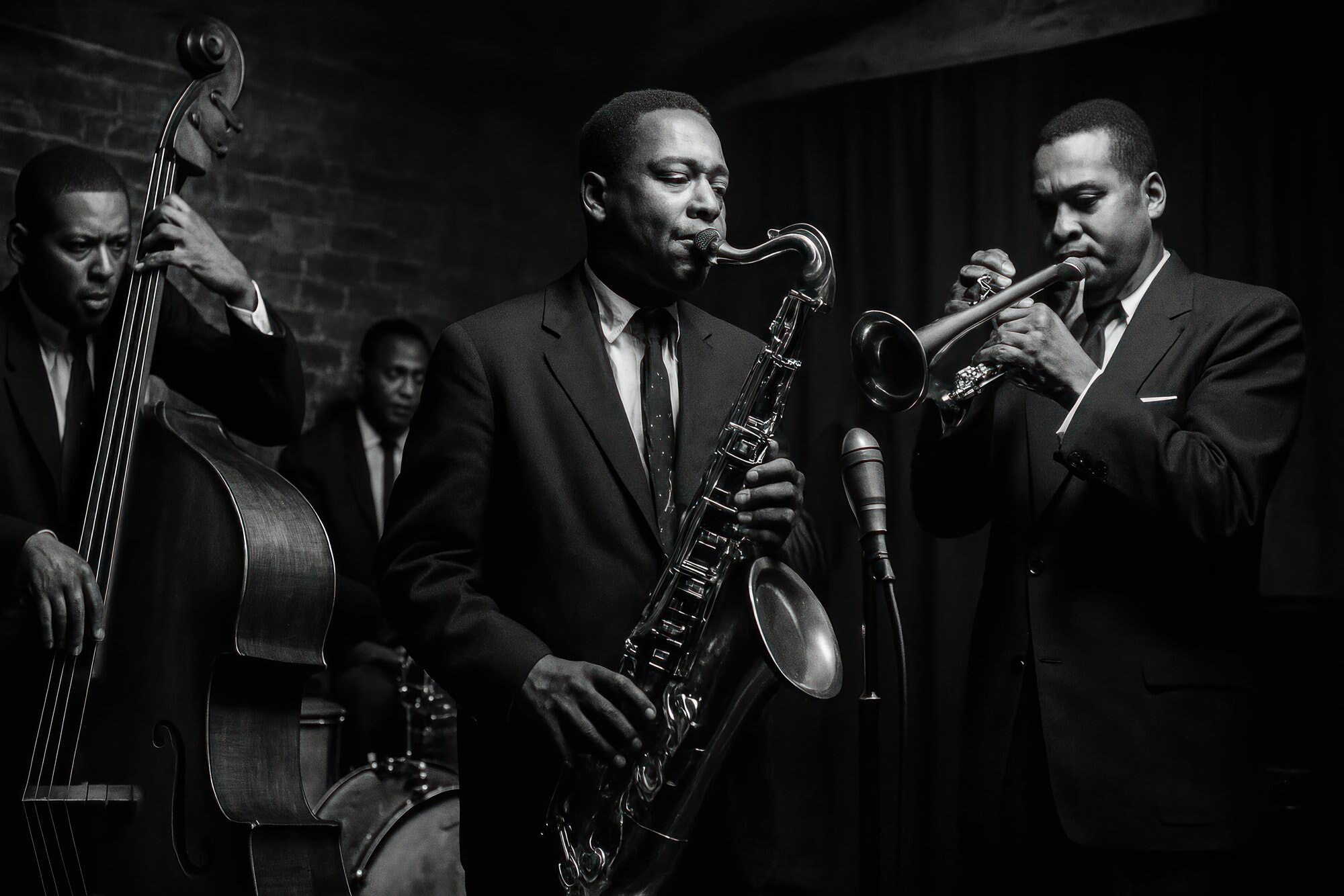
Cool jazz is modern jazz in which a light instrumental tone and measured phrasing can ride over a hard-swinging beat. “Cool” describes the delivery, not the feeling: an unhurried phrase can carry tension without a forceful attack. Carefully balanced ensemble writing gives that contrast room to work.
The style took shape in the United States after World War II, drawing on earlier approaches to tone and bebop’s harmonic ideas. Its sound is easiest to grasp by following the relationship between a soloist and the musicians underneath: a phrase may seem to float while the beat keeps pushing forward.
In This Article
- What Does It Sound Like?
- Where Did It Come From?
- Why Does Birth of the Cool Matter?
- How Do Written Parts and Improvisation Work Together?
- Why Is the West Coast So Closely Associated With It?
- What Do Brubeck and Desmond Add?
- Key Takeaways
- Frequently Asked Questions
- Listen for Tone and Space
What Does It Sound Like?
Cool jazz often favors a clear, light tone over a rough or heavily accented attack. Vibrato, the slight wavering of a sustained pitch, may be subtle or used sparingly. That leaves the shape of the phrase exposed: you can hear where a note begins, how long it lasts, and where the player lets it go.
Letting a note go creates space. A soloist may leave silence where another would add a flourish, allowing the accompaniment to register between phrases. Cool jazz music gives those supporting sounds a place in the balance instead of letting a dominant solo voice bury them.
Chet Baker’s trumpet makes the relationship especially clear. Follow the ends of his phrases as closely as their beginnings; the space after a line belongs to the performance, too. His direct, unhurried attack does not require a slow tempo. The trumpet can sound at ease while the rhythm section beneath it keeps moving briskly.
Where Did It Come From?
Lester Young supplied an important earlier model through his work with Count Basie in the 1930s. His tenor saxophone had a lighter sound than the weightier approach associated with Coleman Hawkins. Young could command attention without pressing every note, making the rhythm section’s pulse a partner instead of something he had to overpower.
On “Lester Leaps In,” recorded in 1939, follow Young’s saxophone against the Basie group’s beat. His phrases feel loose without losing their connection to the pulse. The band gives you a firm rhythmic reference; Young’s relaxed delivery floats over it. That difference between the steadiness underneath and the freedom above is the change in sound to hear.
Young’s example carried into the next decade, when bebop brought sophisticated chords and a strong commitment to improvisation. Cool players retained those demands while changing the texture and delivery. The improviser still had harmonic work to do, but a lighter sound could make that work feel less insistent to the ear.
Why Does Birth of the Cool Matter?
Miles Davis’s nonet recorded in New York in 1949–1950; the recordings were collected as Birth of the Cool in 1957. A nonet is a nine-player group, large enough for varied instrumental combinations but smaller than a big band. The album’s title became a powerful label for the style.
The sound behind that label depended on arrangements as much as Davis’s solo voice. Gil Evans and Gerry Mulligan helped shape writing that featured French horn and tuba. Their middle and low colors changed the balance you would expect from a standard small jazz group built around trumpet and saxophone.
That balance gives the improvisation a distinct setting. The written parts are worth following in their own right, not waiting through until a solo begins. On “Boplicity,” keep your attention on the ensemble: the horns blend into a rounded chord, then separate into moving parts.
How Do Written Parts and Improvisation Work Together?
Written parts can organize what you hear without settling everything the musicians will play. Counterpoint means two or more independent melodic lines sounding together. Instead of each instrument supplying chords beneath one tune, separate lines can answer or overlap one another. Your attention moves between voices.
The Modern Jazz Quartet’s “Vendome,” recorded in 1952, makes that movement concrete through fugue-inspired writing. A fugue develops a musical idea as different voices enter with related material. Follow the idea as it returns in another part, then follow how the performance moves into improvisation. The composed structure remains part of a performance with swing; it does not replace it.
That relationship between structure and freedom also helps explain Lennie Tristano’s place in this history. His piano playing and teaching encouraged long melodic lines and close attention to how an improviser moves through harmony. Cool jazz musicians could make demanding musical thought audible through a restrained surface.
Lee Konitz brings that thought into an immediately recognizable alto saxophone sound. His phrases can turn in unexpected directions, keeping a line from resolving exactly where you anticipate. Compared with Charlie Parker’s approach, the difference lands sharply in Konitz’s dry tone.
Why Is the West Coast So Closely Associated With It?
Los Angeles became an important center for music identified as West Coast jazz. Gerry Mulligan’s pianoless quartet with Chet Baker supplied one of its clearest small-group sounds: baritone saxophone and trumpet had room to work without a piano filling in chords.
Their recording of “Bernie’s Tune” lets you hear how the arrangement works. The two horns state material together, then create space for each other. Bass and drums keep the harmonic movement and pulse clear, so the missing piano does not leave the performance without direction.
That direction lets you follow the horns as partners. When one takes the foreground, the other can provide a moving response underneath; the supporting line remains something you can trace. Follow that response instead of staying with the soloist throughout. Mulligan’s baritone and Baker’s trumpet weave separate lines through the same open texture, without piano chords crowding the exchange.
What Do Brubeck and Desmond Add?
Dave Brubeck and Paul Desmond offer another entry into 1950s jazz through Time Out, released in 1959. The album includes Desmond’s “Take Five,” whose five-beat meter gives it an uneven cycle compared with the four-beat patterns common in jazz. Count through the opening accompaniment until the repeating pattern becomes familiar.
Once that pattern feels settled, shift to Desmond’s melody. His airy alto sound makes the line easy to follow even while the meter gives it an unusual setting. The accompaniment supplies a rhythmic foothold; the saxophone does not have to hammer out the count for you.
For 1950s jazz musicians, an ensemble could gain its identity from differences between its members. This partnership puts that difference directly in your ear. Brubeck’s piano can be weighty and percussive, pressing against Desmond’s floating alto lines.
Key Takeaways
- Follow the rhythm section before judging how relaxed a solo sounds.
- Give a phrase’s ending as much attention as its first note.
- Treat an arranged ensemble passage as something to hear closely, not a wait for the solo.
- In a small group, follow the supporting horn for part of a chorus.
- With an unfamiliar meter, let the repeating accompaniment establish the count.
Frequently Asked Questions
What Is Cool Jazz?
Cool jazz is a style of modern jazz built around lighter tones, measured phrasing, and balanced ensemble sound. A small-band recording can make a pause between phrases especially clear, while a scored ensemble can draw your attention to the blend between instruments. Improvisation remains central to both.
Who Is Best Known for Cool Jazz?
Miles Davis is the strongest starting point because of the landmark collection discussed above. His career extended far beyond this style, while Chet Baker and Gerry Mulligan are closely associated with its small-group sound. Paul Desmond offers a distinctive alto voice if the melody is what first draws you in.
What Came First, Hard Bop or Cool Jazz?
Cool jazz came first as a recognized postwar direction; hard bop developed in the mid-1950s. Hard bop often emphasizes blues and gospel elements, giving you another musical feature to follow beyond instrumental tone. The styles overlapped, and musicians worked across them.
Is West Coast Jazz the Same as Cool Jazz?
West Coast jazz and cool jazz overlap, but they are not the same: one names a regional scene, the other a musical style. Shelly Manne’s work belongs to the West Coast scene and shows its range of musical approaches. The pianoless horn exchange described above is one sound within that scene, not its definition.
Is Cool Jazz the Same as Smooth Jazz?
Cool jazz and smooth jazz are different styles, with smooth jazz developing later through polished production and elements of pop and R&B. A gentle instrumental sound can occur in either. The ensemble writing and improvisational exchanges discussed here give you more to go on than gentleness alone.
Listen for Tone and Space
Choose “Boplicity” first if you want to follow arranged instruments working together. Choose “Bernie’s Tune” if you prefer a small group whose musical exchanges are easier to trace. “Vendome” suits a listener interested in how a written idea passes between parts. Give your choice a full hearing before moving to another track.
On the next pass, follow one player from the written melody into the solo. Pay attention to whether the attack changes and how long each phrase lasts. Keep the accompaniment in your ear when the soloist stops; do not skip ahead mentally to the next entrance. Where does the player leave a pause, and what happens in the music during that pause?