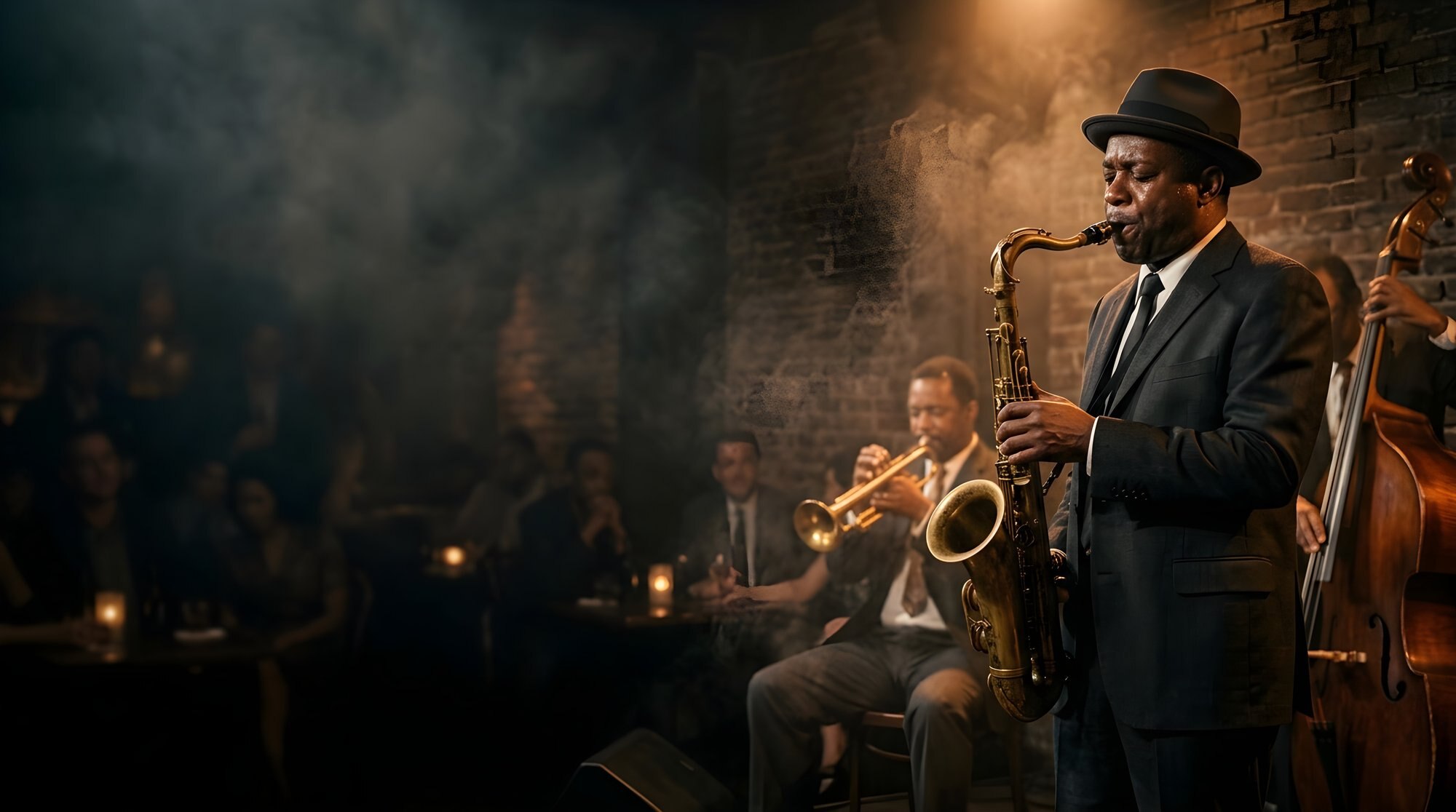
The main types of jazz music range from New Orleans jazz’s overlapping horns to swing’s four-beat drive, bebop’s sharp turns, and the electric crunch of fusion. Other styles stretch a single harmony, soften the band’s attack, or let players pull the beat apart. These 12 styles cover much of that range: in each, the rhythm and the way musicians answer one another give the sound its character.
In This Article
- 1. New Orleans Jazz
- 2. Swing
- 3. Bebop
- 4. Hard Bop
- 5. Cool Jazz
- 6. Modal Jazz
- 7. Post-Bop
- 8. Free Jazz
- 9. Avant-Garde Jazz
- 10. Jazz Fusion
- 11. Smooth Jazz
- 12. Latin Jazz
- Key Takeaways
- Frequently Asked Questions
- Choose Your Next Jazz Listen
1. New Orleans Jazz
New Orleans jazz developed through the city’s Black musical communities, drawing on brass-band traditions and blues. Its defining sound is collective improvisation. A cornet or trumpet carries the tune, a clarinet threads a higher line around it, and a trombone pushes back with low responses. The parts rub together without becoming the same part.
That counterpoint gives the music its bustle: the melody remains recognizable even while other voices crowd its edges. There is movement above and below it, with no need for everyone to wait politely for a solo.
Louis Armstrong’s Hot Five recording of “West End Blues” puts a different force at the center. Its opening trumpet passage stands alone, commanding attention before the ensemble enters. Armstrong helped bring the individual soloist to the foreground; here, the horn steps out of the collective sound and takes possession of the room.
2. Swing
Swing became a dominant popular sound during the 1930s, built for bodies moving together. Four steady bass beats per measure give the music its floor; cymbal timekeeping carries the motion forward while melodies lean across the pulse. In a big band, written passages make whole sections strike together, then clear room for a soloist.
Duke Ellington’s orchestra recording of “Take the ‘A’ Train,” written by Billy Strayhorn, makes that push audible. The coordinated phrases land firmly, but their buoyancy keeps the band from sounding stiff. Individual voices emerge without slowing the dance-floor drive.
Gypsy jazz concentrates that drive in acoustic strings. Django Reinhardt and Stéphane Grappelli’s Quintette du Hot Club de France recordings set guitar and violin against firm rhythm-guitar accompaniment. The repeated guitar strokes give the solo lines something solid to spring away from.
3. Bebop
Bebop emerged during the 1940s, closely associated with Charlie Parker and Dizzy Gillespie. Its small groups made room for intricate melodies over rapidly changing chords. Where swing often lays out a broad invitation to dance, bebop can send a phrase darting ahead, stopping short, then changing direction before your feet catch up.
Parker’s “Ko-Ko” captures that concentrated energy. The fast lines arrive in uneven bursts, and the drums puncture the flow with sharp accents. Bass and drums still keep time, but the surface refuses the predictable pattern a ballroom dancer might expect.
Those jagged phrases have a harmonic route underneath them. Bebop players often built new melodies on familiar songs’ chord progressions; the recognizable framework became a launching point for invention. The excitement comes from hearing a player race through that framework without taking the obvious turn.
4. Hard Bop
Hard bop developed in the 1950s from bebop, bringing blues phrasing and gospel-inflected expression closer to the front. The melodies can hit directly even when the solos remain harmonically demanding. The beat has muscle.
Art Blakey and the Jazz Messengers’ “Moanin’,” composed by pianist Bobby Timmons, begins with a phrase that seems to demand an answer. Its call-and-response shape gives the music a church-rooted insistence. Blakey’s press rolls build a rattling surge beneath the band, turning a sustained drum sound into pressure that pushes the horns forward.
That pressure is the attraction: the tune is immediately graspable, while the drumming makes each return feel charged. Hard bop offers an entry into jazz styles whose improvisation is complex but whose emotional address is blunt and close.
5. Cool Jazz
Cool jazz makes its first impression through restraint. Softer attacks and balanced ensemble writing replace bebop’s most heated delivery with a more measured surface. The details are still busy; they simply arrive without elbows out.
Miles Davis’s Birth of the Cool uses a nine-piece ensemble, including French horn and tuba. That instrumentation lets the band blend middle and low voices into something softer-edged than a typical trumpet-and-saxophone small group. On “Moon Dreams,” the written movement between those voices supplies much of the interest. The French horn and tuba help make the ensemble sound shaded and pastel, its phrases gathering quietly instead of flashing past.
6. Modal Jazz
Modal jazz gives improvisers longer stretches within a scale, or mode, instead of a dense succession of chord changes. With fewer harmonic turns to negotiate, a short phrase can expand, climb, or hover. The space around it becomes audible.
Davis’s Kind of Blue (1959) is the essential reference. On “So What,” the main framework moves between two tonal centers a half step apart. That small shift matters because the harmony has stayed put long enough for your ear to settle into it.
Under Davis’s horn, the relative stillness produces a suspended feeling. A note can hang there without the next chord immediately changing its meaning. Compared with bebop’s rapid harmonic traffic, modal jazz makes the soloist’s pauses feel unusually exposed.
7. Post-Bop
Post-bop keeps bebop and hard bop’s resources while opening the music to modal harmony and freer forms. The most useful clue is a band that shares a structure but keeps changing the pressure inside it. The soloist cannot assume the accompaniment will sit still.
Wayne Shorter’s Speak No Evil supplies compositions with unusual harmonic movement. Herbie Hancock’s “Maiden Voyage” creates a different kind of uncertainty through sustained harmonies and a carefully shaped theme. Its piano chords recur like a signal, leaving open space around the horns.
In “Maiden Voyage,” bassist Ron Carter and drummer Tony Williams make that space active. Carter gives the music low, resonant grounding, while Williams’s cymbal accents and drum responses change the weight around Hancock’s repeating chords. The pulse remains present, but it does not feel nailed down. That tension between a recognizable figure and restless accompaniment gives post-bop a physical identity beyond its broad label.
8. Free Jazz
Free jazz loosens or removes predetermined chord progressions and regular bar lengths. The musicians can build the shape through their responses to one another, letting a cry from a horn or a sudden rhythmic surge determine what happens next.
Ornette Coleman’s Free Jazz (1961) uses a double quartet, with the groups separated across the stereo channels. Collective passages alternate with featured improvisers. The stereo separation lets you hear activity pressing in from both sides, then catch one voice as it rises through the mass.
Coleman’s plastic alto saxophone brings a particularly vocal edge: pinched cries, rough squawks, and phrases that sound urgently spoken. The other players can gather around that edge or answer with their own. The friction between those voices is part of the music’s forward motion.
9. Avant-Garde Jazz
Avant-garde jazz covers experiments in composition and instrumental sound as well as free improvisation. A piece may challenge your expectations by changing what an instrument does, even when its ensemble passages are carefully written.
Cecil Taylor’s Unit Structures makes the piano feel like a percussion instrument with an enormous reach. Sharply articulated attacks pile into dense shapes; low notes strike with weight, while higher figures scatter across them. The physical impression is of hands driving into the keyboard, not a melody floating above a polite chord accompaniment.
The ensemble writing gives those attacks something to collide with. Horn phrases and piano gestures meet at hard angles, making the arrangement itself part of the experiment. Taylor’s intensity comes from the relationship between those sounds, not simply from playing more notes.
10. Jazz Fusion
Jazz fusion joins jazz improvisation to rock, funk, and other amplified music. Electric instruments change the grain of the sound, and repeated bass patterns or backbeats give solos a different footing from acoustic swing.
Davis’s Bitches Brew (1970) uses electric keyboards and layered percussion in extended, shifting grooves. Instruments enter and recede inside an evolving group texture. The repetition holds you in place while the sounds above it keep changing.
Weather Report developed distinctive ensemble colors around keyboards and electric bass. Mahavishnu Orchestra made the blend more abrasive: on “Meeting of the Spirits,” from The Inner Mounting Flame (1971), distorted electric guitar and intricate rhythmic figures give the music a roaring, rock-scale force. The tightly repeated figure bears down while the guitar cuts across it. That is fusion’s electric friction made tangible.
11. Smooth Jazz
Smooth jazz centers accessible melodies and polished production, often drawing on R&B and pop. Steady grooves support shorter, more contained improvisational passages. The tune stays within reach.
Grover Washington Jr.’s Winelight offers warmth first. His saxophone phrasing bends into the melody while the accompaniment maintains an even, supportive feel. Kenny G’s Duotones pushes toward a brighter gloss, with the soprano saxophone’s high, singing voice placed at the center of attention.
Across the style, sustained synthesizer pads can soften the background while slap bass gives the groove a crisp snap. Among different jazz genres, smooth jazz makes this combination especially prominent: a cushioned surface with enough rhythmic definition to keep moving. Washington’s rounded phrasing and Kenny G’s gleaming soprano show two ways a solo voice can inhabit that surface.
12. Latin Jazz
Latin jazz combines jazz improvisation with rhythmic traditions from Latin America and the Caribbean. The rhythm’s source makes a real difference to the sound, so Cuban and Brazilian approaches need separate attention.
Afro-Cuban jazz often organizes its parts around clave, a repeating rhythmic pattern. Machito’s Afro-Cubans were important to its development in New York. Percussionist Chano Pozo’s work with Dizzy Gillespie, including “Manteca,” brought Cuban rhythm into an influential encounter with jazz horns. Conga patterns interlock beneath the brass; the horns’ hard accents create friction against that rolling percussion instead of flattening it into one repeated thump.
Brazilian bossa nova has a lighter, more intimate feel. Antônio Carlos Jobim and João Gilberto are key figures, and Gilberto’s guitar accompaniment interlocks with his understated singing. After the impact of Gillespie’s brass, that guitar-and-voice relationship reveals a quieter rhythmic pull within the same broad category.
Key Takeaways
- Treat the different types of jazz as routes into recordings, not rigid boundaries around musicians.
- Compare the accompaniment: a steady dance pulse, suspended harmony, and a responding rhythm section create different expectations.
- A familiar melody can provide an entry into music whose solos initially feel difficult.
- Contrast acoustic and electric recordings to hear how instrumental texture changes the force of a performance.
Frequently Asked Questions
What Is a Fast-Paced Jazz Style?
Bebop is a fast-paced jazz style, though its jagged phrasing is a better identifier than speed alone. Parker’s “Ko-Ko” is the example above to choose if you want that headlong feeling. Fast swing can feel more even underfoot because its ensemble phrases support a dance pulse.
What Are the Different Eras of Jazz Style?
A broad timeline runs from early New Orleans jazz through swing and bebop, then into overlapping modern, experimental, and electric approaches. The dated recordings above offer useful reference points within that progression. Earlier approaches remain active, so an era describes a style’s emergence rather than its expiry.
What Is Latin Jazz?
Latin jazz combines jazz improvisation with Latin American and Caribbean rhythmic traditions. The contrast in the Latin jazz section matters: Afro-Cuban clave and Brazilian bossa nova do not produce the same feel. Percussion alone is not enough to identify the tradition.
How Do You Identify Jazz Music?
You identify jazz through the way musicians improvise, reshape material, and respond to one another, rather than through one required instrument or beat. A saxophone sound alone tells you little. Listen for whether the players alter the tune’s phrasing or change their accompaniment as a solo develops.
What Is the Big 4 in Jazz?
In early jazz history, the “Big Four” commonly refers to a rhythmic pattern associated with Buddy Bolden that accents the fourth beat of every second measure. It names a rhythmic feature, not a universally accepted ranking of four artists. That distinction separates a historical term from a claim about jazz’s greatest musicians.
What Types of Jazz Are There?
The jazz genres covered here are New Orleans jazz, swing, bebop, hard bop, cool jazz, modal jazz, post-bop, free jazz, avant-garde jazz, jazz fusion, smooth jazz, and Latin jazz. Related traditions can sit within or alongside those labels. Davis’s appearances across several sections show why an artist need not belong to only one category.
Choose Your Next Jazz Listen
Choose “Take the ‘A’ Train” if a firm pulse helps you find your way into music. Choose “Moanin’” for a tune with an immediate emotional pull, or “So What” if you prefer room around each phrase. There is no need to master the whole list before choosing a track.
For a sharper contrast, play Kenny G’s Duotones and Coleman’s Free Jazz back-to-back. The first keeps a polished melodic voice in focus; the second sends competing voices into a much rougher conversation. Let your preference guide the next choice, including any curiosity about the record you liked less. You can use these categories to find more of a sound, or to move deliberately away from it.