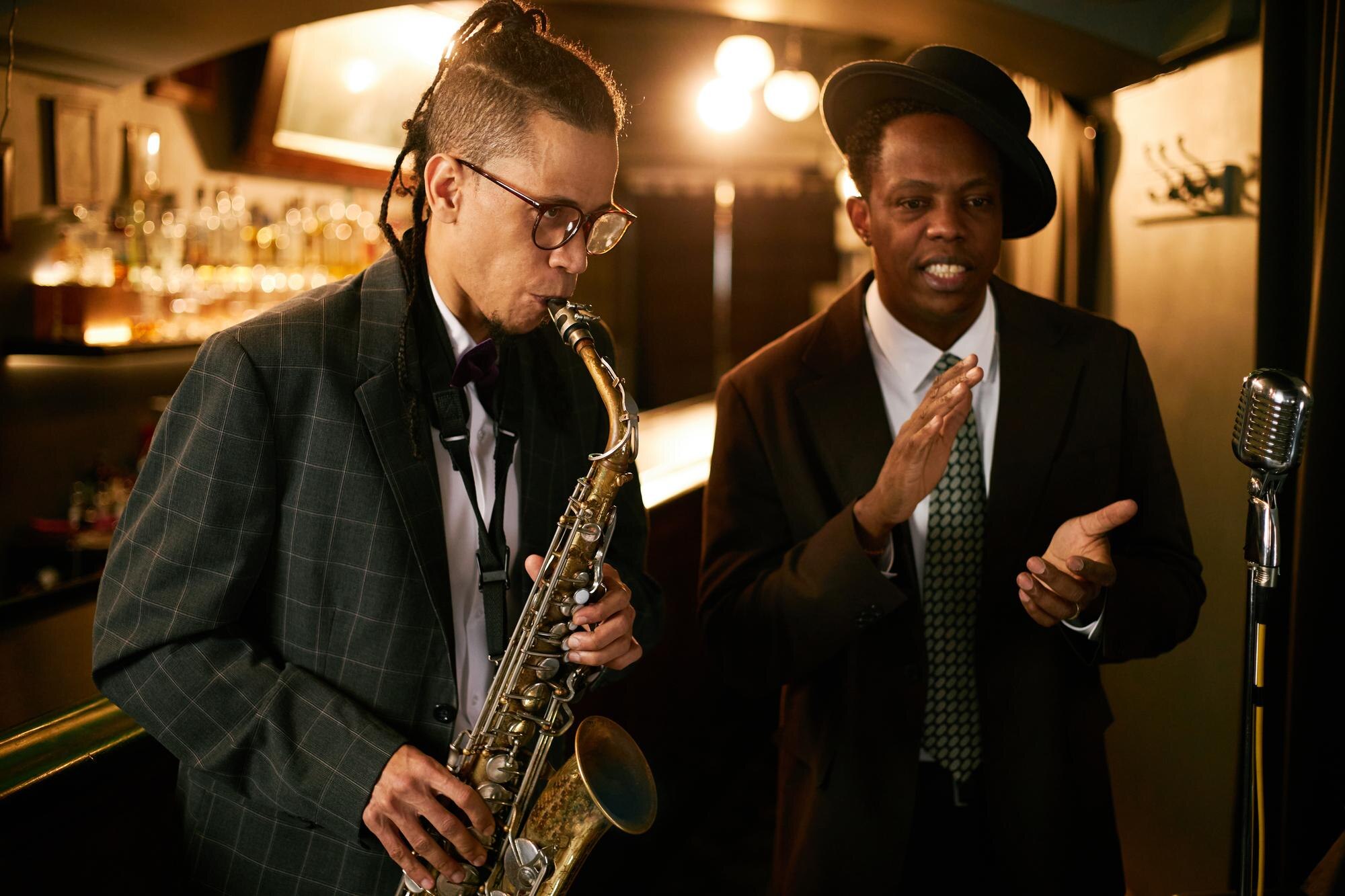
Scat singing is jazz improvisation sung on wordless syllables such as "doo," "bah," and "dat." The syllables mean nothing on their own. They are there so a voice can phrase like a trumpet or saxophone.
In This Article
- What Scat Singing Actually Is
- Where Scat Came From
- Scat Versus Vocalese
- How Different Singers Approach It
- How a Scat Solo Follows the Song
- Key Takeaways
- Frequently Asked Questions
- Start With One Musical Phrase
What Scat Singing Actually Is
In scat music, syllables do the job that articulation does on a horn. A hard "d" or "b" starts a note the way a tongued attack does. An open "ah" or "oo" lets a note ring. A clipped "dat" stops it dead. The same pitch can come out punchy or soft depending on the consonant and vowel used.
Scat has no required vocabulary to memorize, but syllable choices still matter. Two singers using identical sounds can make completely different solos, because the rhythm and the melody carry the music. Syllable choices shape articulation, tone color and rhythmic character; vowel patterns can also give longer phrases color and symmetry.
Cab Calloway's "Minnie the Moocher" (1931) shows how much rhythm one syllable can hold. His "hi-de-hi-de-ho" lines are short and sharp enough that the band shouts them straight back at him.
Where Scat Came From
Chicago, 1926. Louis Armstrong and his Hot Five are recording "Heebie Jeebies" for the OKeh label. In Armstrong's telling, his lyric sheet slipped to the floor halfway through the take. He didn't stop. He kept the vocal going on syllables, the band kept playing, and the take was released.
It makes a perfect origin story. It is also not the whole truth. Gene Greene's "King of the Bungaloos" had nonsense-syllable passages on record in 1911, fifteen years earlier.
What changed in 1926 was reach. Louis Armstrong’s scat singing on a widely heard record brought the technique to a big audience. Put the vocal chorus of "Heebie Jeebies" next to one of his Hot Five trumpet solos and you hear the same snap, with accents falling between the beats. He was singing the way he played.
Scat Versus Vocalese
The two are easy to confuse and easy to tell apart. Scat is improvised on syllables with no meaning. Vocalese runs the other way: a lyricist writes words to an existing instrumental solo, and singers then perform that solo note for note.
Classic vocalese pieces set lyrics to preexisting instrumental performances, including solos and ensemble passages. Eddie Jefferson wrote lyrics to Coleman Hawkins's 1939 "Body and Soul" solo. King Pleasure's "Moody's Mood for Love" puts words to James Moody's saxophone solo on "I'm in the Mood for Love." Lambert, Hendricks & Ross went further on Sing a Song of Basie (1957) and gave lyrics to whole Count Basie band arrangements.
So the test is simple. Words fitted to a preexisting instrumental solo or ensemble passage mean vocalese. Wordless syllables over a line that would be different the next night mean scat. Many singers did both, and Jon Hendricks scatted as freely as he wrote vocalese.
How Different Singers Approach It
Once you can hear the rhythm under the syllables, comparing scat artists turns into a study of choices.
Ella Fitzgerald is celebrated for her horn-like scat improvisation. Her "Flying Home" (1945) runs like a big-band horn chorus. On "How High the Moon" from Ella in Berlin (1960), she drops quotes from other songs into the solo and folds them into the line without breaking stride.
Sarah Vaughan used her wide range and dark tone for big leaps. "Shulie a Bop" (1954) shows how fast she could jump between registers.
Betty Carter, nicknamed "Betty Bebop" while she sang with Lionel Hampton's band, stretched and squeezed phrases until the rhythm itself became the surprise.
Mel Tormé was also a drummer. His articulation was light and exact, closer to a clean-toned horn than to a shout.
When comparing performances, listen for phrase length, rests and register changes. Describe the passage you hear rather than treating one choice as a singer's fixed signature.
How a Scat Solo Follows the Song
In conventional jazz scatting, a solo usually follows the tune's form, whether that is a 12-bar blues or a 32-bar AABA song, and moves through the chord changes the band is playing. Scat singers can also explore free improvisation. Good scat jazz is a conversation with the rhythm section.
That conversation takes practice. A held note can change its effect when the harmony moves underneath it; moving a half step is not an automatic fix. When C major changes to F major, for example, G can move a whole step to A, the new chord's third. To hear those targets, practise singing each chord's root, then its root and third, then its root, third and fifth. Begin by landing on a chord tone as the chord changes. That is an exercise in hearing harmony, not a rule for every phrase.
The rest of the work happens around those landings. As a beginner exercise, leave a beat of silence between phrases, then vary the gap and listen for the band's response. Try a long-short eighth-note pattern as a starting exercise, not a fixed formula for swing. Repeat a three- or four-note motif over changing chords, adjusting its pitches by ear. Then vary its rhythm or leave more space.
Fitzgerald's "How High the Moon" is good practice material because the same chord changes underlie Charlie Parker's "Ornithology." Follow one of her motifs through the changes and you can hear it bend at each new chord and settle onto a chord tone.
Key Takeaways
- Scat uses improvised syllables to make the voice work like a jazz instrument.
- Rhythm and note choice matter more than any fixed set of syllables.
- Armstrong's "Heebie Jeebies" made scat famous, but wordless singing was on record by 1911.
- Vocalese sets words to an existing solo, while scat invents the line on the spot.
- Begin with one short phrase, then change it while keeping the pulse.
Frequently Asked Questions
Who is the most famous scat singer?
Ella Fitzgerald is one of scat's most celebrated singers; Louis Armstrong is another central figure in its history. For a clear Fitzgerald example, listen to "How High the Moon" from Ella in Berlin (1960). Her official store describes that performance as a lengthy scat showcase: an example of wordless improvisation rather than newly invented lyrics.
Why is it called scatting?
The musical noun "scat" dates to 1926. Its precise origin is uncertain, but it probably imitates one of the syllables sung. What scatting means in practice is clear: improvising a melody on wordless sounds.
Is scat singing difficult?
Scat singing is easy to start and hard to master. Anyone who can keep a steady beat can repeat a short phrase on "doo" and "bah." The hard part is hearing the chords change in real time and moving your pitch to match before the moment passes.
What are some examples of scat singing?
Fitzgerald's 1947 "Oh, Lady Be Good!" is a standard example and an easy one to follow. For something stranger, try Leo Watson with the Spirits of Rhythm. His style was looser and more eccentric than almost anyone's.
Do you need to know music theory to scat?
No, many singers learn scat by ear by copying phrases from records. Some theory still helps. Knowing which notes belong to each chord makes it easier to land a phrase where the harmony wants it.
Start With One Musical Phrase
For your first practice session, separate the tasks: keep the notes simple while you vary the rhythm, then keep the rhythm simple while you try different notes. You do not need to imitate a singer's speed to begin exploring those choices.
To begin without transcribing a recording, sing C–D–E–G on "doo" in a comfortable register, one note per beat. Repeat the phrase, keeping the pitches but changing the rhythm. Delay the first note, or put a rest before the last one. Tap a steady beat throughout. Once that feels comfortable, change one pitch and repeat.