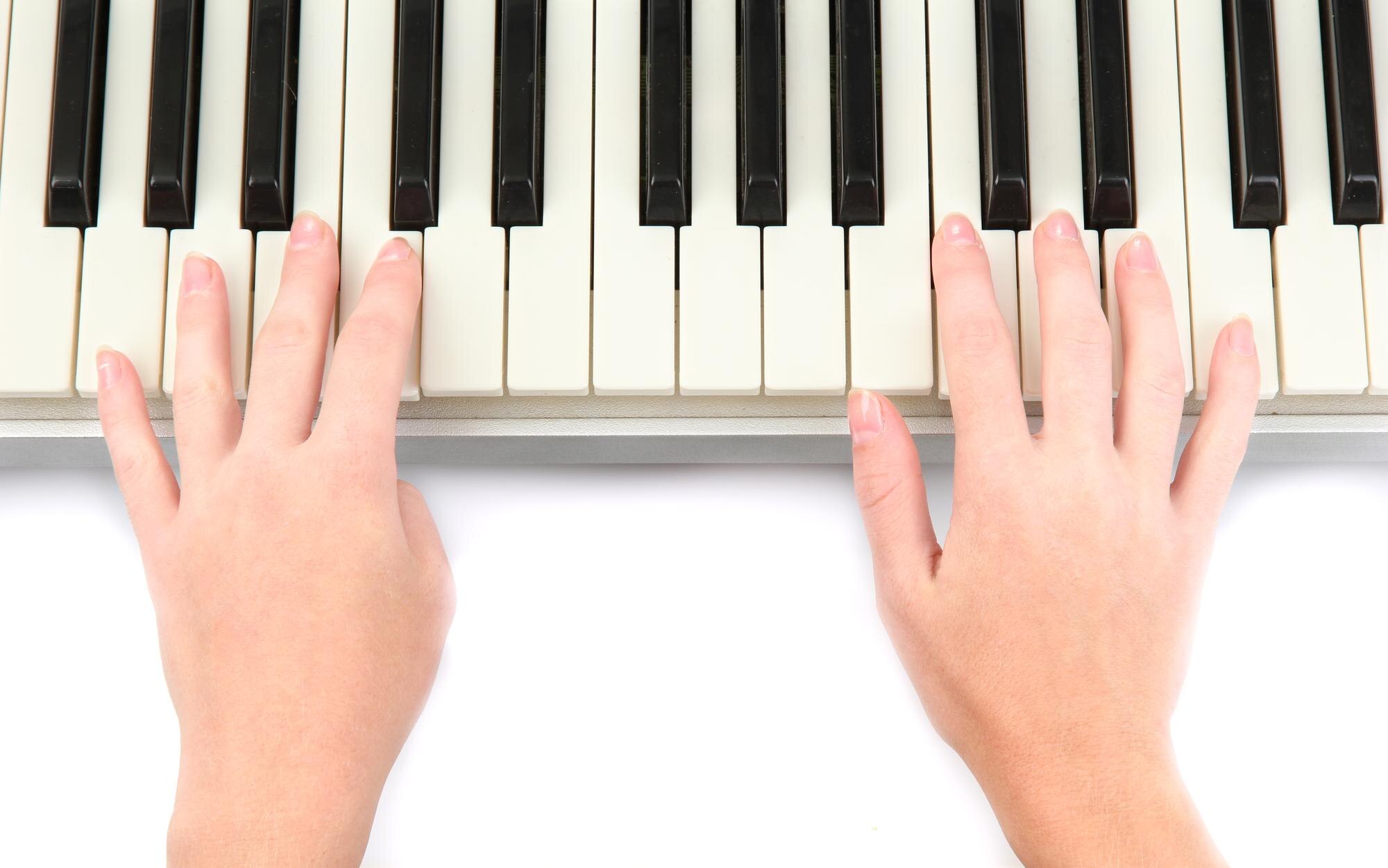
Piano chords are groups of notes you play at the same time. The most common kind is a three-note triad: a root, a third above the root, and a fifth above the root. You build every triad by counting half steps up from the root. Put your right thumb on middle C, count four keys up to E and three more to G, press all three together, and you are playing C major.
A symbol like Am works the same way. It gives you the root (A) and the quality (minor), and your fingers supply the notes. Every chord below comes from those three moves: find the root, count up to the other notes, press them together.
In This Article
- Read Chord Charts and Symbols
- Count Half Steps Between Keys
- Build Major, Minor, Diminished, and Augmented Triads
- Place Your Fingers on the Keys
- Add Sevenths and Suspended Notes
- Play C–G–Am–F With Both Hands
- Key Takeaways
- Frequently Asked Questions
- Play Your First Three Chords
Read Chord Charts and Symbols
A chord symbol starts with the root letter and any sharp or flat belonging to it, as in C♯. What follows can indicate quality, extensions, or alterations. A note after a slash specifies the bass: C/E means C major with E as the lowest note. C alone means C major. Cm, Cmin, or C– means C minor. Cdim or C° means diminished, and Caug or C+ means augmented. A number such as 7 adds a note, and "sus" swaps one out.
Lead sheets print these symbols above the melody line. Simpler song charts often print them over the lyrics with no staff at all. Here is the first line of "Happy Birthday" as a chart in C:
C                  G
Happy birthday to you
The C sits over "Happy," so you play C major as the line begins. You hold it until the next symbol, then change to G on the word "you." The symbol marks the moment of change, and the chord lasts until another one replaces it.
The root letter is where you begin on the keys. The black keys come in alternating groups of two and three. C is the white key just left of any group of two. From there the white keys run C, D, E, F, G, A, B, and then C again. Find middle C near the center of a piano or keyboard, and you have a home base for every chord in this article.
What the symbol leaves out matters too. It doesn't say which octave to use or which hand plays what, but a slash specifies the bass note: C/E requires E as the lowest note. Without another bass specified, root position is conventionally assumed. That C over "Happy" means C, E, and G, with C in the bass. You can arrange the upper notes or spread them across both hands while keeping C lowest. E–G–C alone is still C major, but its E bass is shown as C/E. The next section turns the root and quality into keys.
Count Half Steps Between Keys
A half step is the distance from one key to the very next key, black or white. C to C♯ is a half step, and C♯ to D is another. Where no black key sits between two white keys, the white keys themselves are a half step apart. That happens in two places: E to F, and B to C. Beginners who count only the gaps with black keys come up short at exactly those spots.
For major and minor triads, measure the third and perfect fifth above the root. Three half steps make a minor third, four make a major third, and seven make a perfect fifth. From C, count four keys up (C♯, D, D♯, E) and you reach E, a major third. Count seven from C and you reach G. Those piano chord notes, C, E, and G, form C major. It is the friendliest chord for beginners because all three keys are white.
Use counting to build unfamiliar chords, then practise recognizing their shapes. If you know C major as three white keys, a chart that asks for E♭ or B♭ gives you a chance to apply the same interval pattern from a different root. Find that root, count up to the third and fifth, and play the notes together. Repeat the shape until you can find it without recounting. Counting and memorization support each other: one explains the notes, and the other helps you change chords without stopping.
The same count catches mistakes. If a shape sounds sour, recount it from the root. A missed E–F or B–C half step is usually the culprit.
Build Major, Minor, Diminished, and Augmented Triads
The four triad qualities differ in just two gaps: root to third, and third to fifth. Major is 4 then 3 half steps. Minor is 3 then 4. Diminished is 3 then 3, and augmented is 4 then 4. Major and minor share the same fifth, seven half steps above the root, so only the third moves between them. Diminished pulls the fifth down to six half steps, and augmented pushes it up to eight.
Apply those gaps to A. The A minor piano chord uses only white keys: A–C–E, a gap of three and then four. Raise the C to C♯ and you have the A major chord piano players use for songs in A: A–C♯–E. One key moved by one half step, and to most ears the chord turns brighter. Playing the two shapes back to back is the quickest way to hear what a third does.
Diminished and augmented triads follow the same method. D diminished is D–F–A♭, three half steps and then three, written Ddim or D°. G augmented is G–B–D♯, four and then four, written Gaug or G+. Both sound unstable next to major and minor. In most songs they appear briefly and then move on to a steadier chord.
Black-key roots use the same count. The C# piano chord in its major form is C♯–E♯–G♯. C♯ and G♯ are black keys, and E♯ is played on the white key you know as F. The gaps are still four and then three.
Beginner piano chords: four triad types compared on C
| Piano chord type | Chord symbol (C root) | Notes, low to high | Half-step gaps: root–3rd / 3rd–5th | Sound and common use |
|---|---|---|---|---|
| Major | C or Cmaj | C–E–G | 4 / 3 | Bright, stable; home chord in C major |
| Minor | Cm or Cmin | C–E♭–G | 3 / 4 | Darker, stable; home chord in C minor |
| Diminished | Cdim or C° | C–E♭–G♭ | 3 / 3 | Tense; lowered third and fifth compared with C major |
| Augmented | Caug or C+ | C–E–G♯ | 4 / 4 | Unsettled; chromatic transition from C major to F major |
Using C as the root, major, minor, diminished and augmented piano triads have half-step gaps of 4 then 3, 3 then 4, 3 then 3, and 4 then 4, respectively.
Place Your Fingers on the Keys
Before placing your hand, learn the finger numbers, which are the same on both hands. The thumb is 1, the index finger is 2, the middle finger is 3, the ring finger is 4, and the pinky is 5.
For C major in the right hand, your thumb takes C, your middle finger takes E, and your pinky takes G. D and F sit unplayed under fingers 2 and 4. For A minor, move the whole hand so the thumb lands on A, the middle finger on C, and the pinky on E. For G major, the thumb goes on G, the middle finger on B, and the pinky on D.
Those three placements show the count from the last section in your hand. In C major and G major, three keys lie between the root and the third, counting the black ones. In A minor only two do, so the middle finger sits a little closer to the thumb. Your hand feels the minor third before your ear names it.
The left hand reverses the order: pinky on C, middle finger on E, thumb on G. Your left thumb points toward the higher keys, so it takes the top note. Write it as 5–3–1, against 1–3–5 in the right hand.
Curve your fingers slightly and press with the fingertips so all three keys go down at the same moment. If one note sounds late or weak, lift the hand and set it down again. Pressing harder won't fix it. The same 1–3–5 and 5–3–1 fingering fits any root-position triad, so one hand position covers every root you can count.
Add Sevenths and Suspended Notes
A seventh chord stacks one more note on top of a triad, giving you four notes. On C, three seventh chords come up constantly:
- C7: C–E–G–B♭. A major triad plus the note ten half steps above the root. A plain 7 always means this chord, called a dominant seventh.
- Cmaj7: C–E–G–B. A major triad plus the note eleven half steps above the root. It is also written CM7 or CΔ7.
- Cm7: C–E♭–G–B♭. A minor triad plus the same B♭ as C7. It is also written Cmin7 or C–7.
The symbols trip readers up because "maj" and "m" refer to different notes. In Cmaj7, "maj" describes the seventh: C7 and Cmaj7 share the same major triad and differ only in B♭ versus B. In Cm7, the "m" describes the triad, which has E♭ in place of E. In the right hand, fingers 1–2–3–5 cover any of these three shapes in root position, with the index finger joining in on the third.
Suspended chords drop the third altogether. Csus2 is C–D–G, with the second (two half steps up) in place of E. Csus4 is C–F–G, with the fourth (five half steps up) in its place. The number tells you which note stands in for the third.
Without a third, a sus chord is neither major nor minor, and it sounds like a question. Play Csus4 and then C major. Your middle finger slides from F down one half step to E, and the question gets its answer.
Play C–G–Am–F With Both Hands
In the key of C major, the chords built on the first, fifth, sixth, and fourth notes of the scale are C, G, Am, and F. In Roman numerals that is I–V–vi–IV, with the lowercase vi marking the minor chord. The right-hand triads are C–E–G, G–B–D, A–C–E, and F–A–C. All four use only white keys, so these basic piano chords let you focus on rhythm and hand coordination.
Count a steady 1-2-3-4 for each chord, slowly enough that you never stop between changes:
- C: left hand plays C, right hand plays C–E–G, four beats.
- G: left hand plays G, right hand plays G–B–D, four beats.
- Am: left hand plays A, right hand plays A–C–E, four beats.
- F: left hand plays F, right hand plays F–A–C, four beats.
Play the left-hand root on beat 1 and hold it. In the right hand, either hold the triad for all four beats or replay it on each beat. Then loop back to C.
The jumps in the right hand are the hard part, especially from C up to G. Once the root-position version feels steady, keep your right hand near middle C instead. Play G as B–D–G and F as A–C–F. The left hand still plays G and F, so the chord names don't change, as the symbol section promised. With less distance to cover, the changes land on the beat.
Key Takeaways
- A triad contains a root, a third, and a fifth.
- Count half steps between adjacent keys, including the white-key pairs E–F and B–C.
- Major and minor triads differ by the third.
- Diminished triads lower the fifth; augmented triads raise it.
- Chord symbols identify the root and quality, not a mandatory hand position.
Frequently Asked Questions
What is a famous song that uses only three chords?
"Happy Birthday" is one of the best-known songs that uses only three chords. In C major it can be accompanied with C, F, and G, the I, IV, and V chords of the key. Its first line, shown in the chord symbol section, uses just C and G.
Can the same chord be played in different octaves?
Yes, a chord keeps its name in any octave. C–E–G near middle C and C–E–G an octave higher are both C major, because the note names haven't changed. Lower octaves sound darker and can get muddy in close triads, which is one reason the left hand often plays just the root down low.
Does changing the order of the notes change the chord's name?
Reordering the notes keeps the chord's root and quality, but changing the overall bass can change its symbol. E–G–C and G–C–E alone are C major in first and second inversion, written C/E and C/G. If a lower C sounds beneath either arrangement, the overall chord remains in root position, written C.
Why does C♯ major contain E♯ and not F?
C♯ major contains E♯ because the third of any C chord has to be some kind of E. E♯ and F are the same key on the piano, but spelling the note E♯ keeps the root–third–fifth letters in order: C, E, G. Written as C♯–F–G♯, the chord would look like it has a fourth in place of a third.
Does a chord symbol tell you which hand to use?
No, the symbol leaves the hands to you. A common beginner setup puts the triad in the right hand and the root in the left. When you play from a lead sheet with a written melody, the right hand often takes the melody and the left hand covers the chord.
Play Your First Three Chords
For a final check, return to C, F, and G without looking at the note lists. Build each right-hand triad from its root, then play C–F–G–C with the left hand supplying each root below. Hold each chord for four steady beats. If you stall at a change, slow the count for the next attempt rather than rushing the jump. Your practice target is three full loops with all three notes sounding together and no pause between chords.