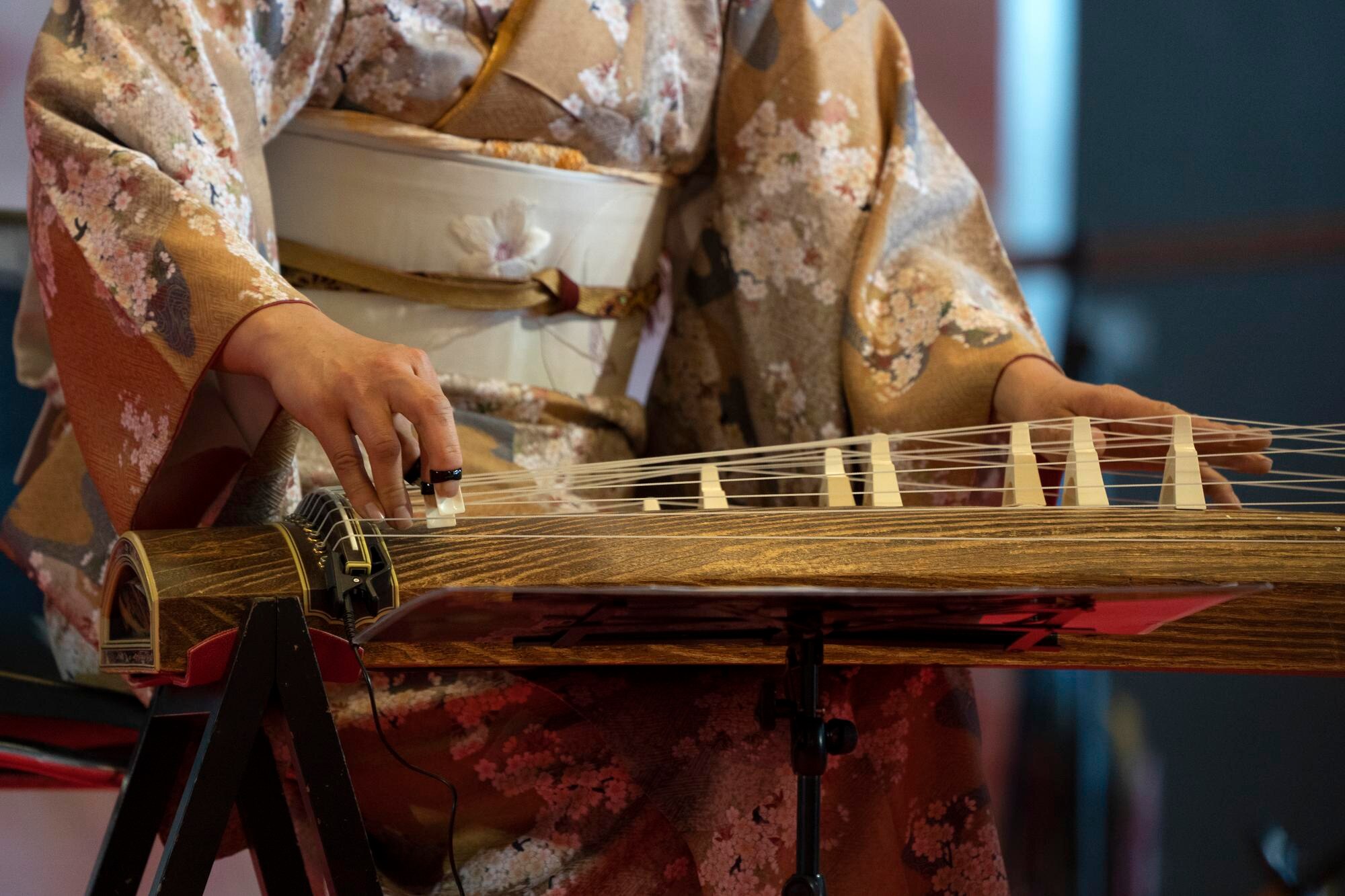
The koto is a Japanese zither, usually with 13 strings stretched over movable bridges on a long hollow wooden body. Players pluck it with picks worn on the fingers and can bend a note’s pitch by pressing the string with the other hand. That bending can give the koto sound a singing, voice-like quality. This article covers where the koto instrument came from, how it is built, tuned and played, its two main schools and its larger forms. It ends with what to look for in your first one.
In This Article
- Where the Koto Came From
- How a Koto Is Built
- Bridges, Tunings, and Scales
- How You Play It
- Ikuta and Yamada: The Two Main Schools
- Bigger Kotos: 17, 20, and 25 Strings
- Choosing Your First Koto
- Key Takeaways
- Frequently Asked Questions
- Listen First, Then Check the Setup
Where the Koto Came From
The koto arrived in Japan from China during the Nara period (710–794). It was played in gagaku, the orchestral music of the imperial court, where it was one voice among many. For centuries that was its main role.
That role changed in the 1600s. Yatsuhashi Kengyō (1614–1685), a blind musician who held the highest rank in the guild of blind performers, was central to building a repertoire of solo music for the koto instrument. Rokudan no Shirabe, a piece attributed to him, is still taught to students today.
How a Koto Is Built
The hollow body is traditionally carved from paulownia, a light wood that resonates well. Strings were made of silk for most of the instrument's history. Synthetic strings are common today because they last longer and hold tension better.
Each string rests on its own movable bridge, called a ji. On the floor, the playing end can be raised slightly by two short feet attached to the body.
A standard koto is roughly 180 cm (about 6 ft) long.
Bridges, Tunings, and Scales
The movable ji are what make tuning possible. Sliding a bridge toward one end of the string or the other changes the length of string that vibrates, which raises or lowers its pitch. Players retune between pieces as a matter of routine.
Two traditional tunings stand out. Hira-jōshi gives the five-note scale, with its half steps, that many listeners link with Japanese koto music. Kumoi-jōshi is another characteristic tuning with a different arrangement of intervals. Neither is fixed by the instrument itself. Both come from where you place the bridges.
How You Play It
Your right hand wears picks, called tsume, on the thumb, index and middle fingers. You pluck near the right end of the strings, and the pick creates the attack, the clear start of each note.
Your left hand works on the other side of the bridges. Pressing a string there raises its pitch, either before you pluck or while the note is still sounding, so a single note can rise, waver or slide. That is where much of the expression in koto music comes from. Pitch bends are one expressive tool, not a requirement in every tradition: Stanford’s Gagaku resource notes that present-day court-koto playing no longer uses left-hand pitch modification. Players also vary tone through plucking position, speed and strength.
Picks must fit your fingers snugly; their shape also depends on the school you study.
Ikuta and Yamada: The Two Main Schools
The Ikuta school, associated with Ikuta Kengyō (1656–1715), uses square-ended picks. The Yamada school, founded by Yamada Kengyō (1757–1817), uses rounded picks. The shape changes how the pick meets the string, so each school's tone and technique differ in small but real ways.
Bigger Kotos: 17, 20, and 25 Strings
Miyagi Michio developed the 17-string bass koto in 1921, giving ensembles a deeper voice beneath the standard instrument. Miyagi is also known for Haru no Umi, one of the most widely recognized pieces of modern Japanese koto music. Keiko Nosaka introduced the 20-string koto at her second recital in 1969. Her archive records that she added a 21st string in 1971 to play Minoru Miki’s Tatsuta no Kyoku. She first performed on her newly developed 25-string koto at her thirteenth recital in 1991. These expanded instruments support contemporary solo and ensemble writing beyond the standard koto’s range.
The 17-string bass koto uses thicker strings and picks than the standard 13-string instrument and has both ensemble and solo repertoire.
Choosing Your First Koto
Choose your first type with a teacher, according to the music and lessons you plan to follow. Ask whether a practice instrument is available to rent or borrow: some studios have limited rentals, while others require students to own an instrument. Check the particular instrument’s dimensions, allowing room for the body, your playing position and storage, and plan how you will transport it.
If you buy used, look for cracks in the paulownia body, a full set of undamaged bridges, and strings that hold their pitch. Ask the seller exactly what comes with it: tsume, ji, a stand or feet, and a case or cover. Confirm with your teacher which pick shape and fit your lessons require. Missing accessories add to the total cost. Before paying, have your teacher inspect the instrument and demonstrate its tuning and left-hand pressure; setup problems are hard for a beginner to spot.
Key Takeaways
- The instrument is a Japanese long zither, not a harp.
- Its standard form has 13 strings, each supported by a movable bridge.
- Plucking creates the attack; string pressure adds expressive pitch changes.
- The instrument's size makes space and support important considerations.
- Before committing, confirm condition, included accessories, and help with setup.
Frequently Asked Questions
Is the koto a Japanese instrument?
Yes. It came from China during the Nara period (710–794) and developed its own music, tunings and schools in Japan. People sometimes call it a Japanese harp, but its strings run along a flat body over bridges, which makes it a zither.
How hard is it to play the koto?
Simple melodies come fairly quickly, because each string is tuned to a set pitch and plucking it is straightforward. The difficult part is the left-hand pressing that shapes and bends notes. Regular lessons with a teacher can help you learn.
How much does a koto cost?
For full-size 13-string kotos in Japan’s specialist-retail market, Wagakki Ichiba lists new beginner sets at JPY 139,950–176,000 and selected used instruments at JPY 195,000–550,000. These are advertised examples in Japanese yen, not market averages; the used range includes high-grade instruments, not just beginner models. They are not U.S. delivered prices. Ask for an itemized quote, including shipping, and compare it with any available rental’s fees and deposit.
What's the difference between a koto and a guzheng?
Both are long zithers with movable bridges, and the koto descends from Chinese instruments of this family. The guzheng is Chinese and typically has 21 strings. The two also differ in picks, tunings and repertoire.
Does a koto usually come with finger picks, bridges, and a stand?
Not always. Bridges normally stay with the instrument, but picks, a stand and a case are often sold separately. Ask the seller for a list before you pay.
Listen First, Then Check the Setup
Before choosing an instrument, listen to a performance and notice the clear plucked attacks, the resonance after each note, and any pitch bends. Use those sounds, not appearance alone, as a starting point when discussing an instrument with your teacher.