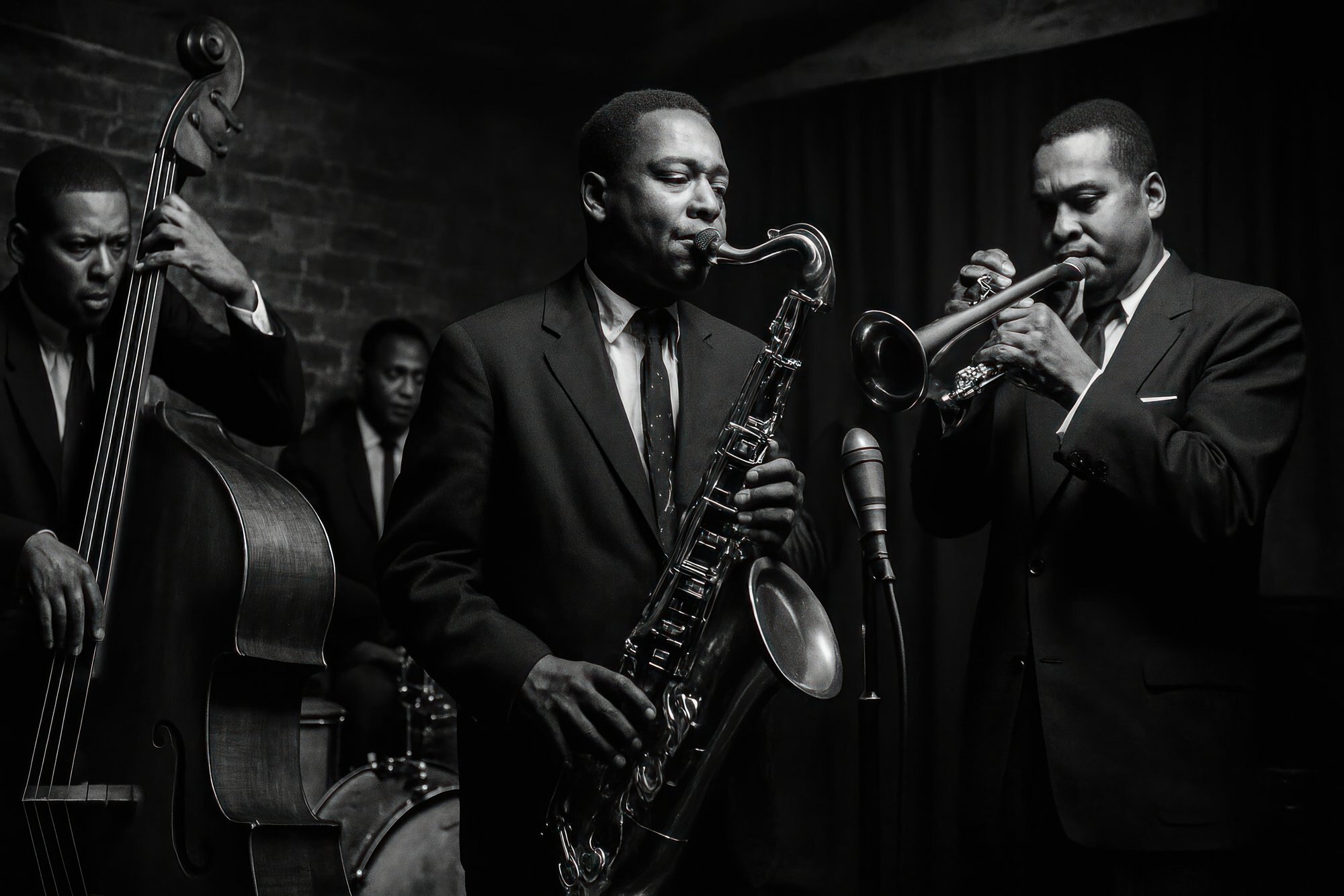
Jazz instruments can put a dry, woody bass pluck beneath a trumpet note that cuts straight through the band. Saxophone, trumpet, piano, guitar, bass, and drums are common, but the lineup can also include clarinet, violin, organ, and other voices.
The useful distinction is how each sound enters, how long it lasts, and what it leaves for the next player. Follow those sounds from a small combo to a full big band.
In This Article
- How Bass and Drums Shape the Groove
- How Piano and Guitar Support the Harmony
- What Makes the Main Horns Sound Different
- Other Sounds You Will Hear in Jazz
- What Changes With the Size of the Band
- How the Lineup Changed Over Time
- Begin With the Instrument You Already Play
- Key Takeaways
- Frequently Asked Questions
- Choose Your Place in the Ensemble
How Bass and Drums Shape the Groove
The double bass gives a note a firm beginning, then lets it decay. On Charles Mingus’s “Haitian Fight Song,” released in 1957, the opening unaccompanied bass passage makes that physical sound impossible to miss: plucked strings carry a melody before the band enters. Mingus’s instrument is no background rumble. It speaks first.
Once a walking line gets going, the bassist commonly plays one note on each beat in a four-beat measure. Those notes connect chords as well as mark time; a line can lean toward the next chord or land squarely on it. The drummer responds to that movement with sounds of different lengths and weights. The bass drum and snare can punctuate a phrase while the ride cymbal carries the main swing pattern in much straight-ahead jazz.
Brushes soften the attack and can make a continuous texture across the snare. Max Roach demonstrated that a drummer could develop musical ideas instead of simply counting off beats. Under a soloist, bass and drums can change accents and intensity while holding the shared pulse and the tune’s form. The beat holds.
How Piano and Guitar Support the Harmony
A piano chord arrives with several struck strings sounding together. Its clear attack places harmony against the beat, and its range lets the player move from bass notes to melody. Rhythmic chord accompaniment is called comping; it gives the soloist something to push against.
That push can become a pile-up when guitar joins in. Suppose the pianist strikes a thick middle-register chord just as the guitarist strums a different voicing there. Each part may sound convincing alone, but together the attacks collide and the chord’s inner notes compete. Alternating comping passages or separating registers gives each sound an edge the listener can follow.
An electric guitarist can balance with the group through amplification, then shape the attack through picking and tone settings. Wes Montgomery’s thumb-picked playing and octave melodies offer a distinct alternative to the piano’s struck notes. Guitar can carry compact chords or single-note lines. It need not compete for every opening.
What Makes the Main Horns Sound Different
Louis Armstrong’s opening trumpet cadenza on the 1928 recording of “West End Blues” puts a brilliant, exposed line ahead of the band. Compare that sharply articulated trumpet entrance with a trombonist sliding between pitches: one separates the notes, while the other can make the distance between them audible. A trombone can also articulate cleanly separated notes. The slide is a choice, not a requirement to smear everything.
That choice of attack matters as much as range. Trumpet can project brightly or turn intimate at low volume, and mutes change its color. Trombone has a broader, resonant voice that can warm a supporting line. Both are brass instruments, sounded by vibrating the lips into a mouthpiece.
Saxophones use a single reed. Among jazz band instruments, they span a wide stretch of the ensemble: soprano, alto, tenor, and baritone occupy successively lower ranges, although their written ranges overlap. Soprano often sounds focused and penetrating; alto has a bright, agile voice, with Charlie Parker a central example. John Coltrane’s tenor offers a fuller, sometimes grainier sound. Baritone adds deep weight and commonly anchors the big-band saxophone section. An arranger can use those differences to make an entrance bite or a supporting passage settle beneath the melody.
Other Sounds You Will Hear in Jazz
The Hammond organ changes what happens after a note begins. Where a piano note naturally fades, an organ tone can stay present, keeping a chord beneath the soloist until the player releases it. That sustained sound makes the spaces between attacks feel occupied. Jimmy Smith helped establish the instrument’s central place in jazz-organ playing, and the organ can supply bass lines as well as chords.
Sustain sounds different on vibraphone. Metal bars give the notes a struck beginning, while a pedal controls how long they ring. Lionel Hampton and Milt Jackson are closely associated with the instrument. Against the organ’s held tone, a vibraphone chord retains the audible impact of mallets hitting bars.
Other instruments used in jazz offer smaller but decisive changes in texture. Clarinet moves from a dark lower register to a bright upper one; cornet, central to early jazz and associated with Bix Beiderbecke, often sounds rounder than trumpet. Flute brings a lighter, breathier attack. Violin can sustain with the bow or turn percussive when plucked, and Stéphane Grappelli’s playing shows how a bowed phrase can carry a strong jazz pulse.
What Changes With the Size of the Band
In a common piano trio, piano, bass, and drums have nowhere to hide. The pianist usually states the melody, but during a bass feature, the disappearance of that main voice makes the quieter instrument newly exposed. A quartet might add saxophone. These names count musicians; they do not prescribe instrumentation.
A standard big band sets five saxophones beside four trumpets and four trombones, supported by a rhythm section. When all thirteen horns attack together, the sound has a mass no trio can produce. Written arrangements coordinate those entrances and chord voicings; the excitement comes partly from many players landing as one.
That mass can also thin suddenly. Saxophonists may double on clarinet or flute, so the available jazz musical instruments can change without another musician entering. A full section is one color, not the band’s permanent volume setting.
How the Lineup Changed Over Time
Early New Orleans jazz put cornet or trumpet beside clarinet and trombone, with banjo or guitar, bass or tuba, and drums underneath. The front line often played simultaneous, related parts. A main melody, a clarinet countermelody, and a lower trombone line stayed distinguishable because their ranges and attacks differed.
Swing-era big bands expanded brass and reed sections and made arranged passages central. Bebop in the 1940s often favored small combos, with more room for extended improvisation over demanding chord progressions.
The 1945 recording of “Shaw ’Nuff,” featuring Dizzy Gillespie and Charlie Parker, makes that shift audible in its fast, tightly coordinated trumpet-and-alto melody. Put that line in a large section and every attack needs agreement across more players; in the small group, two horns can turn together and quickly hand the music to a soloist. Speed did not make big-band bebop impossible. It made precision costly. Earlier instruments remained available, while later acoustic and electric groups kept redistributing the work.
Begin With the Instrument You Already Play
Your first jazz instrument need not be a new purchase. A clarinetist already knows the resistance of a reed; a classically trained pianist already knows where the notes sit. The unfamiliar part may arrive when those familiar notes meet a live swing beat.
Consider a beginner entering with a phrase that sounded secure alone. The bassist keeps moving, the ride cymbal continues, and the phrase suddenly feels planted in the wrong place. Playing louder will not repair its timing. Familiar technique leaves some attention free to hear that mismatch, but it cannot substitute for responding to the band. The written part no longer explains the whole performance. Progress depends on prior experience and practice quality, not a fixed timetable.
Key Takeaways
- Follow a note’s attack and decay to hear why two instruments handle the same phrase differently.
- A rhythm section stays coherent through changes in intensity, not through playing everything at one volume.
- Shared accompaniment needs an agreement about register or timing; more chords can mean less clarity.
- Band size changes the stakes of an entrance, from one exposed voice to a coordinated section.
- Prior technique is useful, but playing with others tests where you place each note.
Frequently Asked Questions
What instruments are used in jazz?
Jazz uses familiar horns and rhythm instruments as well as voices such as cello and synthesizer. Those less conventional choices can carry melody or accompaniment; the musical approach and interaction matter more than an approved inventory.
What instruments are in a jazz band?
A jazz band commonly combines melody instruments with rhythmic and harmonic support, but its exact lineup varies. An organ combo uses the organ’s bass-and-chord capacity to distribute the work differently from an acoustic-piano group. The band’s arrangement determines which parts need separate players.
Can a jazz group perform without a drummer?
Yes, a jazz group can establish its pulse without a drummer. Jim Hall and Ron Carter’s guitar-and-bass album “Alone Together” offers a concrete example. Note placement and articulation make the time audible without a cymbal stating it.
Do jazz ensembles need both piano and guitar?
No, a jazz ensemble can use piano, guitar, both, or neither. With no chordal instrument, a melody and bass line can imply the harmony. The soloist then has more room to suggest chord colors without clashing with a sustained accompaniment chord.
Can electric bass replace double bass in a jazz group?
Yes, electric bass can replace double bass when its sound suits the group. Its more readily sustained, amplified tone changes the texture, and strings and playing technique affect the blend. That change does not prevent jazz phrasing or interaction.
Do saxophones and trumpets only play solos?
No, saxophones and trumpets also play composed melodies, harmonized passages, and accompanying figures called backgrounds. A background can build intensity behind another player’s solo. For a quieter passage, leaving it out may be the stronger choice.
Choose Your Place in the Ensemble
Use the sounds that caught your attention to choose a first role. If the pull of the beat matters most, follow the bass and drums through one complete tune. If chord movement holds your attention, focus on piano or guitar. A particular horn tone may make the melodic role the obvious choice.
Then bring the instrument you already know to one simple tune with other players. Agree on who carries the melody and who accompanies before you begin. Stay with that responsibility through the whole performance, including the places where silence helps. You do not need the largest sound or the busiest part. Your first useful aim is a part the other musicians can rely on.