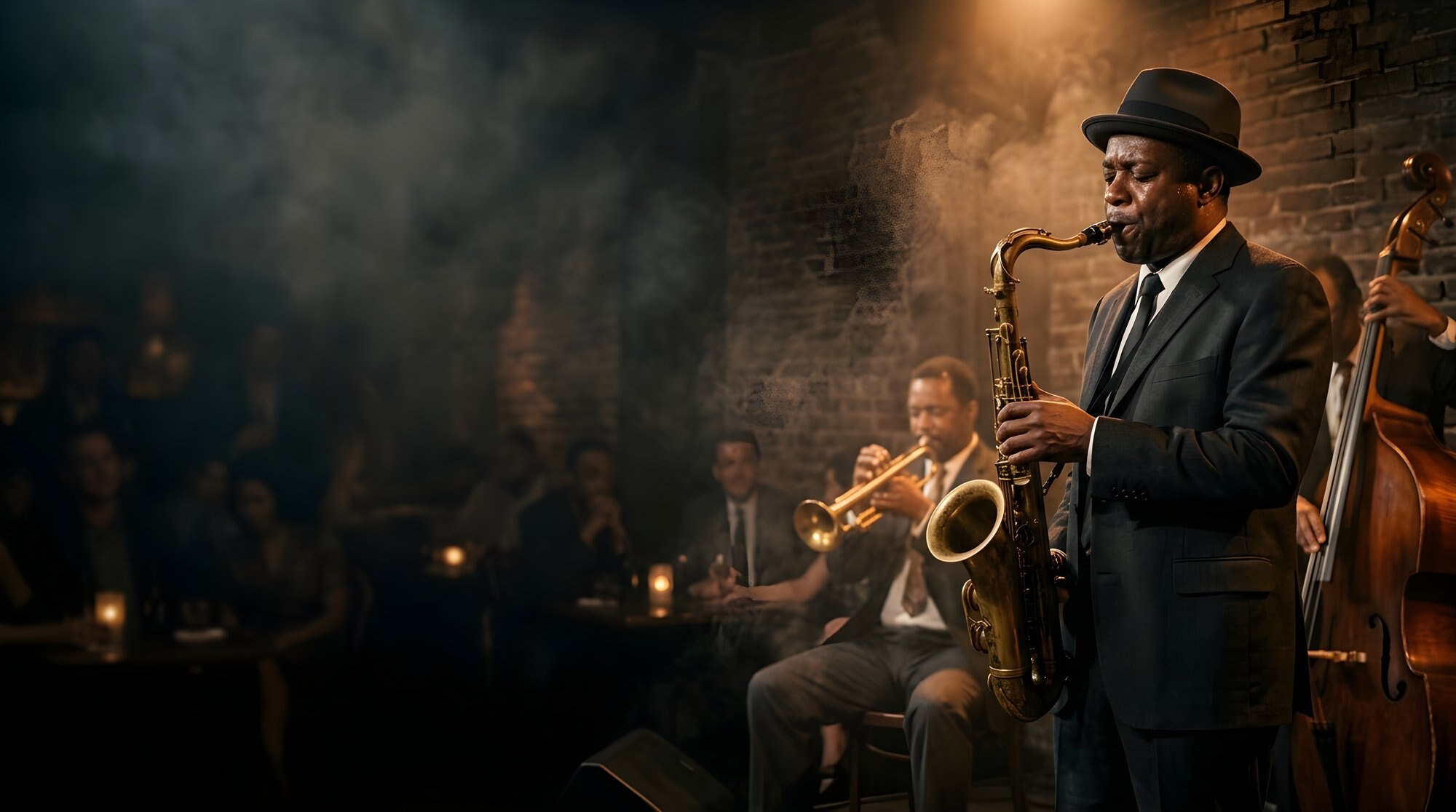
The most famous jazz musicians offer many ways into the music: Louis Armstrong’s trumpet, Ella Fitzgerald’s singing, Duke Ellington’s compositions, and Miles Davis’s changing band sounds are all useful starting points. This directory introduces 53 performers through their lives, their contributions, and a recording you can hear first.
Each profile connects the artist’s history to something specific in the performance: the placement of a phrase, the shape of a solo, or the way musicians respond to one another. The numbers organize the directory; they do not rank the performers. Singers and rhythm-section players belong here alongside the horn soloists who often dominate discussions of the best jazz artists.
These famous jazz musicians span overlapping generations, from early recorded jazz to contemporary ensembles. Some made concise performances that fit on a single side of a record; others explored extended improvisation. You do not need musical training to hear those differences, and you do not need to begin at the beginning.
In This Article
- 1. Louis Armstrong
- 2. Duke Ellington
- 3. Charlie Parker
- 4. Dizzy Gillespie
- 5. Miles Davis
- 6. John Coltrane
- 7. Mary Lou Williams
- 8. Billie Holiday
- 9. Ella Fitzgerald
- 10. Sarah Vaughan
- 11. Nina Simone
- 12. Art Tatum
- 13. Oscar Peterson
- 14. Benny Goodman
- 15. Count Basie
- 16. Django Reinhardt
- 17. Stéphane Grappelli
- 18. Thelonious Monk
- 19. Charles Mingus
- 20. Art Blakey
- 21. Sonny Rollins
- 22. Stan Getz
- 23. Dave Brubeck
- 24. Bill Evans
- 25. Bud Powell
- 26. Herbie Hancock
- 27. Wayne Shorter
- 28. Cannonball Adderley
- 29. Dexter Gordon
- 30. Ornette Coleman
- 31. Eric Dolphy
- 32. Lester Young
- 33. Coleman Hawkins
- 34. Ben Webster
- 35. Sidney Bechet
- 36. Bix Beiderbecke
- 37. Roy Eldridge
- 38. Clifford Brown
- 39. Chet Baker
- 40. Freddie Hubbard
- 41. Lee Morgan
- 42. Wes Montgomery
- 43. Charlie Christian
- 44. Grant Green
- 45. Joe Pass
- 46. McCoy Tyner
- 47. Ahmad Jamal
- 48. Chick Corea
- 49. Keith Jarrett
- 50. Jaco Pastorius
- 51. Max Roach
- 52. Tony Williams
- 53. Esperanza Spalding
- Key Takeaways
- Frequently Asked Questions
- Choose Your First Jazz Recording
1. Louis Armstrong
Louis Armstrong (1901–1971) grew up in New Orleans and helped make the improvising soloist central to jazz. His Hot Five recordings began in 1925; the related Hot Seven sessions expanded that small-group setting. He also became an internationally recognized singer whose rough-edged voice carried unusual rhythmic freedom.
Begin with “West End Blues,” recorded in 1928. Its opening trumpet passage sounds almost like a complete composition before the band enters. Later, Armstrong’s vocal exchanges and spacious trumpet phrases show how much expression he could place inside a short performance.
2. Duke Ellington
Duke Ellington (1899–1974), born in Washington, D.C., treated his orchestra as an instrument with individual voices. His years at Harlem’s Cotton Club helped establish his reputation, but his writing extended far beyond dance-band arrangements into suites and concert works.
“Ko-Ko,” recorded in 1940, is an excellent introduction to his darker orchestral colors. Low instruments give the performance weight, while sharply placed brass passages create tension. Ellington’s piano participates in that design without dominating it. The interest lies in how the whole band changes the character of a repeating musical structure.
3. Charlie Parker
Charlie Parker (1920–1955), an alto saxophonist from Kansas City, helped establish bebop in the 1940s alongside Dizzy Gillespie and other collaborators. His improvisations combined extraordinary speed with rhythmic displacement and a detailed command of harmony.
On “Parker’s Mood,” recorded in 1948, those abilities serve a blues performance with an unhurried emotional pull. Parker leaves room around some phrases, then compresses others into quick, speechlike bursts. This recording offers a useful correction to the idea that his music was only about velocity: the pacing matters as much as the number of notes.
4. Dizzy Gillespie
Dizzy Gillespie (1917–1993) brought a brilliant trumpet sound and a composer’s sense of structure to modern jazz. Born in Cheraw, South Carolina, he became a major bandleader as well as an improviser. His work with Cuban percussionist Chano Pozo helped establish an enduring connection between jazz and Afro-Cuban rhythm.
Begin with “Manteca,” which Gillespie co-wrote with Pozo and Gil Fuller. Its repeating bass figure gives the ensemble a firm foundation, while the brass lines cut across the percussion. The written passages are as important to its character as the solos.
5. Miles Davis
Miles Davis (1926–1991) repeatedly changed his musical setting without losing his recognizable trumpet voice. Raised in East St. Louis, Illinois, he moved through bebop, orchestral collaborations, small-group acoustic jazz, and electric music. His album Kind of Blue appeared in 1959.
“So What” makes an approachable first listen. A bass-led opening establishes the melody before Davis enters with short, measured phrases. His solo shows how a limited collection of notes can support considerable variation. Afterward, the electric album In a Silent Way offers a different setting for his interest in space and atmosphere.
6. John Coltrane
John Coltrane (1926–1967), born in Hamlet, North Carolina, developed from a hard-working sideman into a saxophonist whose music joined technical inquiry with spiritual purpose. His quartet’s A Love Supreme appeared in 1965, with McCoy Tyner, Jimmy Garrison, and Elvin Jones.
Begin with its opening movement, “Acknowledgement.” Garrison’s recurring bass phrase provides an anchor while Coltrane reshapes a small melodic idea through different registers. The intensity develops through repetition and changing emphasis. Even when the saxophone line becomes dense, that underlying figure gives a new listener something dependable to follow.
7. Mary Lou Williams
Mary Lou Williams (1910–1981) was a pianist, composer, and arranger who worked across several major periods of jazz. Born in Atlanta and raised in Pittsburgh, she became an essential contributor to Andy Kirk’s orchestra before supporting and advising musicians associated with bebop.
Her Zodiac Suite, first recorded in 1945, reveals a composer thinking beyond standard song forms. Begin with “Aries,” where compact piano ideas change direction without losing their identity. Williams later wrote sacred works, including Mary Lou’s Mass. Her career connects dance-band practicality with ambitious concert and religious music.
8. Billie Holiday
Billie Holiday (1915–1959), born in Philadelphia, made phrasing one of jazz singing’s strongest expressive tools. She often shifted a melody against the accompaniment, making familiar lyrics sound newly considered. Her early recordings with pianist Teddy Wilson show that approach in a small-group setting.
“Easy Living,” recorded in 1937, is a welcoming introduction. Holiday does not need a large vocal range to hold attention; she changes the weight and timing of individual words. The instrumental replies matter, too. Her singing belongs inside the ensemble’s conversation, not simply on top of it.
9. Ella Fitzgerald
Ella Fitzgerald (1917–1996), born in Newport News, Virginia, combined clear diction with exceptional rhythmic command. She first gained wide attention with Chick Webb’s orchestra and later recorded extensive songbook projects devoted to composers including Cole Porter and George Gershwin.
For a different side of her artistry, hear “How High the Moon” from Ella in Berlin, recorded in 1960. Fitzgerald moves from the song into extended scat improvisation, shaping syllables as a horn player might shape notes. Her quick quotations and changes of register remain tied to the beat, even at a brisk tempo.
10. Sarah Vaughan
Sarah Vaughan (1924–1990) grew up in Newark, New Jersey, where she learned piano and sang in church. Her rich voice, wide range, and harmonic imagination made vocal improvisation a central part of her work. She could alter a melody substantially while keeping its emotional direction intact.
Begin with “Lullaby of Birdland” from her 1954 album with Clifford Brown. Vaughan stretches syllables, changes vocal color, and moves through the tune with remarkable ease. Brown’s trumpet provides a complementary brightness. Their contrasting sounds help explain why this session remains such an accessible introduction to her musicianship.
11. Nina Simone
Nina Simone (1933–2003), born Eunice Waymon in Tryon, North Carolina, joined classically informed piano playing with a commanding singing voice. Her repertoire crossed jazz, blues, gospel, folk, and protest music, so no single label fully describes her work.
“My Baby Just Cares for Me,” recorded for her debut album Little Girl Blue, puts both piano and voice in focus. The accompaniment has a buoyant, precise swing, while Simone’s singing remains conversational. Her piano interlude is integral to the performance. It demonstrates why listening only to her lyrics misses a substantial part of her artistry.
12. Art Tatum
Art Tatum (1909–1956), born in Toledo, Ohio, transformed solo jazz piano through rapid runs, elaborate harmony, and extraordinary independence between his hands. His technique can initially sound overwhelming, but recognizable songs usually remain at the center of the performance.
Start with his 1933 recording of “Tea for Two.” The melody appears amid quick decorative passages and sudden harmonic turns. Following that melody gives the flourishes a clear purpose: Tatum keeps rebuilding a familiar tune while maintaining its outline. His speed is striking, but the changing routes through the song are the deeper attraction.
13. Oscar Peterson
Oscar Peterson (1925–2007), a Montreal-born pianist, made the piano trio one of jazz’s most immediately engaging formats. His long-running work with bassist Ray Brown included groups with guitarist Herb Ellis and, later, drummer Ed Thigpen.
Night Train, recorded in 1962, is a strong entry into the trio with Brown and Thigpen. On the title track, Peterson’s blues phrases sound forceful without crowding the rhythm section. “Hymn to Freedom” offers another perspective, building from a plain melody into a fuller statement. The contrast reveals his ability to make both virtuosity and restraint compelling.
14. Benny Goodman
Benny Goodman (1909–1986), born in Chicago, was a clarinetist whose orchestra became a defining presence in the swing era. He also led small groups that included Teddy Wilson and Lionel Hampton, helping bring racially integrated ensembles before prominent American audiences.
Hear “Sing, Sing, Sing” from his orchestra’s 1938 Carnegie Hall concert. Gene Krupa’s drums sustain the momentum while Goodman’s clarinet brings a lighter, agile sound above the band. The extended performance makes room for changing textures and individual contributions. Goodman’s bandleading gave those contrasts a coherent frame rather than a succession of unrelated solos.
15. Count Basie
Count Basie (1904–1984), born in Red Bank, New Jersey, developed his bandleading identity through the Kansas City jazz world. His piano style favored concise gestures, and his orchestras made carefully placed accents feel unusually powerful.
The 1937 recording of “One O’Clock Jump” offers a clear starting point. Repeated ensemble phrases accumulate over a blues foundation, with solos contributing to the gradual build. Basie’s spare piano fits that collective design. The performance demonstrates how a band can generate excitement through timing and balance without requiring every player to remain busy throughout the arrangement.
16. Django Reinhardt
Django Reinhardt (1910–1953), born in Belgium, became the central guitarist of the Quintette du Hot Club de France. After a severe fire injury, he developed a distinctive technique despite limited use of two fingers on his left hand.
Begin with the quintet’s 1937 recording of “Minor Swing.” Reinhardt’s guitar lines move between clipped rhythmic ideas and fluid runs, supported by an all-string ensemble. The absence of drums makes the accompanying guitars’ pulse especially audible. His sound shows that rhythmic drive does not depend on a conventional American jazz rhythm section.
17. Stéphane Grappelli
Stéphane Grappelli (1908–1997), born in Paris, brought a supple violin voice to the Quintette du Hot Club de France. His partnership with Reinhardt became a major reference point for string-based jazz, and he continued performing with younger musicians for decades.
For a later introduction, hear “A Nightingale Sang in Berkeley Square” from The Menuhin & Grappelli Album. The collaboration with classical violinist Yehudi Menuhin makes differences in phrasing particularly revealing. Grappelli’s lines relax into the rhythm, using slides and light accents to give the melody a conversational quality without abandoning its shape.
18. Thelonious Monk
Thelonious Monk (1917–1982), born in Rocky Mount, North Carolina, wrote melodies and played piano with an unmistakable sense of angles. Unexpected accents, ringing dissonances, and pauses are part of his musical logic, not interruptions to it.
“Straight, No Chaser” from the album Monk’s Dream provides an approachable beginning. Its blues structure is familiar, but the melody’s placement gives it a distinctive gait. In his solo, short ideas can return with changed emphasis or spacing. The rhythm section helps those irregular surfaces feel grounded, making the performance easier to follow than its reputation might suggest.
19. Charles Mingus
Charles Mingus (1922–1979), born in Nogales, Arizona, and raised in Los Angeles, was a bassist whose compositions often combined written detail with collective improvisation. His ensembles could sound carefully organized and emotionally volatile within the same performance.
Begin with “Better Git It in Your Soul” from Mingus Ah Um, released in 1959. Its gospel-influenced energy comes through shouted responses, a recurring theme, and a propulsive rhythmic feel. Mingus gives the ensemble room to sound human and unruly. Those elements are built into the composition’s character rather than added as decoration around it.
20. Art Blakey
Art Blakey (1919–1990), a Pittsburgh-born drummer and bandleader, made the Jazz Messengers an important home for developing players. Musicians including Horace Silver, Wayne Shorter, and Lee Morgan passed through its changing lineups.
The title track of Moanin’, recorded in 1958, introduces Blakey’s forceful approach without requiring a drum solo. Bobby Timmons’s piano theme invites answering phrases from the horns, while Blakey’s accents push the exchanges forward. His drumming creates pressure and direction beneath the arrangement. The result explains why this band became a model for hard bop’s combination of blues feeling and ensemble precision.
21. Sonny Rollins
Sonny Rollins (born 1930), raised in Harlem, built a tenor saxophone style around thematic development. A small phrase can become the basis for a long improvisation as he changes its rhythm, register, and relationship to the beat.
“St. Thomas” from Saxophone Colossus, recorded in 1956, is an inviting first selection. Its calypso-associated melody reflects Rollins’s Caribbean family background. During the solo, short figures become building blocks instead of being discarded immediately. Max Roach’s drumming sharpens that process, giving Rollins rhythmic ideas to engage with while the tune’s cheerful identity remains recognizable.
22. Stan Getz
Stan Getz (1927–1991), born in Philadelphia, became known for a tenor saxophone sound with a soft edge and a clear melodic center. His career included swing and modern jazz before his widely heard collaborations with Brazilian musicians.
Begin with “Corcovado” from Getz/Gilberto, recorded in 1963. João Gilberto’s guitar and the understated vocals establish an intimate scale; Getz enters without disturbing it. His sustained notes carry subtle changes in tone, and his phrases leave the accompaniment audible. The recording rewards attention to breath and melodic continuity more than to dramatic bursts of technical display.
23. Dave Brubeck
Dave Brubeck (1920–2012), born in Concord, California, brought unusual meters into widely heard jazz recordings. His quartet’s success depended partly on the contrast between his weighty piano attacks and Paul Desmond’s lighter alto saxophone sound.
“Blue Rondo à la Turk,” from Time Out, offers more than a demonstration of an uncommon time signature. Its opening groups the beat unevenly, then the performance moves into swinging passages with a different feel. The return of the opening material gives the piece a strong overall shape. That contrast makes the rhythmic experiment audible without requiring you to count every beat.
24. Bill Evans
Bill Evans (1929–1980), born in Plainfield, New Jersey, helped reshape expectations of the jazz piano trio. His work with bassist Scott LaFaro and drummer Paul Motian allowed accompaniment and melodic initiative to move among the players.
Hear “My Foolish Heart” from Waltz for Debby, recorded at the Village Vanguard in 1961. Evans’s chords shade the melody without making it difficult to recognize. LaFaro supplies more than a steady bass foundation, while Motian supports the pace with delicate sounds. The performance’s quiet surface contains active interaction, especially in the spaces between piano phrases.
25. Bud Powell
Bud Powell (1924–1966), born in Harlem, translated bebop’s fast-moving melodic language into a highly influential piano approach. His right hand often carries a hornlike line while the left adds selective chords and rhythmic punctuation.
“Un Poco Loco,” recorded in 1951, reveals another side of his imagination. Its repeated figures and shifting accents create a tightly focused musical problem that Powell keeps exploring. Max Roach’s percussion is a crucial partner in that exploration. The performance can feel urgent, but its recurring material gives you a reliable way to hear how each passage differs from the previous one.
26. Herbie Hancock
Herbie Hancock (born 1940), a Chicago native, has worked across acoustic jazz, electronic experimentation, and funk. His compositions often provide clear melodic identities while leaving performers considerable freedom inside them.
Hancock was still 24 when he recorded Maiden Voyage in 1965. Begin with the title track, whose sustained harmonies and measured melody create a sense of suspended motion. The musicians do not need constant chord changes to keep the performance developing. For a later contrast, Head Hunters places his keyboard playing inside electric grooves, showing how different rhythmic foundations changed his approach without erasing his compositional personality.
27. Wayne Shorter
Wayne Shorter (1933–2023), born in Newark, New Jersey, was a tenor and soprano saxophonist whose compositions became central to several major ensembles. He wrote for the Jazz Messengers, Miles Davis’s quintet, and the electric group Weather Report.
“Speak No Evil,” from his album of the same name, is a useful introduction to his writing. The theme sounds memorable but does not resolve quite where a familiar standard might. That uncertainty gives the improvisers material to explore. Shorter’s saxophone phrasing preserves the tune’s mysterious character instead of treating the melody merely as a preface to soloing.
28. Cannonball Adderley
Julian “Cannonball” Adderley (1928–1975), born in Tampa, Florida, gave the alto saxophone a full, blues-rich voice. He worked as a music teacher before becoming a prominent performer, and his later bands often joined jazz improvisation with gospel-derived feeling.
Begin with “Mercy, Mercy, Mercy,” composed by keyboardist Joe Zawinul and recorded by Adderley’s group in 1966. Its recurring melody and electric piano accompaniment make the performance immediately approachable. Adderley’s phrases retain a vocal quality even when they become more elaborate. The audience response also helps communicate the music’s social warmth without replacing its instrumental substance.
29. Dexter Gordon
Dexter Gordon (1923–1990), born in Los Angeles, brought a large, resonant tenor saxophone sound to bebop. He spent much of the 1960s and 1970s in Europe, where his performances and recordings continued to develop his relaxed but commanding approach.
“Our Man in Paris,” recorded in 1963, places him alongside Bud Powell, Pierre Michelot, and Kenny Clarke. “Scrapple from the Apple” showcases Gordon’s relaxed but commanding approach. Gordon’s phrases often sit slightly behind the beat while still driving toward their destinations. That combination makes the performance feel spacious at a fast tempo and distinguishes his delivery from a more sharply clipped approach.
30. Ornette Coleman
Ornette Coleman (1930–2015), born in Fort Worth, Texas, challenged assumptions about the harmonic frameworks improvisers needed to share. His early groups emphasized melodic interaction and flexible movement instead of relying on a pianist to state regular chord changes.
“Lonely Woman,” from The Shape of Jazz to Come, recorded in 1959, is a compelling first encounter. Coleman and trumpeter Don Cherry play a plaintive theme while bass and drums maintain a more urgent motion underneath. The tension between those layers gives the piece its identity. Its emotional clarity makes it approachable even when the ensemble’s method is unfamiliar.
31. Eric Dolphy
Eric Dolphy (1928–1964), born in Los Angeles, played alto saxophone, bass clarinet, and flute with sharply individual sounds. His music could move from lyrical detail to wide interval leaps within a single phrase.
Begin with “Hat and Beard” from Out to Lunch!, recorded in 1964. The piece pays tribute to Monk, but Dolphy’s bass clarinet and Bobby Hutcherson’s vibraphone create a different instrumental world. The melody has an angular, almost stalking motion, and the rhythm does not settle into routine accompaniment. Repeated listening makes its organized contrasts clearer without reducing the performance to a conventional song shape.
32. Lester Young
Lester Young (1909–1959), born in Woodville, Mississippi, offered an alternative to the heavier tenor saxophone sounds prominent in early swing. His lighter tone and fluid phrasing became important reference points for later saxophonists.
“Lester Leaps In,” recorded with a small group drawn from Count Basie’s orchestra in 1939, captures his rhythmic confidence. Young can make a phrase feel relaxed while placing its accents with great precision. His lines move across the beat without losing it. That balance helps explain how an apparently effortless style could have such a strong effect on subsequent jazz playing.
33. Coleman Hawkins
Coleman Hawkins (1904–1969), born in St. Joseph, Missouri, established the tenor saxophone as a major jazz solo instrument. His full tone and harmonically detailed improvisation offered a different model from Young’s more floating approach.
The 1939 recording of “Body and Soul” is the essential starting point. Hawkins spends relatively little time presenting the familiar melody directly; instead, he builds an improvisation through the song’s harmony. The result remains lyrical because his phrases have clear direction. A ballad becomes the setting for sustained invention, demonstrating how a solo can stand as a complete musical statement.
34. Ben Webster
Ben Webster (1909–1973), born in Kansas City, Missouri, combined a forceful tenor saxophone attack with an exceptionally tender ballad sound. His work in Ellington’s orchestra established one side of that identity, while later small-group recordings gave his quieter playing more space.
“Soulville,” from the 1957 album of the same name, highlights Webster’s breathy tenor sound. Webster’s breathy tone is prominent, but so is his control of phrase length. Notes can trail away without making the performance lose direction. The blues setting allows him to alternate warmth and roughness, making tone itself part of the musical argument.
35. Sidney Bechet
Sidney Bechet (1897–1959), born in New Orleans, brought a powerful solo voice to clarinet and especially soprano saxophone. His pronounced vibrato and assertive melodic style made him recognizable even in a crowded ensemble.
“Blue Horizon,” recorded in 1944, offers a slower introduction to his clarinet playing. Bechet works through the blues with sustained notes, bent pitches, and phrases that rise in emotional intensity. The accompaniment stays relatively restrained, allowing the changes in his sound to carry the performance. It is a useful reminder that early jazz virtuosity included expressive control, not only fast ensemble exchanges.
36. Bix Beiderbecke
Bix Beiderbecke (1903–1931), born in Davenport, Iowa, played cornet with a clear, compact tone that contrasted with more overtly forceful early jazz styles. He also played piano and composed pieces reflecting his interest in unusual harmonies.
Begin with “Singin’ the Blues,” recorded with Frankie Trumbauer in 1927. Beiderbecke’s solo proceeds through carefully shaped melodic ideas, making each phrase feel connected to the next. The performance does not depend on a huge sound or theatrical attack. Its appeal lies in balance, tonal clarity, and the sense that the improvisation has an internal design.
37. Roy Eldridge
Roy Eldridge (1911–1989), born in Pittsburgh, helped connect swing-era trumpet playing with the technical and harmonic demands of bebop. His high-register command was impressive, but his phrasing also had a restless rhythmic energy.
“Rockin’ Chair,” recorded with Gene Krupa’s orchestra in 1941, gives that trumpet style a clear setting. Eldridge can turn a sustained note into a launching point for a quick ascending phrase. The band’s support makes those shifts especially dramatic. His solo retains the melody’s character while adding pressure, showing how personal improvisation can transform a familiar song without making it unrecognizable.
38. Clifford Brown
Clifford Brown (1930–1956), born in Wilmington, Delaware, developed a trumpet voice marked by a round tone, precise articulation, and flowing melodic invention. His career ended in a car accident, but the recordings he made with Max Roach document a remarkably complete musical identity.
“Joy Spring,” Brown’s composition, is an ideal first listen. Its melody has enough twists to remain interesting while sounding buoyant and singable. Brown’s solo extends that feeling through long, connected lines. Even at speed, the notes have distinct beginnings and a consistent tone, making the performance clear rather than crowded.
39. Chet Baker
Chet Baker (1929–1988), born in Yale, Oklahoma, became widely recognized as both a trumpeter and singer. His restrained delivery made him a prominent figure in West Coast jazz, though his later career included varied European collaborations.
Begin with his vocal recording of “I Fall in Love Too Easily” from Chet Baker Sings. The voice has a narrow, intimate character, and the phrasing avoids grand gestures. That directness is part of its effect. His trumpet performances often share the same preference for a clear melodic line, allowing you to hear a connection between his two forms of expression.
40. Freddie Hubbard
Freddie Hubbard (1938–2008), born in Indianapolis, combined a bright trumpet tone with exceptional agility. His recording career included hard bop, more exploratory sessions, and electric settings, often with a strongly recognizable attack.
“Red Clay,” the title track of his 1970 album, is a good entry into the overlap between acoustic improvisation and electric accompaniment. Ron Carter’s bass figure anchors the piece while Hancock’s electric piano changes the texture around the horns. Hubbard’s solo moves from firmly stated ideas into increasingly expansive lines. The groove gives those developments a stable foundation without restricting their reach.
41. Lee Morgan
Lee Morgan (1938–1972), born in Philadelphia, joined Gillespie’s big band while still a teenager and later became a prominent member of Blakey’s group. His trumpet playing joined a cutting attack with blues phrasing and a strong sense of rhythmic placement.
The title track of The Sidewinder, recorded in 1963, makes an immediate first impression through its danceable bass-and-drum pattern. Morgan’s melody fits that pattern without sounding mechanically attached to it. His solo uses repeated figures and sudden bursts to maintain momentum. The performance’s accessibility comes from its construction, not from an absence of improvisational detail.
42. Wes Montgomery
Wes Montgomery (1923–1968), born in Indianapolis, developed a warm guitar sound by playing with his thumb. His use of octaves and block chords gave solos a clear way to increase in density and impact.
“Four on Six,” from The Incredible Jazz Guitar of Wes Montgomery, offers a focused introduction. The opening bass pattern helps define the piece before Montgomery develops his solo through increasingly full textures. His phrases retain a rounded sound even when the rhythm becomes insistent. The recording makes his technical choices audible as musical choices, especially when a single-note line becomes something broader.
43. Charlie Christian
Charlie Christian (1916–1942), born in Bonham, Texas, helped establish amplified guitar as a frontline jazz voice. His work with Goodman’s small groups demonstrated that a guitarist could improvise long, hornlike lines instead of remaining primarily an accompanist.
Begin with “Seven Come Eleven,” recorded in 1939. Christian’s clear articulation gives the guitar a distinct presence alongside clarinet and vibraphone. His solo phrases build across the rhythm instead of relying on isolated flourishes. The amplification matters because it allows those lines to remain audible, but the real development is the instrument’s expanded melodic role inside the ensemble.
44. Grant Green
Grant Green (1935–1979), born in St. Louis, made single-note guitar lines the center of a highly recognizable style. His playing drew deeply on blues phrasing and remained rhythmically direct across small-group jazz and later funk-oriented recordings.
“Idle Moments,” from the album recorded in 1963, is an especially patient introduction. Green allows the slow melody to unfold without filling every space. Joe Henderson’s tenor saxophone and Hutcherson’s vibraphone give the ensemble contrasting colors. The extended performance develops through changes in touch and phrasing, showing how a restrained guitarist can hold attention without leaning on dense chord work.
45. Joe Pass
Joe Pass (1929–1994), born in New Brunswick, New Jersey, developed a solo guitar approach that could suggest several musical roles at once. Bass movement, chords, and melody appear in rapid alternation, creating the impression of a self-contained ensemble.
“Have You Met Miss Jones?” from Virtuoso, released in 1973, is a clear first example. Pass moves between a recognizable tune and improvised passages while keeping harmonic direction clear. The texture changes constantly, but the song remains the organizing thread. His achievement is especially audible when a brief bass note or chord makes a melodic phrase feel supported without another musician present.
46. McCoy Tyner
McCoy Tyner (1938–2020), born in Philadelphia, became a defining voice in Coltrane’s quartet before building an extensive career as a bandleader. His piano playing often joined powerful low-register figures with open-sounding chords and sweeping right-hand lines.
“The Real McCoy,” recorded in 1967, shows that vocabulary in his own group. Begin with “Passion Dance,” where a compact theme opens into forceful improvisation. Joe Henderson’s saxophone provides a contrasting voice, while Tyner’s chords give the music breadth. The energy comes from repeated rhythmic commitment as much as from the size or speed of the piano gestures.
47. Ahmad Jamal
Ahmad Jamal (1930–2023), born in Pittsburgh, made silence, arrangement, and dynamic contrast central to his piano-trio work. His ensembles could change direction abruptly while maintaining an unmistakable sense of shared timing.
“Poinciana,” from At the Pershing: But Not for Me, recorded in 1958, offers an accessible example. Vernel Fournier’s repeating drum pattern becomes a major part of the arrangement rather than neutral background. Jamal places compact piano statements above it, sometimes allowing the groove to carry the performance almost alone. The balance demonstrates how an ensemble can make restraint feel active and deliberate.
48. Chick Corea
Chick Corea (1941–2021), born in Chelsea, Massachusetts, worked in acoustic improvisation and electric fusion, often drawing on Spanish and Latin musical ideas. His compositions frequently combine clear themes with demanding rhythmic movement.
Begin with “Spain” from Light as a Feather, released in 1973. Its introduction draws on Joaquín Rodrigo’s Concierto de Aranjuez before the performance moves into Corea’s brisk main theme. The electric piano has a percussive clarity, and the ensemble’s synchronized passages make the written structure easy to recognize. Improvisation then expands that structure without losing the piece’s bright, forward-moving character.
49. Keith Jarrett
Keith Jarrett (born 1945), a native of Allentown, Pennsylvania, has made extended solo improvisation a major part of his career. He also spent decades exploring standards with bassist Gary Peacock and drummer Jack DeJohnette.
The opening of The Köln Concert, recorded in 1975, is a useful solo starting point. Small piano figures become extended passages through repetition, shifting harmony, and changes in register. The music develops in real time instead of moving through a sequence of familiar songs. Following one recurring figure helps you hear its construction without needing to understand every harmonic turn.
50. Jaco Pastorius
Jaco Pastorius (1951–1987), born in Norristown, Pennsylvania, brought the fretless electric bass to unusual prominence in jazz. His work with Weather Report and as a leader made the instrument a melodic voice with a distinctive singing tone.
“Portrait of Tracy,” from his 1976 debut album, is a revealing first selection. Played on solo bass, it uses harmonics to create bell-like sounds that differ sharply from the instrument’s usual low-register role. The piece is compact and composed, so its appeal does not depend on a long virtuoso solo. It demonstrates how technique can create an entirely different instrumental texture.
51. Max Roach
Max Roach (1924–2007), born in North Carolina and raised in Brooklyn, helped develop modern jazz drumming through precise cymbal time and independent accents around the kit. His later projects connected composition, percussion, and political expression.
Begin with “The Drum Also Waltzes” from Drums Unlimited, recorded in the mid-1960s. This unaccompanied performance has recognizable recurring material, allowing the drums to carry a complete musical shape. Changes in pitch, accent, and spacing do work that melody and harmony might perform elsewhere. Roach makes the solo understandable as a composition rather than a display of endurance.
52. Tony Williams
Tony Williams (1945–1997), born in Chicago and raised in Boston, joined Davis’s band as a teenager. His drumming helped make that group’s rhythm unusually flexible, and his later band Lifetime explored electric jazz with an aggressive sound.
“Emergency,” from Lifetime’s 1969 debut, introduces the latter approach. Williams plays with guitarist John McLaughlin and organist Larry Young in a trio that can sound far larger than its lineup. His drumming changes the music’s density and direction instead of merely marking a consistent pulse. The recording suits listeners interested in the point where jazz improvisation meets rock’s volume and force.
53. Esperanza Spalding
Esperanza Spalding (born 1984), raised in Portland, Oregon, combines bass playing, singing, and composition across projects with markedly different formats. Her work makes a useful contemporary endpoint because it treats jazz as an active practice rather than a fixed historical style.
“I Know You Know,” from Esperanza, released in 2008, puts her voice and bass in close relationship. The sung line and instrumental movement remain distinct while fitting into the same rhythmic design. Later projects, including Emily’s D+Evolution, expand her use of electric instruments and theatrical presentation. Her recordings offer several routes beyond a conventional acoustic ensemble.
Key Takeaways
- One representative recording per artist is a more manageable entry point than an entire discography.
- Singers, composers, and rhythm-section players feature alongside trumpet and saxophone soloists.
- Follow collaborations to connect Armstrong, Parker, Davis, Coltrane, and later performers.
- Compare an artist’s acoustic and electric recordings when their career spans both.
- Treat the numbered list as a listening directory, not an objective ranking.
Frequently Asked Questions
Who is the most famous jazz singer?
Ella Fitzgerald, Billie Holiday, and Louis Armstrong are among the most widely recognized jazz singers, but there is no single objective measure of fame. Fitzgerald is a strong first choice for vocal range and improvisational fluency; Holiday offers a particularly direct introduction to expressive phrasing.
Who is the true King of Jazz?
“King of Jazz” was a promotional title associated with bandleader Paul Whiteman, not an agreed judgment about artistic achievement. Armstrong is a more useful starting point for understanding jazz’s development as a soloist’s art. Calling any performer the true king obscures the contributions of many of the greatest jazz musicians.
Which listed performers were both instrumentalists and singers?
Armstrong and Baker recorded extensively as both trumpeters and singers. Simone and Spalding also place instrumental performance at the center of their vocal work. Vaughan was a pianist as well, although her recorded reputation rests primarily on singing.
Which artists on this list recorded together?
Fitzgerald and Armstrong made Porgy and Bess together, while Davis and Rollins appear on Dig. Peterson, Grappelli, and Pass can be heard together on Skol. These sessions provide practical connections between jazz musicians whose individual recordings may initially seem quite different.
Are these artists ranked by importance?
No; the numbers make the profiles easy to locate. Any selection of the best jazz musicians depends partly on whether you value composition, improvisation, singing, ensemble leadership, or another contribution. This directory includes contrasting approaches so you can develop your own preferences.
Choose Your First Jazz Recording
Choose one performance that matches an existing interest. If you enjoy lyrics, begin with Holiday’s “Easy Living.” If guitar already appeals to you, Montgomery’s “Four on Six” offers a clear melody and an engaging band. For a more exploratory ensemble, try Coleman’s “Lonely Woman.”
Give that recording a second listen before moving on. On the first pass, follow the melody; on the next, attend to an accompanying player and how the soloist responds. A credit on the recording can then suggest your next artist. Your route through these famous jazz musicians does not need to follow chronology or reputation. Keep the performances you want to hear again, and let those choices shape a listening collection that feels like yours.