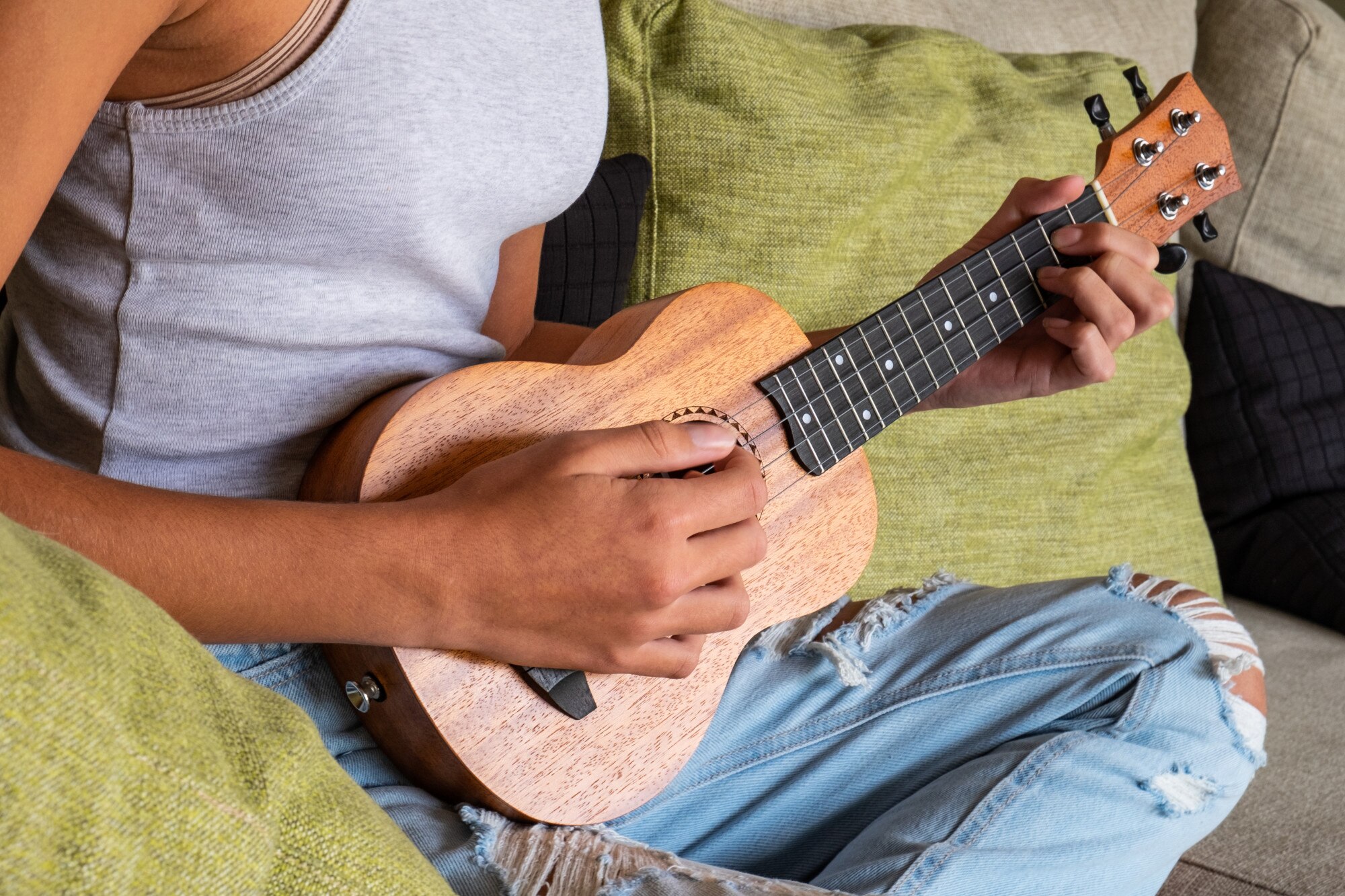
If you want to sing over a few chords, ukulele is often the easiest instrument to learn. For a first melody, electronic keyboard makes things simpler: press a single key and you get a clear note. Strumming puts rhythm in your hand; the keyboard spreads the notes out where you can see them. These 10 picks weigh that first musical reward against skills that take longer, helping you choose what suits your music.
In This Article
- 1. Ukulele
- 2. Harmonica
- 3. Recorder
- 4. Electronic Keyboard
- 5. Piano
- 6. Acoustic Guitar
- 7. Electric Guitar
- 8. Bass Guitar
- 9. Bongos
- 10. Drum Kit
- Key Takeaways
- Frequently Asked Questions
- Choose Your First Instrument to Try
1. Ukulele
Four strings make your first chord shapes easier to manage. Soprano and concert ukuleles usually share G–C–E–A tuning, but the concert gives your fingers more space for the same shapes. Nylon strings tend to feel softer under your fingers than steel guitar strings. You still need to press firmly enough to prevent buzzing.
For home practice, you can skip amplification: a playable beginner ukulele usually costs less than $150, with a little extra for a tuner and gig bag. Treat the prices here as rough US estimates rather than quotes. What you pay varies by brand, retailer, and season.
Put those first shapes to work in “Three Little Birds,” which uses A, D, and E chords. Learn each shape before practising changes in time, since E can be awkward to finger. Start with one downstroke for each change. Aim for an A-to-D transition where your fretting fingers land together while your strumming hand keeps moving. Keeping that rhythm going is your first reward.
2. Harmonica
For well under $100, you can buy a pocket-sized 10-hole diatonic harmonica in C. No stand, amplifier, or separate mouthpiece is needed to start playing. Buy a playable model from an established maker, since poor airtightness makes breath control needlessly difficult.
A chord sounds as soon as you breathe across several holes, but getting one clear note takes more work. You need to focus your mouth on a single hole while keeping your breathing relaxed. Start with simple melodies before tackling blues bends, which call for changes inside your mouth.
Many beginner lessons work with a C harmonica, though you cannot expect it to match every recording. To play in other keys, you may eventually need to buy additional harmonicas. Being easy to carry does not make it easy to use for every musical task.
3. Recorder
With just B, A, and G, “Hot Cross Buns” gives your left hand a first tune to tackle. Playing those notes on a soprano recorder takes gentle breath and a secure seal over the holes. Even when a fingertip feels properly placed, a tiny gap can let air escape. That leak can cause a squeak without you blowing too hard.
To close those gaps, cover the holes with your finger pads rather than pressing down with the tips. Getting that seal right makes touch as important as breath in recorder practice. As you progress to higher notes, you will need finer breath control. Clean articulation and expressive phrasing also leave plenty to work on after your first tune.
For a low-cost start, a plastic soprano recorder is among the cheapest instruments available and usually includes a cleaning rod. Match your teacher or course by choosing Baroque fingering if that is what they use. German-fingering models follow a different system. The recorder earns its place among the easiest instruments to learn on a small budget, but you need somewhere to practise audibly.
4. Electronic Keyboard
An electronic keyboard lets you start a recognizable tune without first learning to control your breath or press strings firmly. Each key produces a note with a press, so you can get straight to picking out a melody. The black keys form a repeating pattern that helps you find notes and match written music to hand positions.
For simple melodies, a 61-key model may be all you need. Look for full-size, touch-sensitive keys that respond to how firmly you press them. Budget a few hundred dollars for the keyboard, a stable stand, and headphones. Check whether a power adapter comes in the box. Headphones make practice easier in shared homes, but they cannot silence the keys’ mechanical noise.
Adding the left hand brings a harder task: getting your hands to work independently. Try holding one low note while your right hand plays a short melody. When the tune pauses, you may find yourself lifting both hands at once. Holding the low note through that pause makes the coordination challenge clear. Automatic accompaniment can play a backing for you, but you still need to learn to keep your own time.
5. Piano
Playing a first note on an 88-key weighted digital piano is easy; shaping its volume takes more work. Under your fingers, the resistance feels closer to an acoustic piano’s action than a light switch. You press through the weight of the key. Then you learn to release it without pulling your hand away abruptly.
Weighted keys help you develop that control, making them a useful choice for formal piano lessons. With the full range, you can also tackle music that extends beyond the notes on a smaller keyboard. Harder parts demand sustained practice as you learn to read separate lines and coordinate both hands. Having the notes within reach does not make every piece easy.
Budget several hundred dollars for an entry-level weighted digital piano, then check what the package includes. A suitable stand, bench, and sustain pedal can add to the bill. Built-in speakers usually spare you an amplifier, while a digital instrument needs no acoustic tuning. Put your money toward the key action you will practise on rather than a bigger selection of sounds.
6. Acoustic Guitar
If you want to strum an accompaniment, acoustic guitar is a good fit. America’s “A Horse with No Name” has a repeating two-chord pattern that keeps the focus on your strumming rhythm. It shows how a guitar can carry a song without much change in the harmony.
To make that accompaniment work, let the strings ring clearly under your fretting hand. The open chords A, D, and E have different shapes from their ukulele versions. Play each string separately to catch muffled notes. Then practise changing shapes while keeping your strumming hand moving.
You can play a steel-string acoustic without an amplifier. Starter packs containing a guitar, tuner, picks, and gig bag begin at about $160. Most entry-level instruments cost a few hundred dollars. Strings set too high make fretting harder, so a professional guitar-shop setup is worth the modest expense. Budget a little for replacement strings as an ongoing cost.
A comfortable setup helps, but tender fingertips are still common when you begin. Keep sessions short while your fingers adjust, rather than pushing them through another song when they are sore. Regular playing builds firmer calluses at the contact points, making the strings feel less sharp against your skin.
7. Electric Guitar
Distortion gives even a short riff a rough-edged roar, but an unwanted string can buzz between the notes. That amplified sound changes the reward of playing. Deep Purple’s “Smoke on the Water” gives you a recognizable riff to aim for. A simple single-note exercise builds coordination between picking and fretting before fuller shapes add complexity.
Electric guitar’s lighter strings often feel easier to play than those on a steel-string acoustic, though a poor setup can still cause discomfort. Beyond that physical adjustment, distortion demands control over which strings ring. You need to mute any you do not want to hear. Effects enlarge the sound, but they make stray notes more obvious too.
Plan on a few hundred dollars for a beginner electric guitar, then budget for the rest of your setup. You will need a cable, tuner, picks, and a small practice amplifier or headphone amp. Without amplification, the guitar cannot produce the sound you hear on a recording. Choose equipment that makes that sound enjoyable without hiding uneven timing.
8. Bass Guitar
Early bass parts often stick to one note at a time, letting you join in without learning guitar chord shapes. A standard four-string bass is tuned E–A–D–G, starting with the lowest string. Among easy to play instruments, bass gives you a straightforward first task. The less forgiving challenge is getting every note on time.
Budget about the same for a beginner bass as for a beginner electric guitar, then add a bass practice amplifier, cable, and strap. For a shorter reach between frets, choose a short-scale model. Expect strings to cost more per set than guitar strings. How often you replace them depends on your playing habits and preferred sound.
Repeating a root note at an even pace involves clean stops as well as steady starts. Those starts and stops help you build a shared groove with a drummer. A note landing with the kick drum can make both sounds feel like one firm pulse. Rush it, and you pull against that pulse. Keeping a simple line steady preserves that connection.
9. Bongos
With two connected drums played by hand, bongos let you explore rhythm on a separate surface for each hand, unlike a shaker. A beginner pair costs less than most instruments in this guide. You can also play seated, with no stand to buy.
Your first reward comes when the same skin produces distinctly different sounds: a ringing open tone and a sharper, more abrupt slap. That contrast depends on how your hand touches and leaves the head. Hitting harder alone will not produce it. Keep your hands relaxed as you experiment, rather than leaving them sore with repeated heavy blows.
Build a short, steady pattern with those contrasting tones, leaving gaps so the ringing sound has room to carry. Add more strokes only after that. Compact as bongos are, their sound carries clearly through an apartment, and headphones are not an option. They suit hands-on rhythm practice if your home can accommodate the noise.
10. Drum Kit
You can play a beat on a drum kit straight away; the challenge is getting your limbs to work together. An even hi-hat pulse provides the foundation for adding the kick and snare. Adding a foot can make the pulse rush, even when your hands have the pattern under control. Aim for steady timing rather than speed.
Before buying a kit, check what you need to make it playable, not just the price of the drums. A shell pack still needs cymbals, hardware, a throne, and sticks. Complete beginner kits cost several hundred dollars, and you'll need hearing protection when playing acoustic drums.
Budget around $270–$1,000 for an electronic starter setup; some inexpensive kits include a throne and headphones. Pads reduce airborne volume, though pedal impacts can travel through floors. If space or budget rules out a full kit, a practice pad and sticks let you learn stick control. They cannot reproduce whole-kit coordination, so treat them as a useful first step, not an equivalent substitute.
Key Takeaways
- What you want to play matters: backing a song and carrying a melody require different skills.
- Budget for everything you need to play, rather than comparing instrument prices alone.
- Check comfort and fit, especially for movements that involve repeated reaching, pressing, or holding a position.
- Work out how practice will fit your household before you commit to buying equipment.
- Measure your first gains by a tune you can play or a pattern you can keep steady, not advanced technique.
Frequently Asked Questions
What Is the Easiest Instrument to Learn?
Ukulele suits simple accompaniment, while electronic keyboard offers an easy route to a first melody. Your goal determines the easiest musical instrument to learn, so think about what you want to play first. Decide whether you want to sing over chords or pick out a tune before comparing equipment.
What Is the Easiest Instrument to Teach Yourself?
Visible shapes and patterns make ukulele and electronic keyboard practical options when you want to teach yourself. For these easy instruments to learn, pick a self-study course that matches your instrument’s tuning or key layout. If you develop pain or persistent tension, seek instruction rather than repeating the same movement.
What Instruments Can I Learn in 3 Months?
Make one complete song or pattern your goal for three months of regular practice. You might work toward simple ukulele accompaniments, recorder tunes, keyboard melodies, basic guitar chord changes, or steady percussion patterns. Treat that as a practical beginner skill you can use, not a sign of mastery.
What Is the #1 Hardest Instrument to Learn?
No instrument is objectively the number-one hardest to learn; that judgment depends on who is playing and which skill matters. Cello, for example, demands accurate finger placement without frets while you control the bow separately. But advanced challenges tell you little about how much you might enjoy the first lessons.
Can I Practise Quietly If I Live With Other People?
Yes, you can practise in a shared home using keyboards, digital pianos, guitars, and basses equipped for headphones. Physical movement still makes noise, though, as the keyboard and drum-kit sections explain. Where impacts travel through the floor, a keyboard is a more straightforward choice than electronic drums.
Should I Rent an Instrument Before Buying One?
Renting offers a trial period when an instrument’s price or size makes buying a risky commitment. A cello outfit costs more than most instruments on this list. When comparing buying with renting, factor in the bow, case, and replacement strings. A rental shop’s included maintenance can make renting better value, but you’ll still need to budget for reeds with saxophone rentals.
Choose Your First Instrument to Try
The music you want to make is the starting point for comparing models. To sing over chords, try holding a concert ukulele and check how comfortably your fingers fit. A keyboard suits melodies, with weighted keys worth choosing if you plan to study piano formally. If you prefer the sound of guitar, try both acoustic and electric. Less equipment does not necessarily mean easier playing.
As you try them, let your reach and comfort guide you toward the easiest instrument to play for you. Weigh the full setup cost against its space needs and noise level. Choose something that lets you practise one song you genuinely want to learn. That first purchase should get you playing without leaving you with equipment you have no room for.